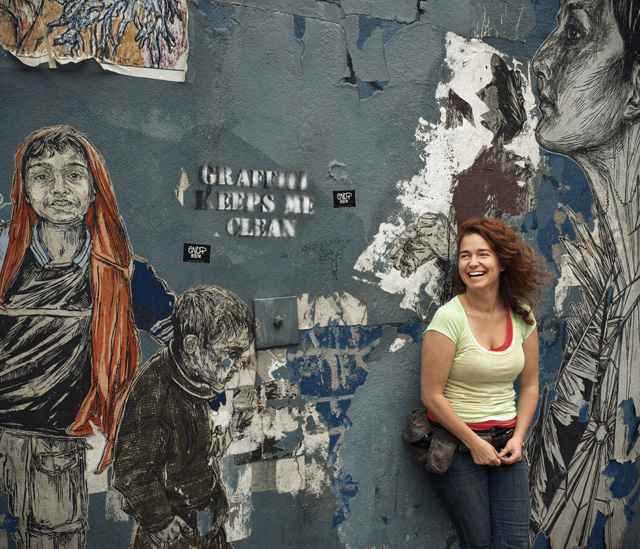
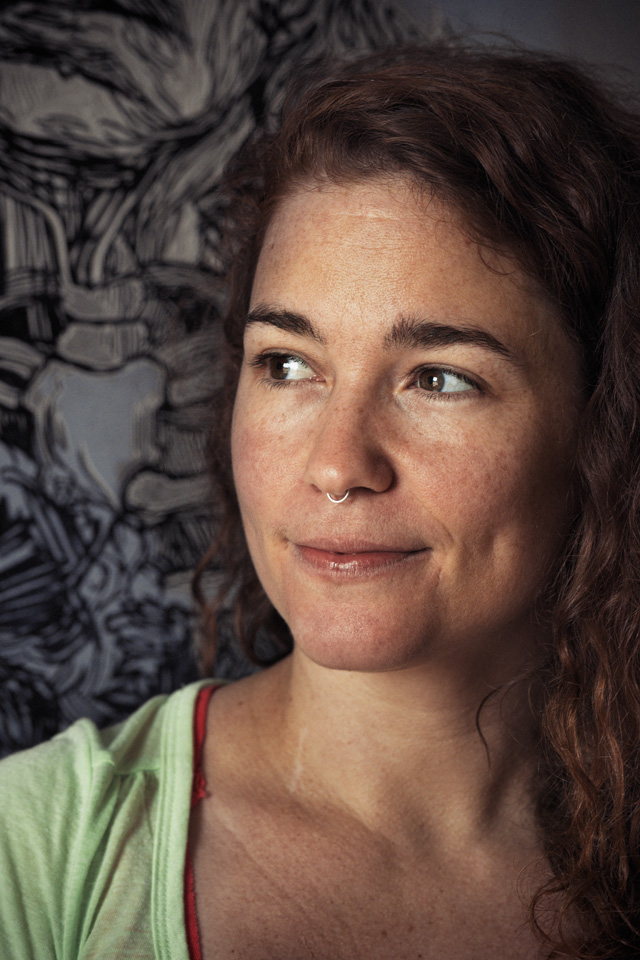
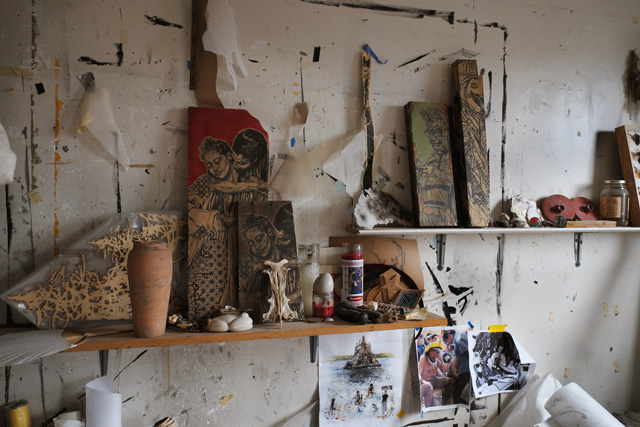
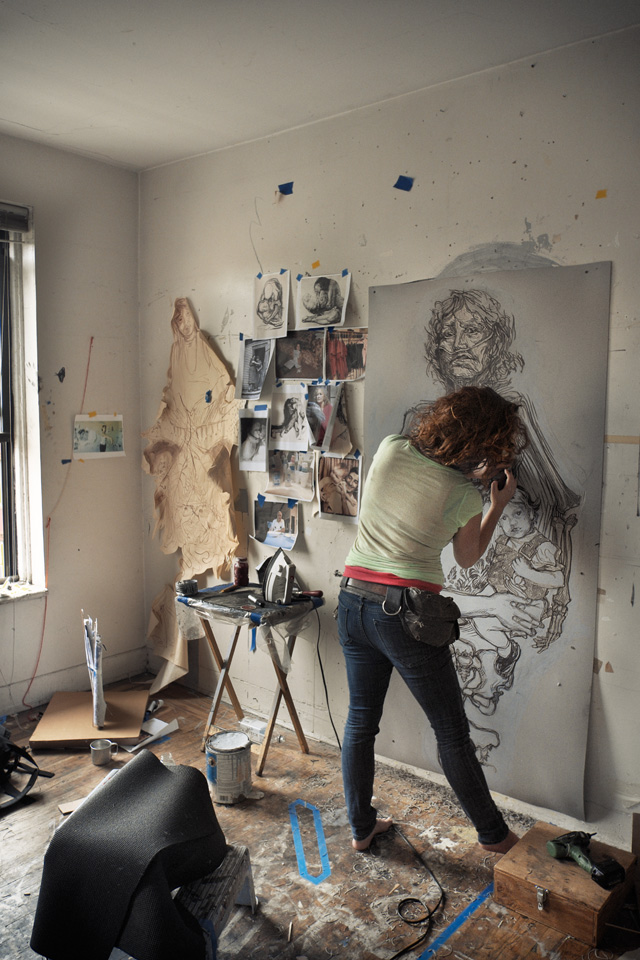
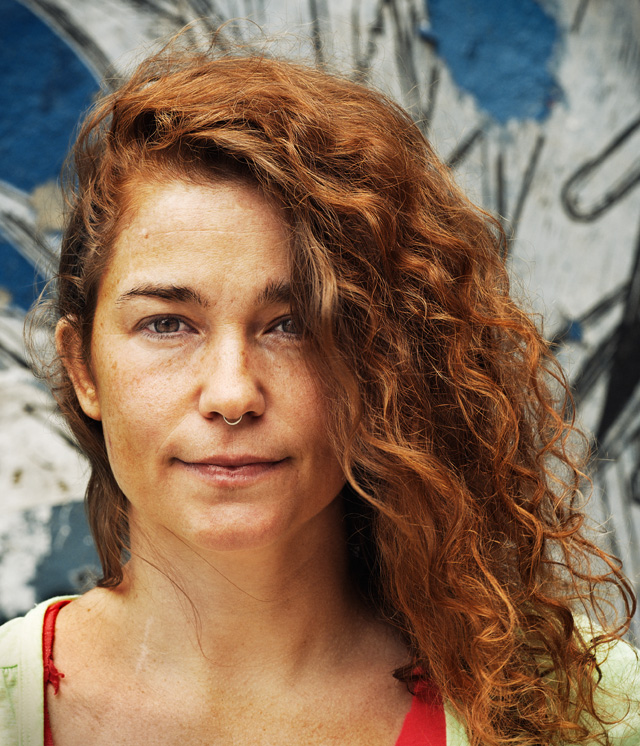
Caledonia Curry aka Swoon has to be one of my all-time favorite artists. Her wheatpastes have inspired a generation of street artists, and her work indoors and outdoors touches hearts in a way that many artists aspire to but few achieve. Earlier this year, Tim Hans met up to Swoon for the latest in our continuing series of photo-portraits of artists by Tim, and I asked her a few questions over email.
RJ: You always seem to have a lot on your plate. What projects are you working on at the moment?
Swoon: Today I am gonna finish a paper cut out that’s hanging on my wall and needs my attention… what else?
I have a big installation coming up at the Brooklyn Museum that I’m pretty excited about, it opens in April 2014, along side Ai WeiWei and Judy Chicago, so I am honored to be in such good company, as well as just excited to create a big project in New York again after all these years.
And then besides a few other small projects in the works, the rest of my energies revolve around the big 3 that have dominated my life for the last couple of years – Konbit Shelter, sustainable architecture in post earthquake Haiti. Braddock Tiles, restoring a formerly abandoned church in Braddock, Pa to become an arts based learning center. And Dithyrambalina, musical architecture for New Orleans!
Whew! I get tired just thinking about it all!
RJ: You just finished a community mural with Groundswell, right? How does that process compare to your usual public art or street art projects?
Swoon: Actually the mural is still in progress. We will be installing a version of it together on the Bowery wall in Manhattan in October. What I love about groundswell is the thoroughness of their process. Everybody benefits from a groundswell mural, all of the youth artists that are involved, as well as the community members who get an awesome colorful mural that they helped to inform and create. It’s been amazing watching them work.
RJ: So many of your projects (Miss Rockaway Armada, Swimming Cities, The Music Box…) seem to be able inspiring people to be creative themselves. Why is that such a focus of yours?
Swoon: I’ll answer this one in a story.
So, one night in New Orleans we had an event to introduce our ideas to community organizers from various neighborhoods. There was a woman there named Linda Jackson, a resident of the Lower Ninth Ward who has been working tirelessly to bring her neighborhood back since the storm. This woman was fierce and I really admired her. She came up to me and said “Whatever I have to do to welcome you to into my community, I will. I got your back if you guys decide you want to work in the Lower Nine.” I asked her a bit about why she thought a project like musical architecture could be good for her neighborhood and she said “You know, it’s gonna really help these kids. We have kids with no parents, latch key kids, and kids whose parents are addicted to drugs, and in that situation creativity can save a kid’s life.”
Right then a light bulb went on in my head. I don’t know why I had never put this thought together until this conversation, perhaps I had been avoiding it, but all of the sudden I understood something about my own life — and perhaps something about why I do the work that I do — and I said, “It’s true, my parents were hardcore drug addicts and my mother stayed an addict for the whole of my life. When I was 10 years old, and I found painting, it absolutely saved me.”
RJ: What is it about block printing that keeps you interested in the medium after all these years?
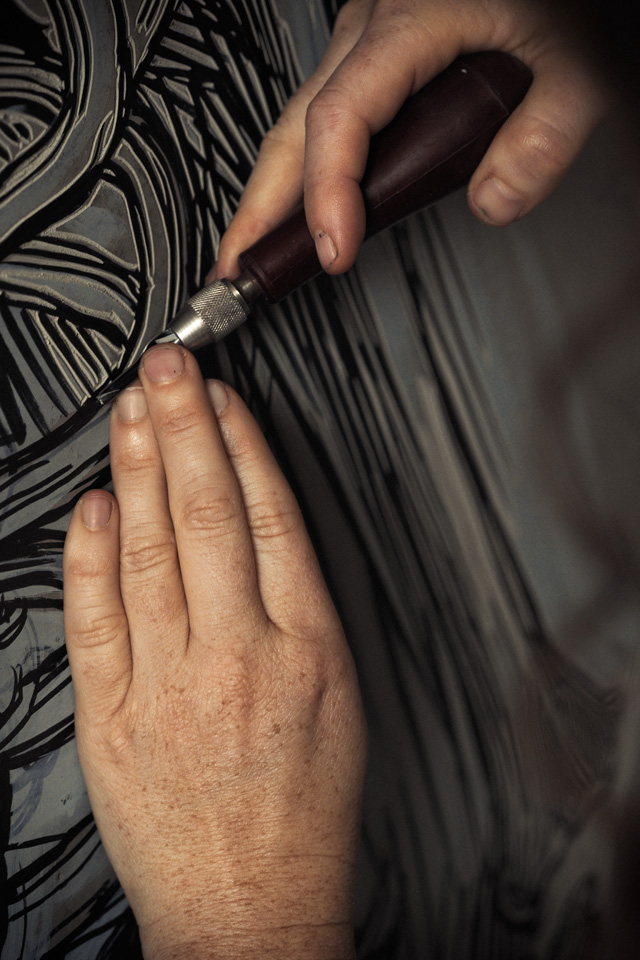
Swoon: I was just saying this the other day, that I find it funny that no matter how many blocks I carve, each time I start to carve one I get excited to begin it. I just love the process. I love the transformation that happens to the drawing through carving, and I love the permutations you get to experiment with when you have a bunch of different prints to work with.
RJ: What was the last great book you read?
Swoon: Hmm, well, I just watched a documentary and started on a book I found from watching it, and to be honest the documentary was only barely watchable, and the book may or may not turn out to be great, but both of them are on a subject that is so incredibly important that I dearly hope they keep up their work.
The doc was called Punishment: A Failed Social Experiment, and it centers around the way that the prison system, and indeed the idea of punishment are both dysfunctional in philosophy and in practice, and then tries to highlight the work of some people like the psychiatrist Bob Johnson who worked for years in the maximum security prisons in Britain and believes that even the hardest criminals can heal psychologically given the proper help. It’s a whole mind shift toward the idea that retribution is barbaric and unacceptable, and that our only real goal is to help people heal and to stop violence from continuing in our communities. Seems a really promising direction.
I have a confession to make: If you read Vandalog at all this August, you were taking part in an experiment, but today we are ready to publicly announce what we were doing. We nicknamed the experiment Illegal August. Look back through what we posted last month and you’ll see that we only posted about illegal work or news stories relating to illegal work from August 1st-31st. The experiment extended to our Tumblr and Facebook pages too. It was an entire month of ignoring murals, gallery shows, print releases and the VMAs on all of the general Vandalog sites (we didn’t include our personal social media accounts in the experiment, so that’s why you may have seen legal work on the Vandalog Twitter or Instagram accounts, which are really my personal accounts).
The idea for Illegal August came out of a dinner that Caroline and I had with Luna Park and Laser Burners. We were discussing mural festivals and legal murals, and how perhaps street art blogs have lost focus on street art in favor of covering a roving band of international murals touring city to city like mercenaries with spray cans, ready to paint something out of their sketchbook on any wall they can get access to, as long as they also get access to a lift. Somehow, I don’t think Luna Park actually ever said this to me, but I got the idea in my head that she had challenged Vandalog to only post about illegal work for one month. Whether she said that outright or even intended to make that challenge or not, I associate Illegal August with Luna Park. I thought it was a great idea to try only posting about illegal street art and graffiti for one month, and I chose August for the challenge/experiment because I thought that would be the most difficult month. There are so many mural festivals from July through September that I knew Vandalog would miss out posting about some great murals. It would hurt, but if it wasn’t going to hurt, what would be the point?
The rules for Illegal August were simple: Anyone posting on Vandalog from August 1st through 31st had to be reasonably confident that what they were posting about had been done without permission, or if they were posting news or an interview that the content was related to something that had been done without permission.
Illegal August morphed from a challenge into an experiment when I decided that we would attempt to complete the challenge without announcing it publicly. I wanted to see what readers would do. Would people complain that we weren’t covering Living Walls? Would they stop visiting? Would they get tired of posts featuring stickers and tags when they had come to expect murals? Would anyone notice what we were doing and ask us about it?
One way to analyze what happened is by looking at visitor numbers. In July, our most popular post by a mile was this one about a legal mural by Escif. In August, it was this post about a piece by Above that I believe to have been done illegally but I’m not positive. The Escif post got about 3x the visits as the Above post. Looking at pageviews in July versus August, we saw about a 10% drop in visitors.
But not all visits should be counted equally. Multiple posts in August inspired people to email me personally to say how much they enjoyed something that we had published. Most months, people will share what they like on Facebook or Twitter, but honestly it isn’t common for me to receive the kinds of emails I got last month. To me, that says that at least some of the people who did visit Vandalog in August were more engaged than visitors in July. I would rather know that a handful Vandalog readers are really loving the content than that a lot of people are visiting who are mostly indifferent about the content. It seems that focusing on illegal work forced myself, the rest of the Vandalog team and this month’s guest posters, to create more engaging and unique content.
What a lot of people may not realize is that a lot of what gets posted on Vandalog are things that I learn about because people email me press releases (sometimes very formal ones, sometimes entirely informal) about them. But most artists don’t send out messages to their mailing list when they put up a wheatpaste. Those emails are pretty much reserved for legal murals and gallery events. Illegal August forced me to not be so lazy. I had to go out and find content, whether that be interesting guest posts or searching through archives to highlight underrated artists. It was a lot harder than just publishing whatever was in my email inbox. But because I wasn’t worried about posting the latest murals, it freed me up to write about artists like You Go Girl! and Enzo&Nio whom I love but tend to neglect posting about. Basically, Illegal August allowed me to escape the rat race that street art blogging can be, the very existence of which is nuts since all of us bloggers are doing this out of love and a passion for the art.
But what art are we really so passionate about? I’ve always described Vandalog as a street art blog, and then there are blogs like StreetArtNews and Brooklyn Street Art with “street art” right in the name. I did a quick look at at what StreetArtNews, Wooster Collective, Brooklyn Street Art and Juxtapoz (in their “Street Art” section) posted during the week of August 19th…
28 out of 38 posts on StreetArtNews that week were definitely about legal work, with one post mixing legal and illegal work and 9 where I wasn’t positive if the work was painted legally or illegally.
The only post on Wooster Collective that week was about a print release related to their 10 year anniversary show with Jonathan Levine Gallery.
Brooklyn Street Art had 2 posts about legal work, 2 posts about work that seemed likely to be illegal, and 3 posts that had a mix of legal and illegal work.
13 out of 14 posts that Juxtapoz published under their “Street Art” category were entirely about legal work.
I would guess that if Vandalog had not been in the midst of Illegal August, at least 75% of our posts for that week would have been about legal work.
Given those numbers, if you think that “street art” means art placed in public space without permission, it’s pretty clear that street art blogs are not the place to go looking for street art online. But why is that? Talk to any street art blogger and they will tell you about the awesome wheatpaste or sticker that they saw recently before mentioning the mural they posted about the night before.
Huge murals captured in the perfect light by professional photographers look great on blogs, regardless of how they look in person. Stickers and wheatpastes captured with an iPhone that look like crap on blogs can stop you in your tracks on the street. And on the street, the work is confronting you, so you’re going to look at it whether it’s Swoon or Mr. Brainwash or someone you’ve never heard of. Online, if you’re like most viewers and see a headline for a blog post along the lines of “Some guy you’ve never heard of who does wheatpastes in a city you’ve never been to,” you’re maybe not so likely to read that post. This may be one reason why street art blogs and general art and culture blogs that cover street art have shifted from covering street art to covering contemporary muralism under the guise of covering street art.
And then there is the issue of laziness that I mentioned. Well, not really laziness, but it’s just easier to post about the legal piece is sitting right in your inbox than to go out searching through flickr or actual streets (if you’re lucky enough to live near a lot of street art) in search of something brilliant but still illegal.
Or maybe street art just doesn’t mean the same thing that it once did. Maybe mural festivals and the ease of finding legal walls has elevated the genre. Artists can spend days on a mural without worrying about police rather than sneaking around at night and working as quickly as possible. With plentiful legal walls, maybe some artists don’t see the need for working illegally anymore. Can the same goals be achieved at a legal wall as at an illegal spot? I don’t think so, but some may disagree with me.
For me, Illegal August was difficult. I had to spend a lot more time than usual coming up with content, even though I asked guest bloggers to come in and help lighten the load. And it hurt. It hurt to not post about Living Walls while Caroline and I were there watching the conference happen. It hurt to not post about Tristan Eaton painting a spot that I helped to organize in Little Italy. It hurt to tell artists whose work I really like, “Sorry, no. I can’t post about this.” But Illegal August was also freeing. It made me realize when it hurt to not post something, and when I hardly cared. It allowed me to get out of posting work that I would have otherwise been on the fence about, but would have felt obligated to post because of personal ties or because all the other blogs were posting about it and not posting would make it look like Vandalog wasn’t up on the latest thing. I hope that this experiment can spark a discussion in the street art and contemporary muralism communities about how we create, promote and consume art, but on a personal level it has helped to remind me that Vandalog is about what I feel strongly about, and I need to keep the focus on that. Today Vandalog goes back to “normal,” but it won’t be unchanged.
What do you think about Illegal August? Did you notice anything different on the site? Was the experiment valuable or a waste? Are street art blogs too focused on legal walls? Has “street art” become about legal work? If so, should that change and how could it?
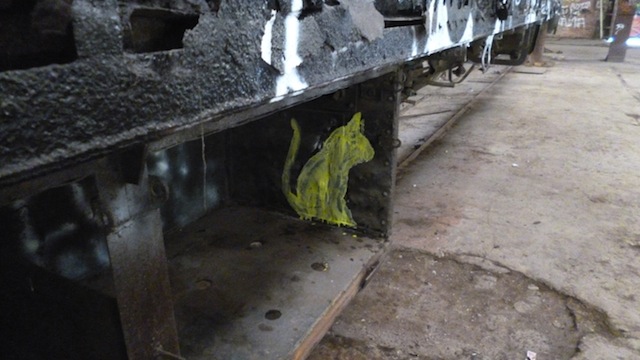
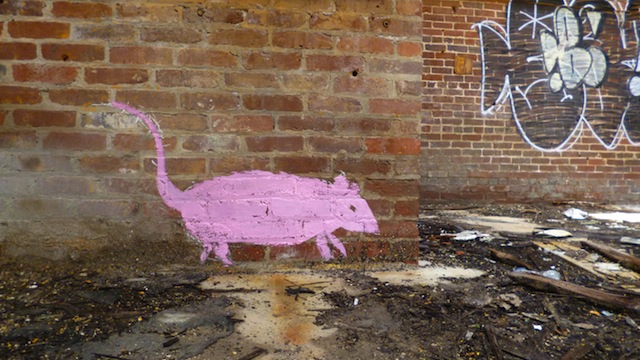
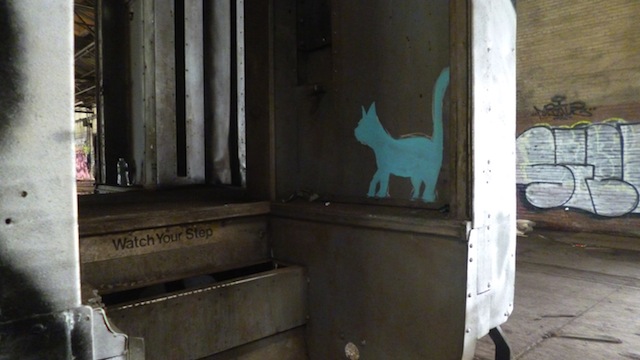
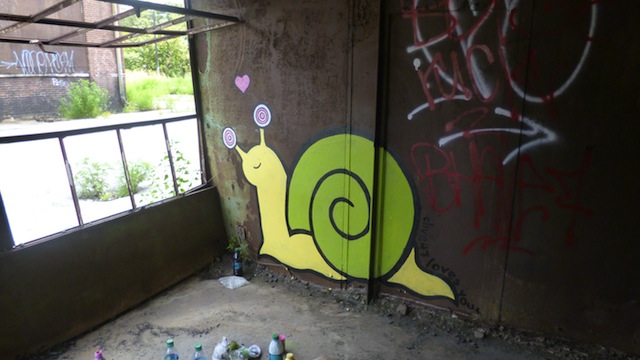
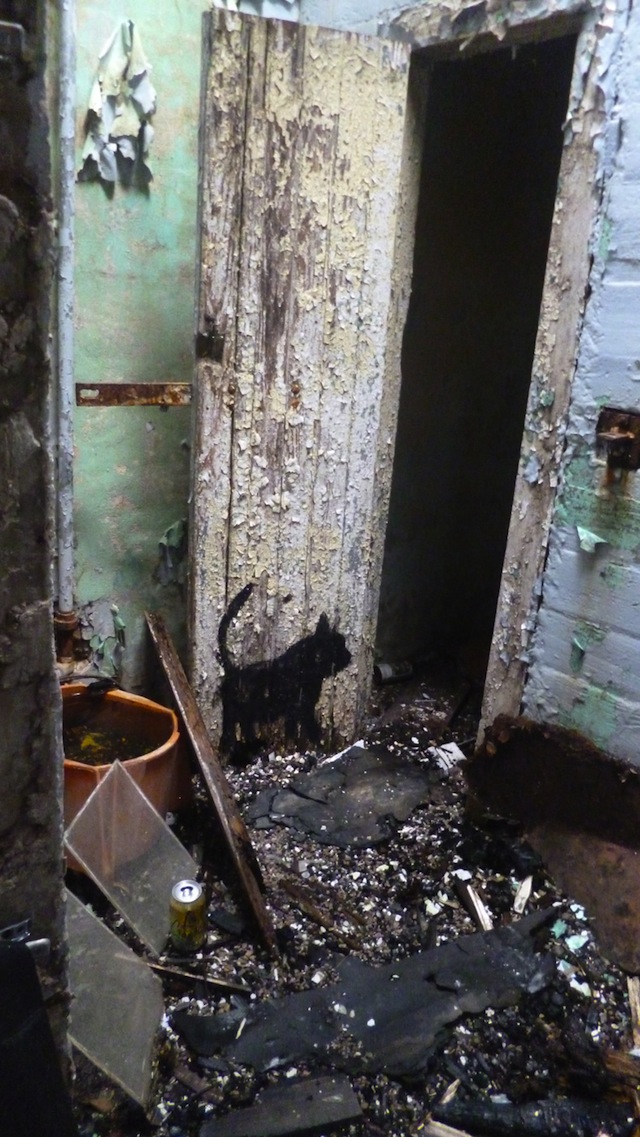
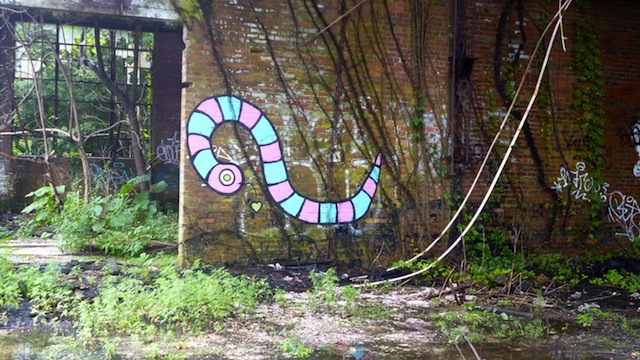
Olive47 has been exploring some of Atlanta’s abandoned sites recently with her artistic partner Wigglebear. Here’s a bit of what they have been getting up to there:
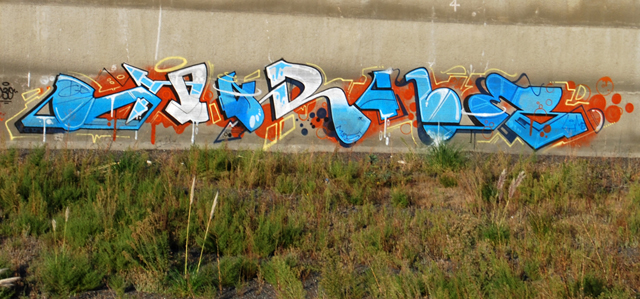
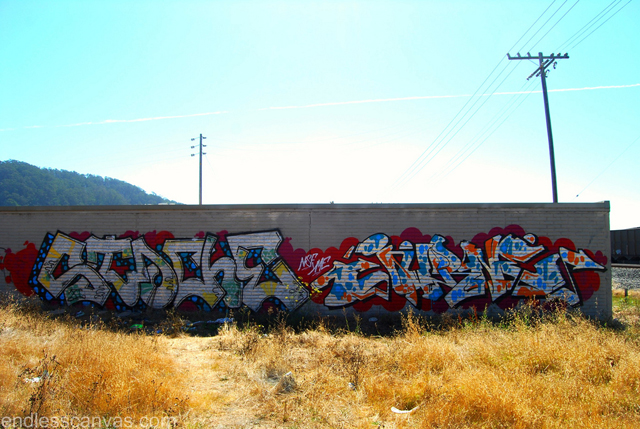
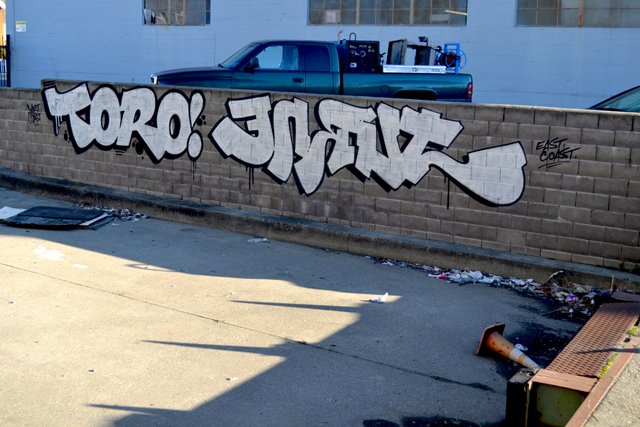
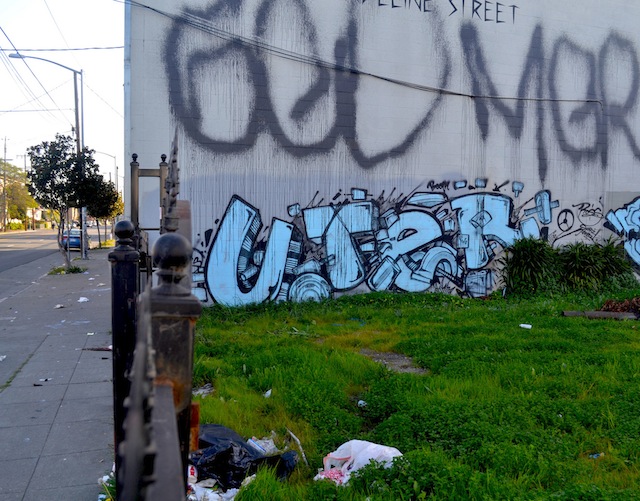
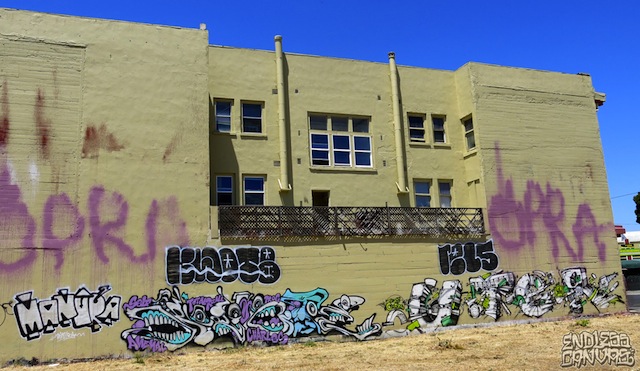
Today we finish up our series of posts in collaboration with Endless Canvas, a fantastic street art and graffiti blog covering what’s going on in the Bay Area. This is the 6th posts in collaboration with Endless Canvas in so many days, where I asked them if they could send over some photos of illegal work by Bay Area street artists and writers. We finish up the series with these photos of work by Jurne:
Stikman and Droid: On the Importance of Illegality in Their Work, an introduction by ekg
a few weeks ago, i was asked by RJ to do an interview with Stikman, which would be published on Vandalog during the month of august, 2013. first and foremost, i was thrilled to be interviewing Stikman, a long-time friend, and longer-time Street Art hero of mine. of secondary interest, over the past year, i’ve been working on an epic essay called Anti-Legal Art: On the Importance of Illegal Aesthetic Manifestations in the Twenty-First Century, so i thought this might be a good opportunity to collect some first-hand data on that topic from one of the lifetime-dedicated, constantly up and consistently innovative street artists today. no matter what else is going on, he is always up with new series and new materials, which has cemented in my mind his dedication to the medium, embodied in his consistent efforts for the past twenty plus years to disseminate his sign, spread the word, and challenge the law.
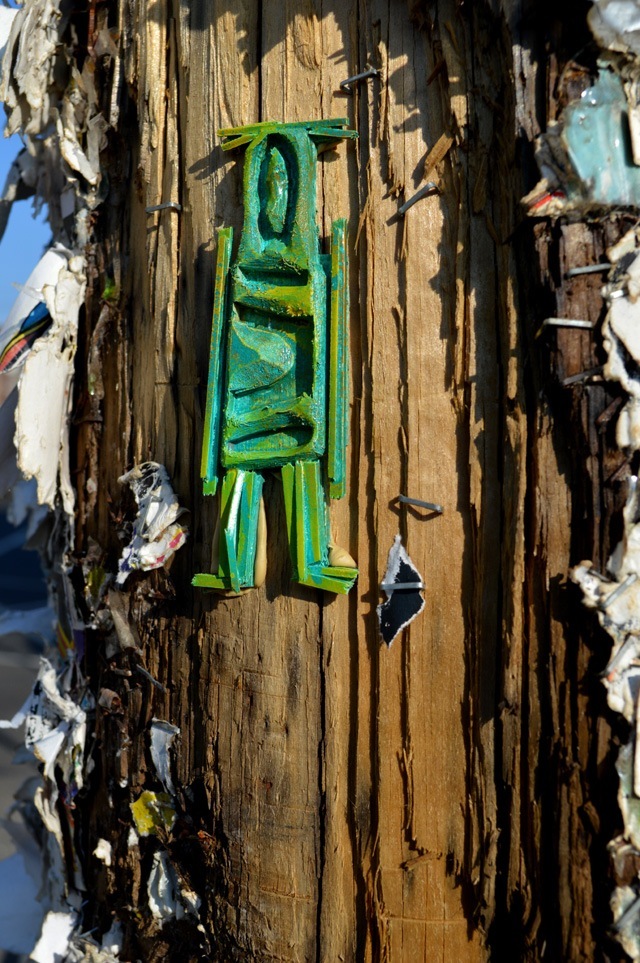
with a weird subtle quiet alien language, Stikman has been leaving a cosmic trail of lo-res multimedia crumbs throughout the urban semiotosphere for us to discover and decipher. his main icon is an alien form rendered with primitive materials in an infinity of mutations and environments. in a sense, Stikman operates much like a tagger in terms of his obsession with constantly being up, the wide dissemination of his mark, and the large quantity of his small-to-tiny pieces. but instead of markers and spray paint, Stikman utilizes alternative materials to disseminate his character, such as wood, metal, glass, and other sculptural elements recovered from the trash, as well as wheat pastes, printed and hand-made stickers, computer-manipulated mutations in all mediums, photographic and illustration fictional environments, and other interesting series as well. unlike a graffiti writer, Stikman does not utilize letterforms, but his primitive alien could be defined as a “character,” which quickly became an important element in the writer’s palette during the seventies as the movement grew in size and diversity of talents.
more often than not Stikman chooses small humble spots for his offspring: the alcove of a steel girder; floating almost unnoticeable in the middle of a peeling sticker mess; forgotten rusty metal boxes; underneath staircases in the dark; inside a missing-brick nook; yet all right under our noses in highly congested urban display hubs. sometimes as large as life, but more often as an invasion of miniatures, totemic and other worldly, charismatic and resonant, significant. does the primitive expression of a futuristic character inspire paradoxical feelings of nostalgia for a simpler earth bound time but at the same time create a yearning for an alien saviour to save us from ourselves? or does it emote a sensation of elation as in the moments of a visionary scientific discovery through alien contact? or is it simply a sign that encapsulates a relief that the alien isn’t a member of the slimy bloodthirsty hordes like a majority of our movies promote as the dominant dystopic mythology? whatever theoretical narrative can be applied to our attraction to these graphic alien insurgents, they have landed, been building underground support, attracting a large vocal segment of our population that is excited about it.
in my recent paris travelogue, i wrote that i feel like Johnny Appleseed as i disseminate marks. this concept of a writer or street artist sprinkling tags or stickers around a city like the iconic Johnny Appleseed flinging his seeds from his sack in an anarchistic, unsanctioned trail behind him across the rural landscape, first occurred to me during a conversation about Stikman’s series of municipal street adhesives. he literally walks around dropping those thick adhesive aliens onto the asphalt in crossing walks and parking spots as if it was a fertile bed of dirt in which his alien flowers will pollinate, mutate and grow, due to the constant motion and weight of traffic passing over them. like a twenty-first century Johnny Appleseed, Stikman releases his beings into cultural consciousness on the anarchistic and rebellious broadcast channel of Street Art; and yet still transmits a quiet message of poetic transgression, positive cultural mutation, and personal vision, a calm voice of beauty and reason in the aetherial semiotosphere, a contrasting environment of hyper texts and semiotic wars, missives and missiles, data patterns and pigment irruption, agents of the matrix and guerrilla aesthetic actions.
Droid 907 and Amanda Wong in the Catskills. Photo by Amanda Wong.
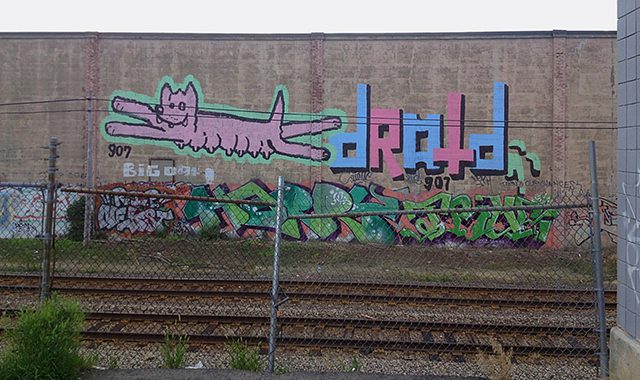
in the past couple years, i have also been in contact with Droid 907, a graffiti writer who continues to blow me away as he expands his repertoire, exploring a wide-range of hardcore graffiti tools; collaborating constantly with other artists and crews on missions, painting larger and larger outdoor pieces while developing unique roller letterforms, as either clean-and-bright two-tone pieces, or wacky and crude expressionistic letterforms; expanding his already-wide geographic perimeter through a network of bike maniacs, van nomads and freight hoppers, poetry in motion, all dedicated to an off-the-grid DIY lifestyle making music and art, publishing zines and encrypted web pages, curating shows and running galleries, while also managing exposure on the internet through a network of friends, fans, and a sympathetic media community.
in the previously mentioned paris travelogue, i was snarky at one point about the overuse and meaninglessness of the term “Punk” forty years after it’s inception; but here i am just a week later reading statements by and looking at photos of Droid’s work, which have, in total for me (including other interactions with him over the past three years), imbued the term once again with its original anti-status quo meaning, a symbolic power derived from IRL transgressive action, off-the-grid DIY work ethic and alternative lifestyle, and blunt radical political statements. to sum up: Droid gives Punk meaning again. this may even be a sign of something else brewing, the crest of some building resonance, the immediate unseen and unrecognized now pregnant with singularity and tumescence, rearing itself up from a minority to a majority, no longer a whisper but a shout. from a third-person vantage point, reading the accruing signs, Droid’s memoires and photo essays, as well as his friend’s zines and other media, such as Avoid’s Vagrant Space website and the novel Train To Pokipse by Rami Shamir, are a bold collective attempt at creating a transom-window visionary-view statement about the growing youth underground in America that in another ten years, as the chasm between rich and poor continues to grow unacceptably wider and future opportunities are proactively hoarded by the one percent, may well become the angry fist of a job-less, cash-less, CPU-less, homeless, transient mass culture with no where to go but off-the-grid onto unregulated topology, creating a new kind of culture that will not be based in anaesthetization in front of a computer screen or by an American Dream that is unattainable for 99% of the population.
so, having Droid on my mind while i was thinking about what to ask Stikman, i was struck by how differently these two artists express themselves with their work on the street, and wondered how two such distinct personalities ended up choosing the same illegal alternative channel to broadcast their message. Graffiti and Street Art can be defined abstractly as a channel, a broadcast media, an alternative wavelength that also imbues the signs transmitted through it with an aura of rebellion under a Halo of Illegality. therefore, since the Medium is the Mess, this particular media manifests an inherently anti-status quo, anarchistic and revolutionary signal and sign. this added layer of outlaw semiotic definition is embedded in the remnants of the art on the street and in the photographs of the art on the internet by the indications of the transgressive action that took place in the placement of the symbols illegally on an unsanctioned display surface. this is the heart of art placed on the streets, the human pulse of the populace, the urge to take back our surveillance reality, re-manifest ourselves through coordinates of insurrection, and visual civil disobedience.
the Illegality of graffiti and street art is a crucial formal aesthetic category at the root of the movement’s cultural power, strategic operations, aesthetic forms and choice of materials. the choices an artist makes from this selection of options defines their personal vocabulary with which they symbolically define themselves and express their message. etch tags or wheat paste? spray paint or rollers? fame spots or cutty hideaways? freights or walls? quantity or detail? stickers or extinguishers? construction sites or high end retail? some materials are contentious, but can be offset by other elements in play. each makes a statement about the artist, their temperament, their strengths and their intentions. so why and how do artists as different as Stikman and Droid express themselves on the same illegal broadcast channel?
Stikman. Photo by Stikman.
i sent Stikman and Droid the same twenty questions, each consisting of three-to-four more increasingly specific sub-questions on a similar theme; so in essence i sent them about sixty questions total. as i was crafting them, i did not really think about how much i was asking of them, so i want to emphasize that i appreciate their time and effort. it meant a lot to me that they wrote so much detailed, thoughtful and inspiring text. as well as RJ for the suggestion to combine the answers underneath each question. i’m sure it took a lot of time to format, and was well appreciated. thank you.
i’d also like to mention that both Stikman and Droid expressed mutual admiration for each other’s work when i first raised the idea to them. if forced to make this kind of comparison, each of them fall onto opposite ends of the Graffiti and Street Art spectrum, but, at the same time, because of their unique aesthetic paths, they are also outsiders within their designated categories. so mutual awareness makes sense: in the presence of Art, categories collapse and unique minds recognize each other. for instance, when it comes to street operations, Stikman is basically a solo agent on the streets and a ghost on the internet with no self-directed presence except through fan photography and gallery representation; where as droid is constantly painting with different partners, as well as utilizing methods to stay off the grid that involve multiple subcultural supports and many layers of socially-engineered encryption when utilizing the internet. for Stikman, who is celebrated more often in Street Art contexts, he is still a complete enigma in that subculture, because of his refusal to show his face in public or do legal walls, even during his own solo shows; similarly, Droid could be considered a Graffiti outsider from a traditionalist’s viewpoint because of his dedication to the raw power of rollers, an underground comix aerosol aesthetic, and a strong political voice in a movement that usually counts on the aesthetic transgressions to speak for themselves.
important to note is that any truly singular voices, such as Stikman’s or Droid’s, frequently are quarantined in a marginalized cultural space until enough mass-market interest makes it economically feasible for the mass media to broadcast it; but on the other hand, this gives culture-at-large some time to assimilate difficult artist’s visions from the ground up. ironically, this is usually due to a significant portion of the mass population already being altered by, or at least familiar with the artist’s message through the artist’s personal subcultural osmotic-homeopathic resonance which eventually vibrates up to the mass cultural level. an attempt at a flow chart illustrating such relationships between artist’s fame and cultural demand would be fascinating: it is impossible to hold back a resonant aesthetic form when it speaks using the pertinent vocabulary of an era. due to their own particular aesthetic voices, or simply because of their utilization of and dedication to the Graffiti and Street Art broadcast mediums, Stikman and Droid may be recognized as artists historically at ground zero, relevant to cultural discourse, symbolic expressions of a time period, ideal examples of new technologies manifesting aesthetic forms, visual metaphors that summarize the feelings of the majority of the populace, but above and beyond all that: i see Stikman and Droid at their cores as enduring flames in a flat-lining world.
Droid 907 and Wolftits in Boston. Photo by Danika2.
egk: when and where did you first get up?
Stikman: When I was 15, I wrote my name in black paint with a paintbrush all over town like everyone else I grew up with. It was in an older inner ring suburb of a large city in the Northeast US.
Droid 907: the first writer i got up with was DESIGN NFO from brooklyn in the mid 90’s. i was broke and new to the city. the subway was still free and one could venture all over town with no money. he put me down on $35 ounce weed spots in harlem, basically showing me how to make a buck and keep my head above water. he’d write his name whenever he felt like it, regardless of who was around, and pass the marker or can to me and expect me to do the same. it was a different time in new york city for sure. i wrote a different name then and met a number of city kids who all wrote tags. i kept scrawling and scribbling for a few years, as more of an aimless act than one with a mission or purpose. it was more like graffiti found me and it took me awhile to understand it. it wasn’t until 2003 that i did my first roller with FIYAH EMP that i got deeper into the organism.
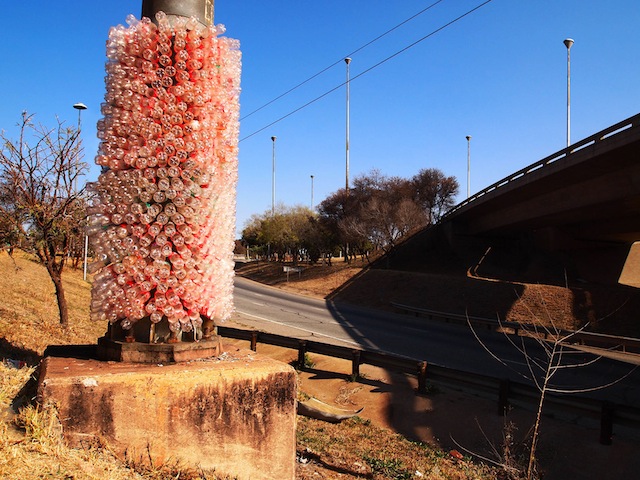
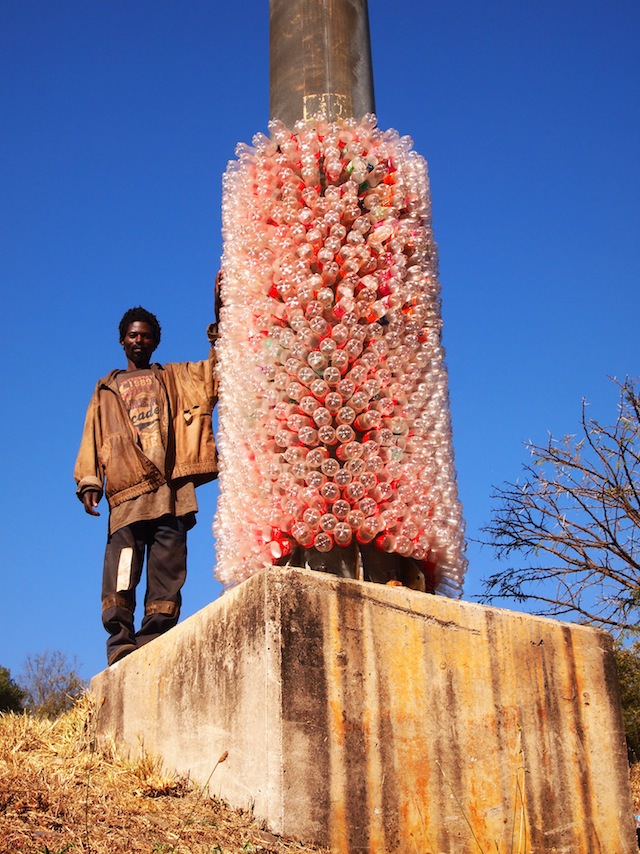
Broke, the artist that Endless Canvas has selected for today’s post, is known for two of my favorite sayings in street art: “More beer, less work” and “Beer is good.” I asked Endless Canvas to
r1 sent over a few photos of a recent piece, The tower of Isaac, and this explanation of it:
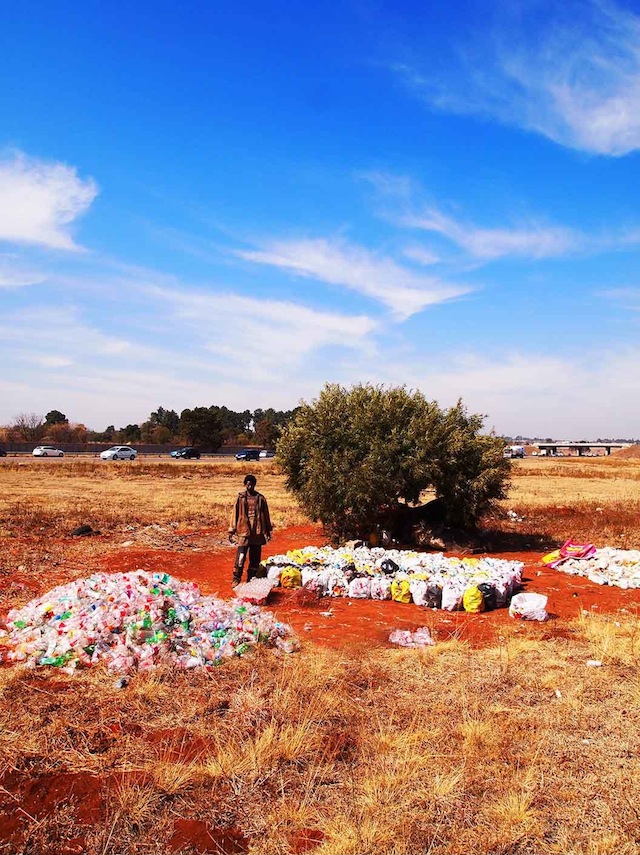
This is Isaac.
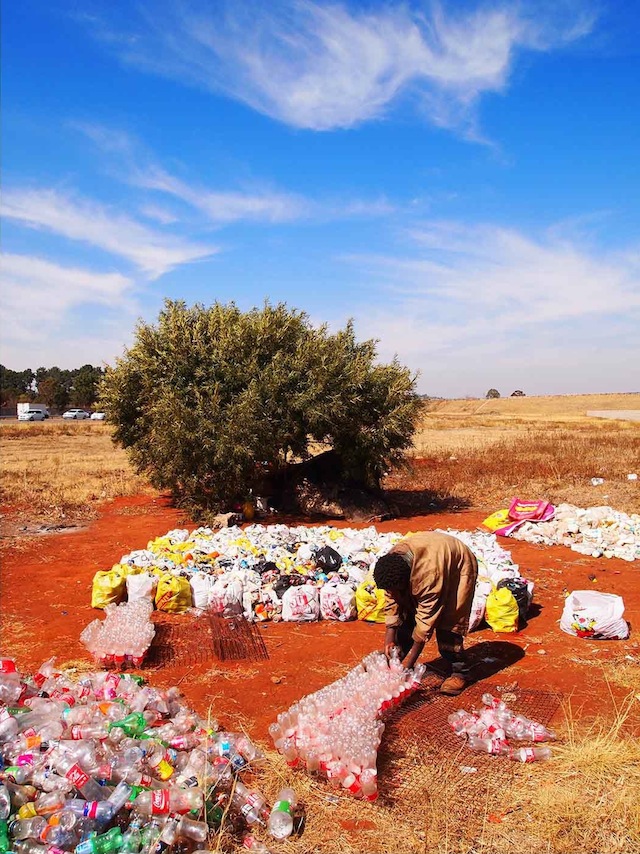
He does not have any possessions or family members. Isaac has a speech impediment, is unemployed and homeless. He lives underneath this tree next to the highway and keeps the surrounding area clean from debris. During the day he collects tins, bottles and plastics and recycles it for a small amount of money 5km away.
I am a street artist. In this piece I interacted with Isaac and collaborated with him by assembling his plastic bottles into a wired mesh. We installed it around a streetlight tower 800m away from his home (the tree).
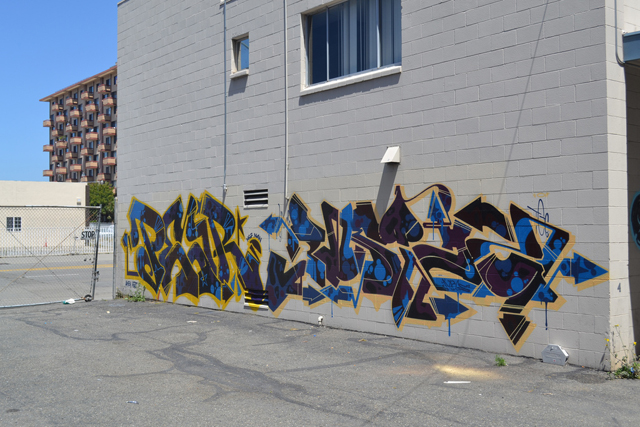
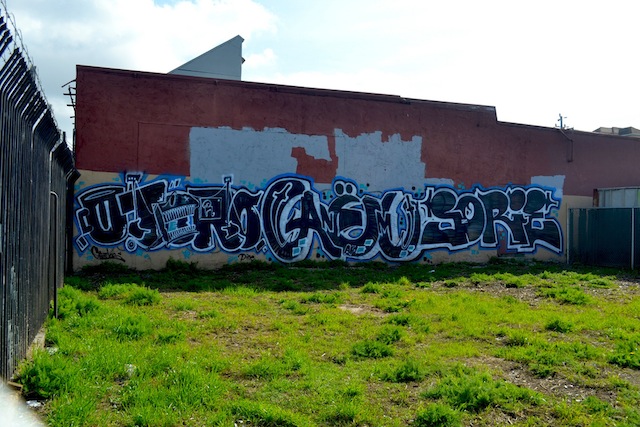
Uter of Charles Crew is the third artist in our series of artists being highlighted by Endless Canvas, a great blog that I’ve invited to contribute a few posts on Vandalog to bring attention to the great work that’s going up in the Bay Area. For today we have Endless Canvas’ photos of Uter, a member of Charles Crew, who is doing some really great work with illegal graffiti that looks more complex that many writers’ legal pieces. In fact, all of Charles Crew seems to be great at that. Check out this flickr page for more from the crew. Here are a few of Endless Canvas’ photos of Uter’s work: