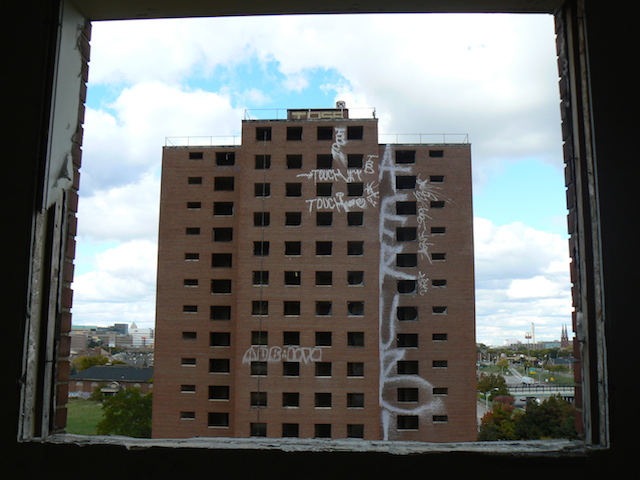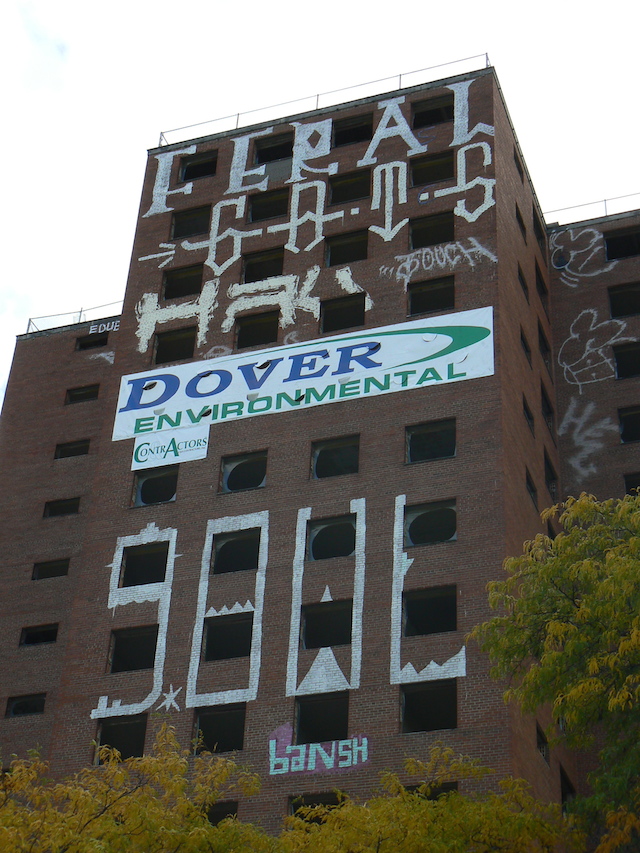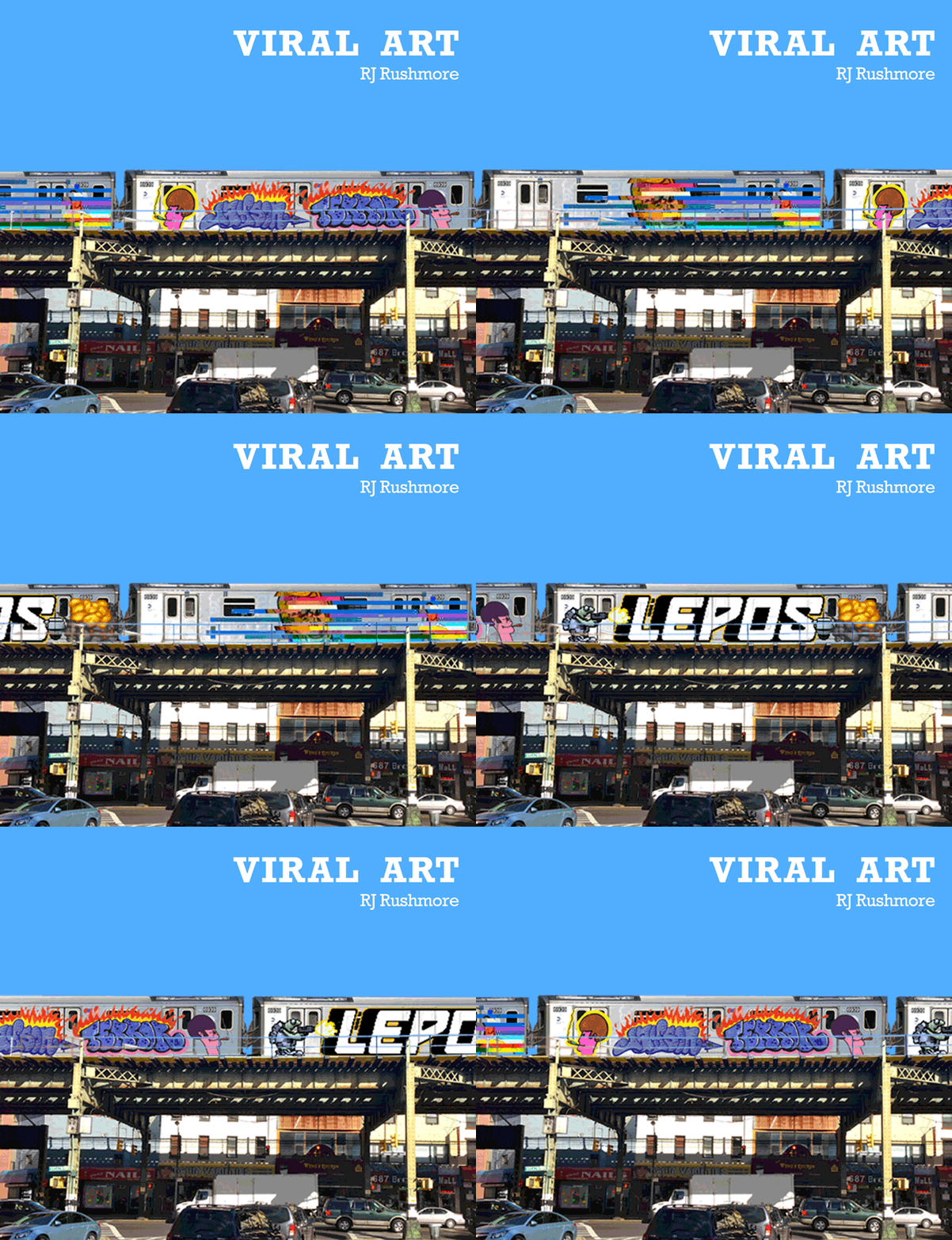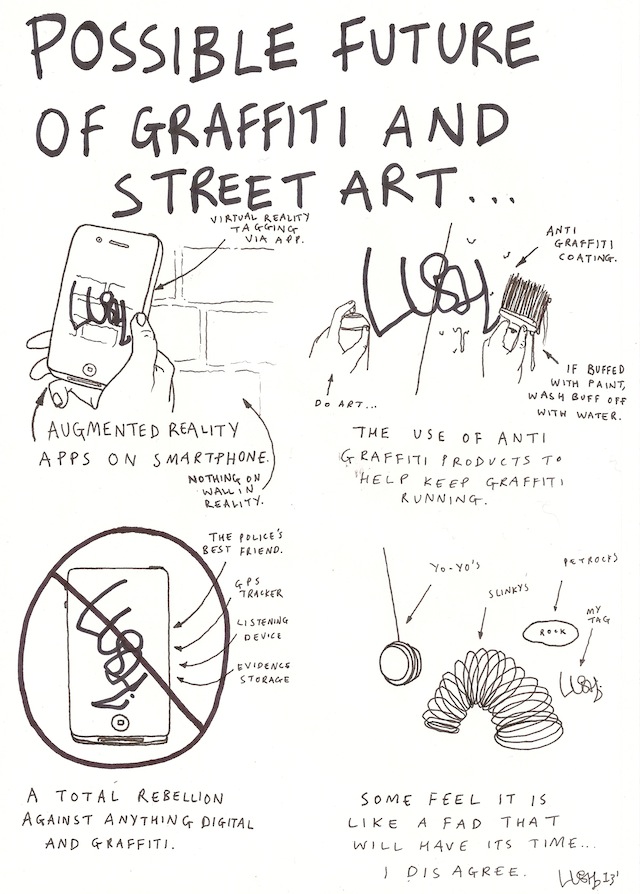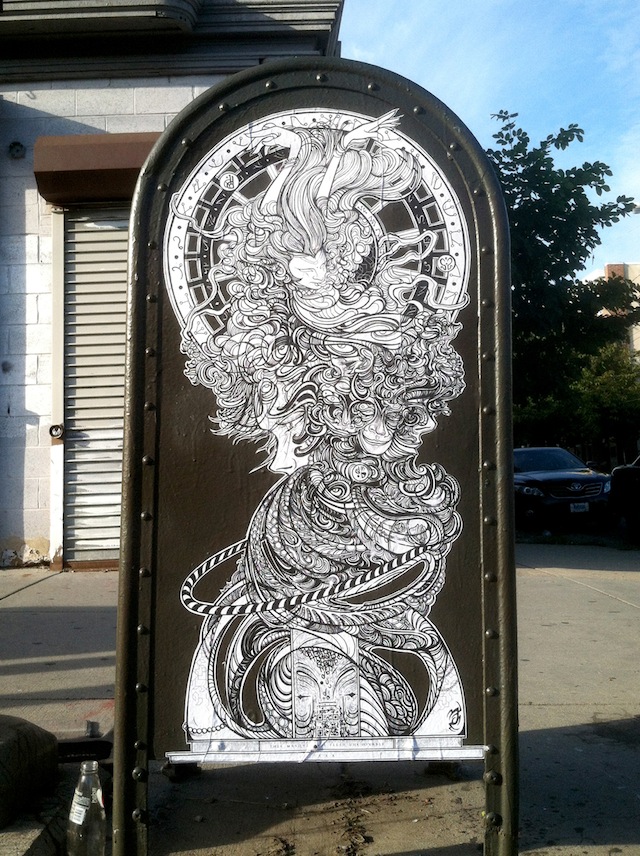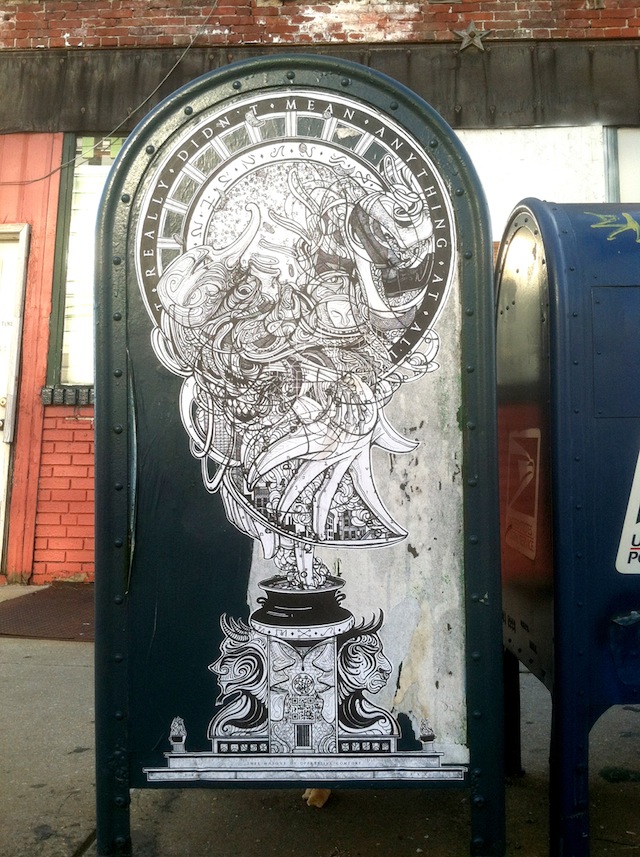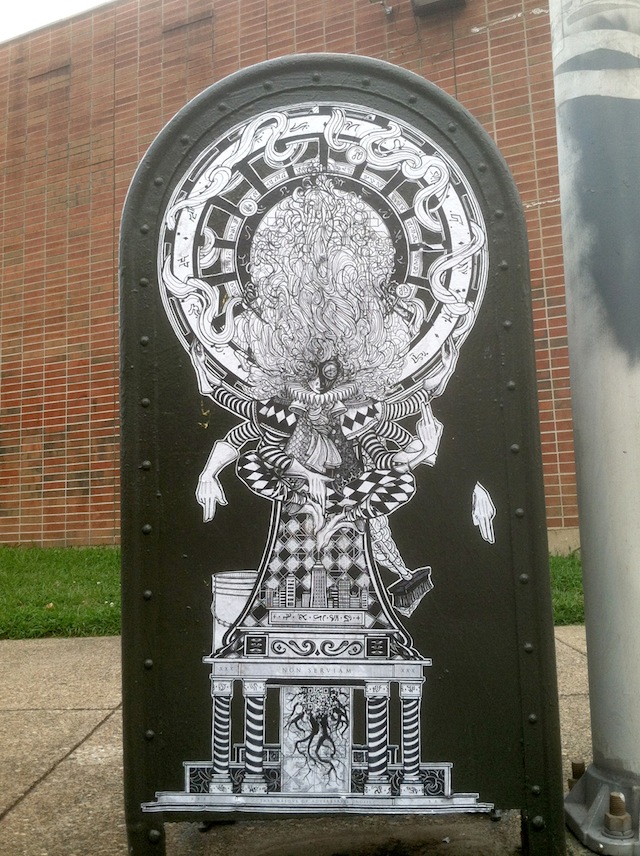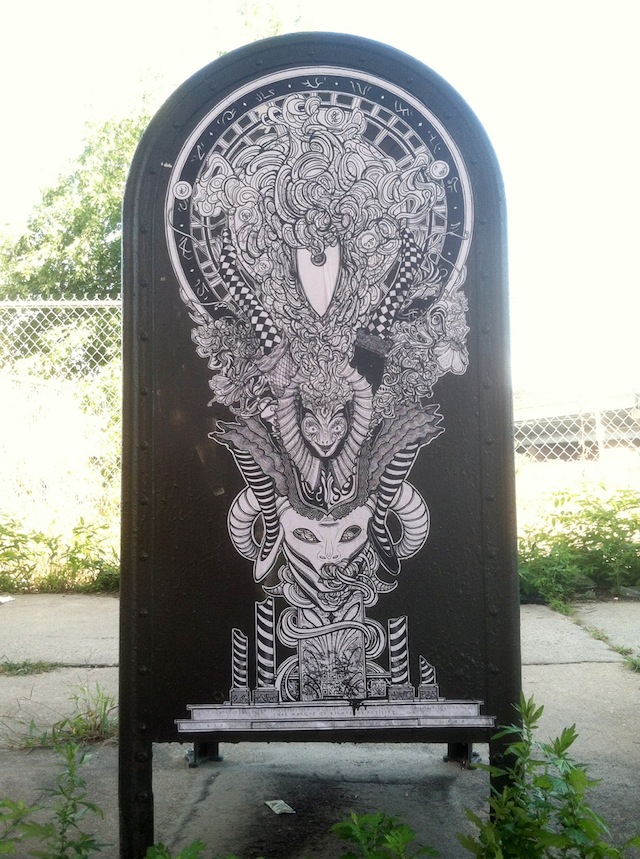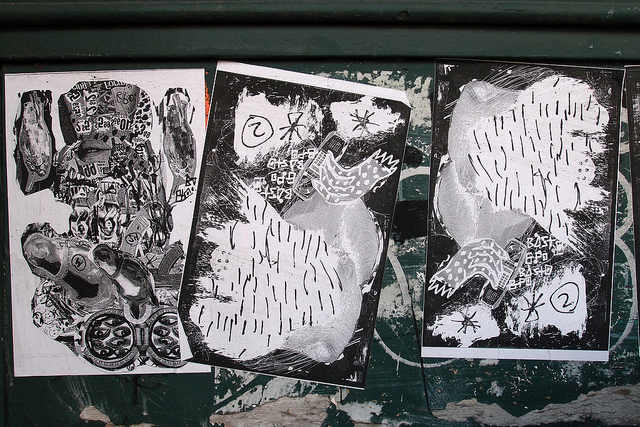
KATSU, one of my favorite writers of all time, has had quite a week. I was just going to throw these things in the weekend link-o-rama because other blogs have covered the events so well, but then stories about KATSU just kept piling up. So, here they are:
KATSU is part of F.A.T. Lab, and they have a show (F.A.T. Gold) on right now at Eyebeam in NYC. This evening from 5-7pm, KATSU and Mike Baca aka 2ESAE will be in conversation live online. That event should be streaming here and will presumably be available to watch at a later date as well.
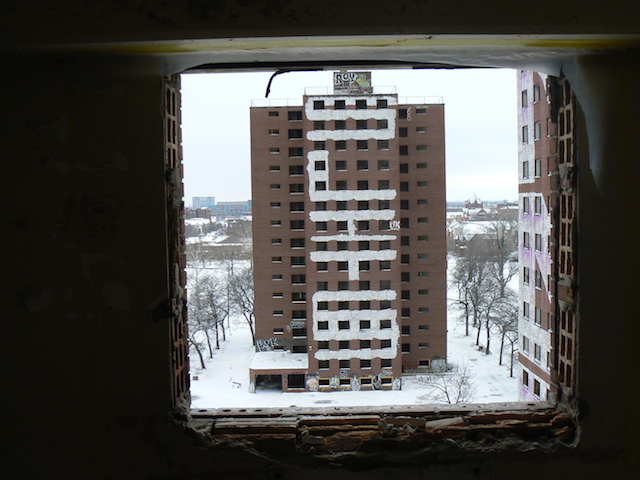
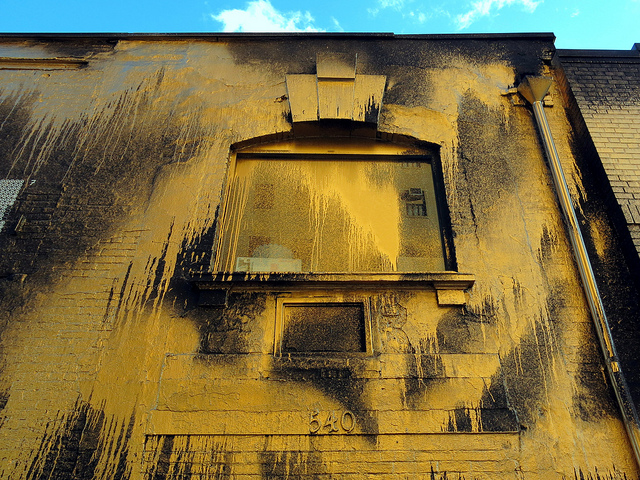
It seems that KATSU’s most noticeable contribution so far to F.A.T. Gold has been to paint the outside of Eyebeam with a fire extinguisher, as pictured above. As it turns out, those things are hard to control when it’s windy. Some of the paint got onto the gallery next door, Paula Cooper Gallery. Paula Cooper is not happy about that. For the rest of us, there’s a hilarious video to watch of a Paula Cooper Gallery employee trying to figure out what’s going on with all the gold paint flying everywhere.
As I tweeted the other day, my mind is kinda stuck on how much I wish the Parra show at Jonathan Levine Gallery opened today and not on Saturday so that I could go see it. So while I’ve been distracted by that point, here’s some of what I almost missed this week:
Nice video of Eine updating one of his walls in London from saying PRO PRO PRO to PROTAGONIST. Interesting comment about street art being a thing that “looked like it would offer what graffiti promised but didn’t deliver.”
Jonathan Jones is up to his old tricks of dissing Banksy to get more hits for his column, and I’m biting. He writes, “Banksy, as an artist, stops existing when there is no news about him.” Even if that is the case, is that the end of the world? Does that relegate Banksy to “art-lite”? No. Banksy is one of the most talked-about artists in the world. I would bet that the same criticism was leveled against Warhol, who I believe Jones likes. Banksy’s manipulation of the media, playing it like a damn violin sometimes, is some of his greatest artwork of all. He manipulates the media to spread a message. The best example of this was probably him going to Bethlehem to paint on the separation wall because he knew that the media would cover it. He was able to play the media to draw attention to an issue that he felt strongly about. Banksy’s paintings are sometimes great and sometimes not. But his ability to make people fascinated with him and his paintings is just as much of an art, and that shouldn’t discredit him.
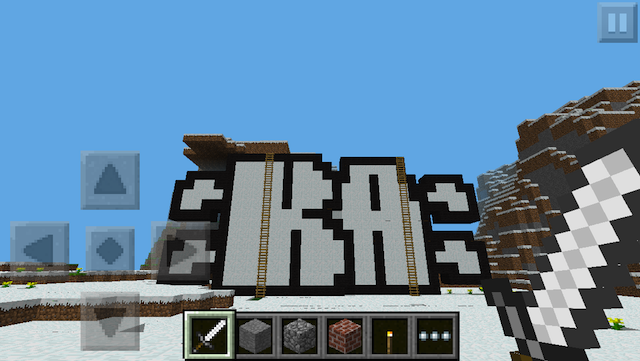
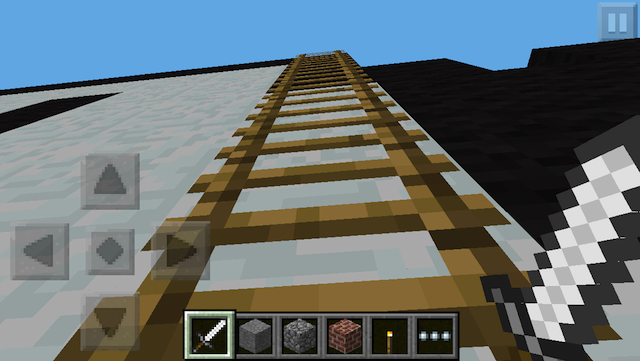
Yes. KATSU is the man. He continuing to explore what graffiti can look like in this century and he’s leaving most street artists in the dust in the process. These screenshots are from a piece by KATSU within the game Minecraft. I’m not a gamer, but, as far as I understand it, the vast majority of Minecraft games are not played in an online multiplayer setting, but they can be. So, like Franco and Eva Mattes performing during a game of Counter-Strike or Diego Bergia getting his graffiti into Tony Hawk’s Project 8 (which spread his Where’s Lepos project from the street into a game), KATSU has brought his graffiti into the digital world and could potentially put it in places in the digital world where others could see it. Most likely though, this throw-up wasn’t made in a multiplayer game and won’t be, so in that sense it’s more like doing something in a sketchbook and posting a photo of the sketch to Instagram than doing a piece of graffiti, but it’s still pretty cool and it’s another step for KATSU towards doing graffiti in the world of 1′s and 0′s.
The project was announced through F.A.T. Lab, where KATSU is currently an Artist in Residence. In that post on F.A.T. Lab’s website, KATSU says “The future of graffiti for me will be in the form of black hat tactics.” For those who may not know, “Black hat” is a term used to describe hacking which would typically be considered invasive or malicious in some way, rather than the good kind of “white hat” computer hacking. I can’t wait to see what KATSU does next. A move from physical graffiti to the digital graffiti of website defacement could be very interesting.
This weekend I’ve been without solid internet access, and Caroline and I have both been knee-deep in exams and final essays for the last week, so here’s a belated link-o-rama…
The New York Times has a story on Living Walls, centering on the removal of Hyuro’s mural a few months ago and now the removal of Roti’s mural. I hope that this does not dissuade artists or the amazing people behind Living Walls from doing more of the amazing work that they have become known for over the last three and a half years.
Earlier this week, I hosted a movie night at The Wren’s Nest in Atlanta for the Living Walls Conference. Living Walls asked me to put together a list of some short films to show, and I ended up with 27. A few people have asked me to post those films online to share with friends or just to see a film that they missed while they were getting some food, so after the jump you’ll find embedded versions of all 27 films that were screened at the movie night (many of which have appeared on Vandalog before). Enjoy! Read the rest of this article »
I wish I could be in Chicago later this month for DB Burkeman’s sticker art exhibit at the Maxwell Colette Gallery that RJ posted about yesterday. But, at least, here in NYC, I do get to see new stickers surfacing daily. And lately there seems to be a proliferation of them in Manhattan. Here are a few:
Katsu with his signature character that has become an integral part of NYC's visual landscape
Baser with his masterful handstyle on spray-painted background
A note from RJ: After writing this, I read Rub Kandy‘s interview in the most recent issue of IdN, where he speaks about street art that is created for and best experienced on the web.
What do Kidult, Blu, Maismenos and Katsu have in common? They are all examples, although not the only examples, of artists using the internet in a similar way to how graffiti writers and street artists have traditionally used the streets. These artists are each trying to spread a message at all costs. That’s standard street art/graffiti. But with these artists, a traditionally static artform is turned into a performance, what they do might be fake or impossible to see in person and, most importantly, they see the spread of their work online as at least as important as the physical pieces.
Check out these videos from Kidult (the first one is hilarious), Blu, Maismenos and Katsu…
With all of those videos, the resulting films are more important than the actual physical artworks. And yet, they were all done by street artists and graffiti writers and include (or pretend to include) art that is generally considered street art/graffiti. Who cares if anyone ever sees any of those artworks in person, or if they are even real? Even in the case of the real works that are depicted in those videos, most of those were seen by far fewer people, or at least art/graffiti fans, than these videos. In the case of Katsu’s tag on MOCA, that was buffed in less than 24 hours and it was a while before the existence of the tag and the story of it being buffed was even confirmed. The important thing for these artists is that the videos get seen. These videos and photos are more impressive than the actual work they capture. The intended audience for these street pieces is not the public on the street. These, and many other, pieces of street art and graffiti were created with an online audience in mind rather than a physical one.
So what does this mean for street art if the streets and a medium for viewing street art are being used in this way? Is street art just as legitimate when specifically designed, executed and documented for an online audience? What about graffiti? Does it even matter if a piece is real, so long as people see it? I would say that, at least when it comes to graffiti, it does not really matter if a piece is real or not. So long as it creates fame. Of course, fake videos won’t work at creating fame forever, but they are a temporary technique that can accomplish one of the goals of graffiti. It seems the case is more murky with street art. Certainly the street art in these is still art and probably still street art, just maybe not “street art” as the term is generally understood today. I consider the work in The Underbelly Project to be street art and graffiti, but others do not because it had to be viewed through photographs. Street art that is specifically designed to be viewed through the filter of documentation is still street art, but it’s an evolution too. As I’ve said before, I think hacking is 21st century graffiti, so maybe the internet is the new “street.” It’s quickly becoming a better avenue for artists to show their work to the public than real life.
Over at her blog on 12ozProphet, Martha Cooper has a series of photos documenting the work of Katsu, Blade, Rime, Freedom and Os Gêmeos at MOCA. Cooper had a behind-the-scenes look at how things transpired after Katsu hit the MOCA building with a fire extinguisher tag just a few days before Art in the Streets was due to open inside. That night, the wall was buffed, and then it looked like this:
Photo by Martha Cooper
Of course, that wouldn’t do. Os Gêmeos had been scheduled to paint a mural on that wall, but they decided that they did not want to go over Katsu, which is how they ended up painting the MOCA ticket booth. A replacement had to be found.
Similar to the wall that Lee Quinones, Futura, Cern, Push, Risky and OG Abel collaborated on just on the other side of the building which had originally been the site of Blu’s buffed mural, repainting over Katsu’s spot would have to be a collaborative effort. Freedom sketched a tribute piece to Blade, using some of his most iconic images. A few people painted the outline of the Blade tribute, and Rime came in to add the color. For more detail on the story and images of the entire process, check out Martha Cooper’s blog.
Photo by LindsayT
I don’t want to say that Blade does not deserve a tribute mural (he is one of my favorite early writers, particularly for the very piece that makes up the core of this tribute mural), but I think it is telling that no one writer would go over Katsu alone. MOCA has every right to do what they want with their own walls, which is why I don’t think the covering of Blu or Katsu’s pieces should be considered censorship, but I definitely wish that Katsu piece had stayed. The man is at the top of his game and a trailblazer in 21st century graffiti, so he deserved mention in the show as part of the next generation of great writers, and it just would have given the show a gritter feel. On the other hand, I don’t want to begin to imagine the problems that keeping that piece would have caused… At least Blade got some added props in the show and Os Gêmeos still painted something.
Why haven’t hotels figured out that they should have strong free wifi in all rooms? And, if they make you pay for wifi, the signal and speed had better be amazing? Starbucks has it figured out, and I don’t have to pay a boatload of money to hang out in a Starbucks for a couple of hours (unless I’m drinking their coffee while I’m there). And yet, hotels haven’t seemed to get the message. So that problem, and the general busyness of the last few days in LA, is why I am woefully late covering the opening of Art in the Streets at MOCA in LA, probably the biggest indoor event this year relating to street art or graffiti. And I’m still going to be woefully late with coverage today. Expect a full review in a couple of days, but in the mean time, here’s some of the best reviews and coverage from around the web:
The LA Times reports on an increase in graffiti throughout LA because of the show. A. Umm… duh. B. MOCA director Jeffrey Deitch attributed this increase to “some of the young taggers who are anarchic,” but neglected to mention that some artists in Art in the Streets are involved too. Barry McGee, Amaze, ESPO and friends painted somegraffiti. I saw some McGee stickers around the museum. And Shepard Fairey’s crew has been hitting up electric boxes right out in front of MOCA without permission.