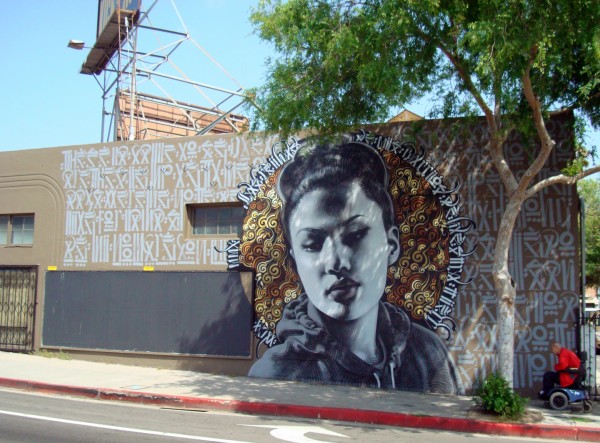
I’m really liking this new mural from Retna and El Mac. Always great stuff coming from these guys.
Photo by Known Gallery
I’m really liking this new mural from Retna and El Mac. Always great stuff coming from these guys.
Photo by Known Gallery
Note from RJ: The following post by Alison Young was originally published on her blog, Images to Live By. We at Vandalog would like to thank Alison for kindly allowing us to republish it here, along with part I of the review (posted yesterday).
Since the previous post, about expectations of what Exit Through the Gift Shop is about, turned out to be a long one, I thought I’d write a separate one dealing with what it’s not about.
So let’s go back to the second response that a lot of people seemed to have after seeing the movie – a feeling of surprise that it’s not ‘about’ Banksy, or at least not as much as they had expected.
It’s worth looking at this closely. Is the film ‘about’ Banksy? Well, the film is made by him, and thus it provides us with a text which tells us something about the artists and his concerns, just as his artworks, books and exhibitions do.
And then again, Banksy is in the movie: we see him in his studio; we see him stencilling; we see him with his crew of helpers creating the famous ‘vandalized telephone box’ in London (which goes on to sell for an extraordinary sum at auction); we see him installing a blow-up doll, hooded, shackled, and wearing an orange jumpsuit, at Disneyland, in a direct juxtaposition of American mass entertainment culture with the torture of detainees at Guantanamo. (All of these occurrences are filmed by Guetta.)
But of course, while all of these events are taking place, Banksy still withholds himself from any kind of identifying gaze – he wears the hood of his sweatshirt pulled over his head, his face is blanked by pixillation, his voice distorted (and his assistants’ identities are similarly masked).
So Banksy’s certainly in the movie, but he’s simultaneously on display and hidden from our view. But what we do see in plain sight are his stencils and his hands: as Banksy himself states in the film, ‘I told Thierry he could film my hands but only from behind’.
As he says these words in voice-over, the film shows us Banksy at work, cutting stencils (for one of his signature rats, to be put up on a wall in LA). And for me, that was one of the highlights of the film – watching those hands, whether at work on the stencil or gesturing along with the words spoken by Banksy’s distorted voice.
They’re slender hands, with long fingers. They’re the hands of an artist. What does the face matter, or the voice? Watch the film – and watch out for the scene of Banksy cutting stencils, with speed, and with great skill. That moment might not be central to the film, but it’s certainly what street art is all about.
Forgot to post this video in yesterday’s post about Escif and his upcoming solo show at Pictures on Walls. You may recognize it for its inclusion in Exit Through The Gift Shop. As I understand it, he set up the video camera and painted in that particular spot in an effort to get arrested on tape. And he succeeded (if you can call getting arrested success).
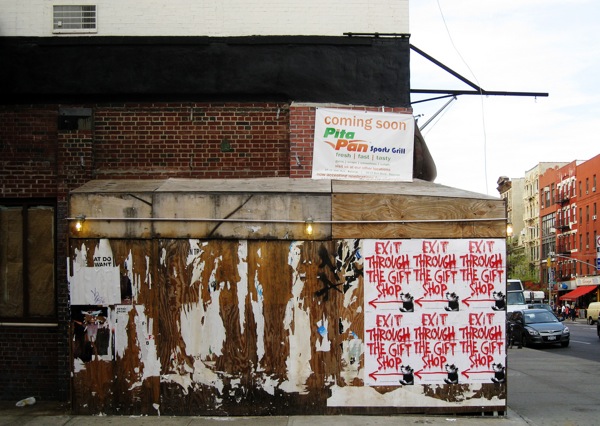
Banksy once said “‘Every time one of my friends borrows my ideas, mounts a huge art show and becomes a millionaire celebrity,’ a little bit of me wants him dead.” I’ll amend that to “Every time a street artist turns their back on their values, mounts a huge flyposting campaign and becomes what is essentially an advertising executive, a little bit of me wants to write over their work.”
But I suppose that’s the natural order of things.
Photo by Jake Dobkin
Black Rat Press have just sent me a few images as a preview to their upcoming group show Now’s The Time. The line-up is pretty sick. Black Rat have really found some fantastic paintings from some of the world’s top street artists (past and present) including Banksy, Shepard Fairey, Barry McGee, Keith Haring, Swoon, Jean-Michel Basquiat and Os Gêmeos. The show opens Thursday April 22nd, and I expect the gallery is going to be packed. Here’s what I can reveal so far:
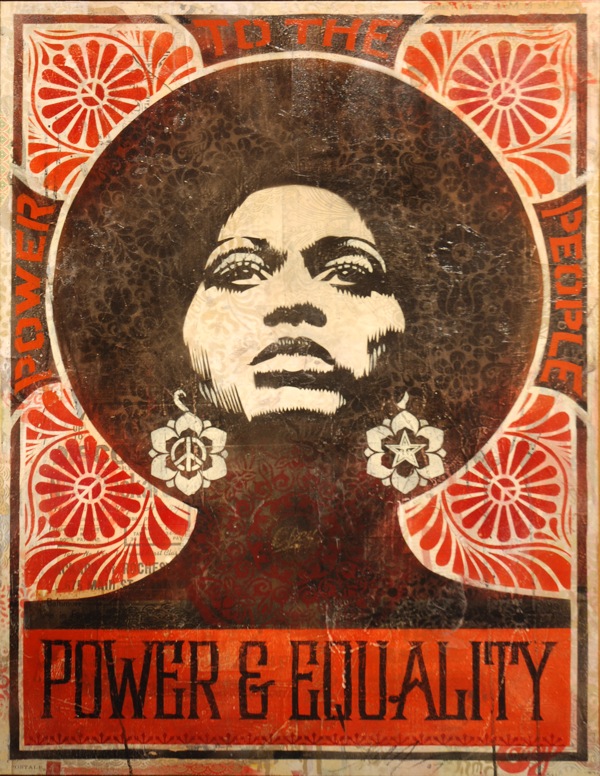
That’s got to be the best Angela Davis (edit: okay apparently this isn’t of Angela Davis, but it still looks amazing) I’ve seen from Shepard Fairey.

Swoon keeps getting better and better and better. Definitely my favorite living artist.
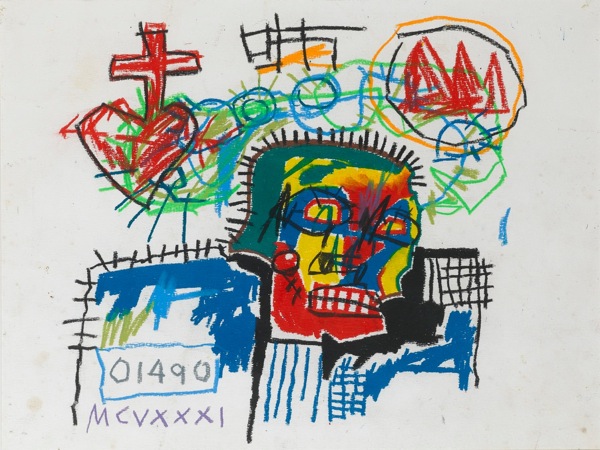
While it’s only a drawing, how often do you get a see a Basquiat in person? This is something special for sure.
Note from RJ: The following post by Alison Young was originally published on her blog, Images to Live By. We at Vandalog would like to thank Alison for kindly allowing us to republish it here, along with part II of the review (coming tomorrow).
I’m in New York City right now, and last night I attended a preview screening of Banksy’s film, Exit Through the Gift Shop. The film is being released in a number of US cities from April 16th and if you click here you can find a list of release dates, cities and theaters. (If you’re reading this in Britain, the film’s been out for a few weeks; if you’re reading this in Australia, be patient a little longer because the film will be released there in early June.)
Given the intense interest in Banksy as an artist and in the mystery of his identity, it’s inevitable that this film will attract a lot of attention. What’s as interesting as the movie itself is the range of responses that people are having to the film. Among those who’ve seen it so far, people speak positively of the film (as they should, since it’s a highly enjoyable documentary), but they also seem, first of all, surprised that it is more about Mr Brainwash (aka MBW aka Thierry Guetta) than it is about Banksy; and, second, disappointed that, because the film is more about Mr Brainwash, Banksy doesn’t reveal much of himself in the movie.
Let’s start with the first of those reactions, that the film’s not ‘about’ Banksy, which certainly raises the question of what the film is about. Well, the film operates on many different levels, and one of its main ones is the story of how street art took off, from being something with an intense local significance which was shared through the networks of the global street art community for the enjoyment of those who practice or appreciate street art, to became an entrenched part of the mainstream art world, whereby paintings (and artists) are commodified for profit.
To tell that story, the film focuses on Thierry Guetta’s transformation from amateur film-maker into artworld succes du jour, as a means of demonstrating both the possibilities open to anyone with the will to put up art and the (slightly frightening) logical consequences of those possibilities (for example, having people queueing for hours to get into your art show, simply because they’ve been told by the media that your art is important).
The film treads a clever and careful line between condoning and critiquing the commercialization of street art, as its embodied in Guetta’s transformation: it really is left up to the viewer to work out where you stand on the issue. In some ways, the film seems to be criticizing the people who have bought Mr Brainwash’s work for vast sums of money and who have contributed to his art world stardom, but, then again, isn’t this the same art world that has made stars of Shepard Fairey and Banksy and Blek le Rat? If we want to critique the art world, it must be a critique that can specify why Mr Brainwash’s stardom is problematic when that of the others is not.
So: how do we think through that problem? Is it because Mr Brainwash doesn’t make all of his art himself? Neither does Shepard Fairey nowadays, nor Banksy (both of whom have assistants – and we see some of Banksy’s assistants at work in the film), and neither does Jeff Koons, for that matter. Is it because Mr Brainwash’s work is derivative (his work repeats many of the devices used by Andy Warhol, Banksy, Fairey, Nick Walker, Blek…)? Well, that might be a better founded criticism, but it still requires us to think through its implications: each of those artists borrow from other artists and art movements, re-presenting certain tropes in order to create a new art idiom. Perhaps Mr Brainwash’s endless borrowing (what some would even call plagiarism) from the borrowers lacks aesthetic merit because it does nothing new – no new idiom emerges from his pillaging of pop culture and street art.
At any rate, I think these issues form the heart of what the film is about – and I’d back this up by referring you to the movie’s title. By calling his film ‘Exit Through the Gift Shop‘, Banksy is both having a sly dig at museum culture, which often cynically seeks to extract more money from visitors after they have viewed an exhibit, but he is also pointing out to us the direction that street art may be heading in, now that its commercialization is so advanced – the only ‘exit’ is to find a way through the endless consumption offered to us as a poor substitute for the art itself.
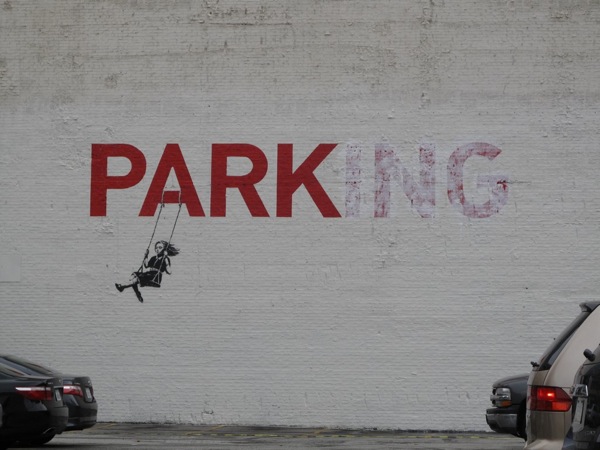
As predicted yesterday, Banksy wasn’t going to stop at painting one spot in LA. Here’s what appears to be LA Banksy #2. I wasn’t blown away by yesterday’s stencil, but I love this. It’s another one of Banksy’s artworks about kids playing despite interference from the adult world, a series he’s been working on for years (perhaps most notably with his recent No Ball Games print and street piece in London).
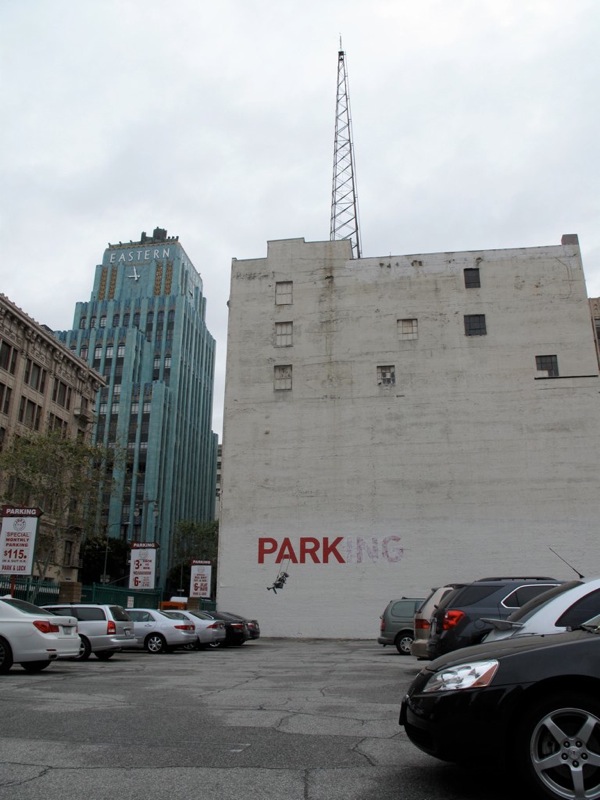
Photos by Sonja Teri (posterchildprints.com)
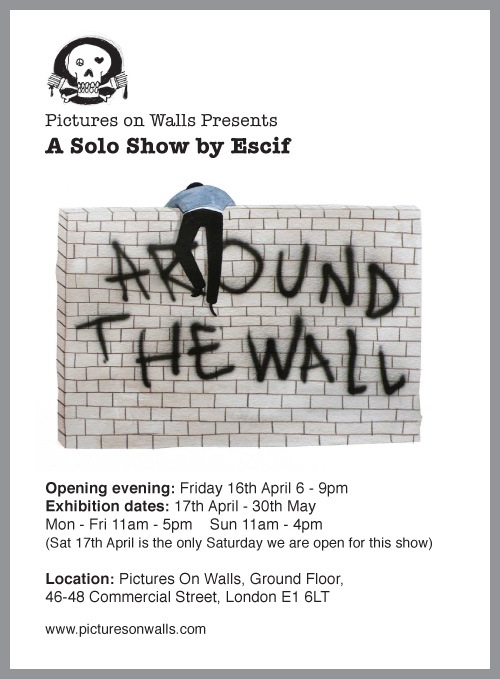
Two weeks ago I saw a painting by Banksy and jumped up and down with excitement. I think that I may once again jump up and down with excitement this Friday at the opening of Escif‘s first London solo show. Pictures on Walls is putting on Escif’s show, so you know it’s going to be something special. Last month, Elisa Carmichael wrote that this show would include a hundreds of small drawings. I’ve also heard a rumor that it will be more “conceptual” than people might expect from an artist mostly known for his painting and drawing skills.
Basically: Don’t miss this show. Last week was all about Roa, this week is all about Escif. But keep in mind, Friday is the opening night. Not London’s traditional Thursday. So don’t show up on Thursday. That won’t be as much fun as Friday.
Anyway, Escif has come Spain to London to work on the show as well as paint a few outdoor spots in the city. Here’s a mural that he painted over the weekend at Truman Brewery:
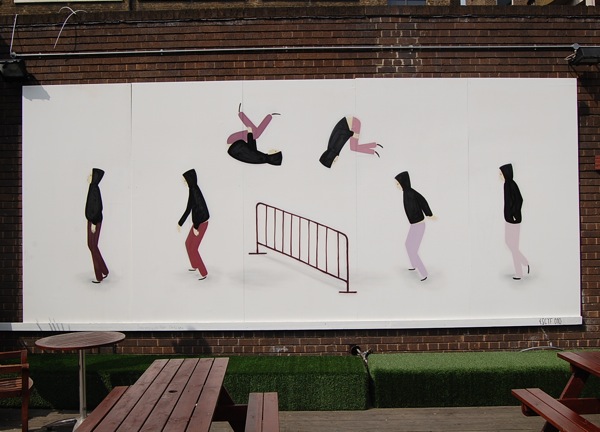
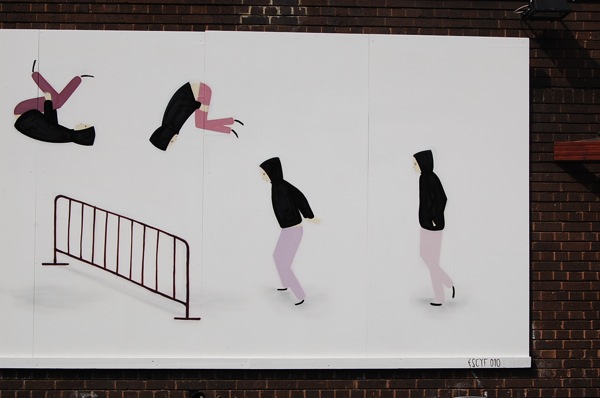
Photos courtesy of Pictures on Walls
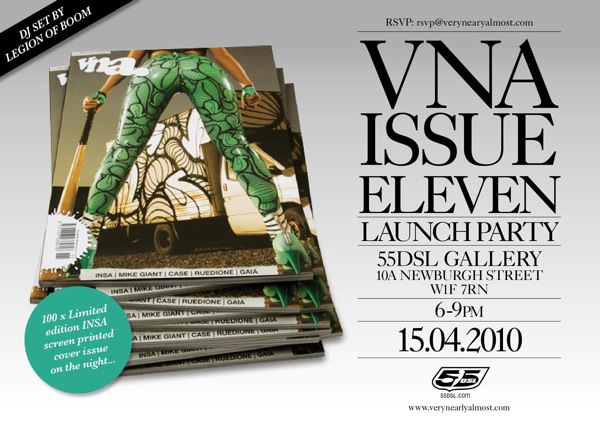
Very Nearly Almost‘s 11th issue hits shelves this month, and so next week they’ve got a launch party for the magazine. Should be good fun. This issue’s cover artist is the UK’s INSA, and other artists from around the world are featured inside. In fact, make sure to pick up this issue of magazine because it’s where you can read an interview that I did with Case earlier this year. Plus they’ve got the legendary Mike Giant, the super-cool photographer Ruedione and one of my personal favorite artists, Gaia. Hope to see you at the launch.
And speaking of Ruedione, Acclaim Magazine has just posted an interview that Ruedieone did with Revok just moments before Revok’s infamous arrest in Australia.

In case you hadn’t already heard, one of this years most spectacular urban art events is already under way this month in Berlin. The event entitled Art Monument will see four famous street artists repaint a 46 meters high tower called Bierpinsel which stands tall in the center of Berlin. It promises to be one of the most spectacular open-air galleries in all of Europe. The aim is to create the ultimate piece of contemporary art and judging from what has already gone down over there these guys are not far off . The artists involved are Honet, Flying Förtress, Craig KR Costello and Sozyone – who can all be heard in the video below talking about their concepts and plans to combine their different styles. Other street art names such as Nils Kasiske, Form 76, Keramik, Mr. Nonski, Dave Decat, Dave the Chimp, Poch and Stak will also be presenting their artworks inside the prominent buildings.
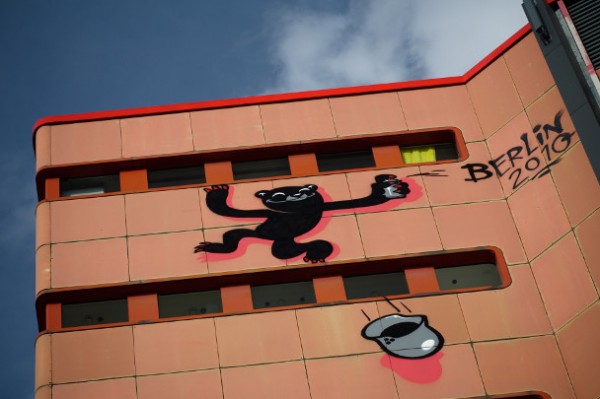
For more info and photos please visit Urban Artcore
Photos from Urban Art Core