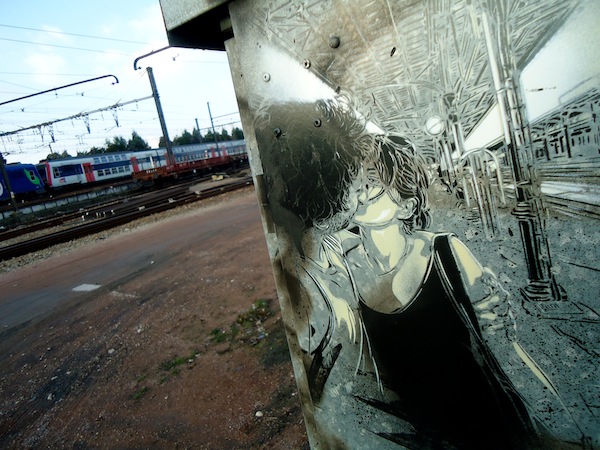
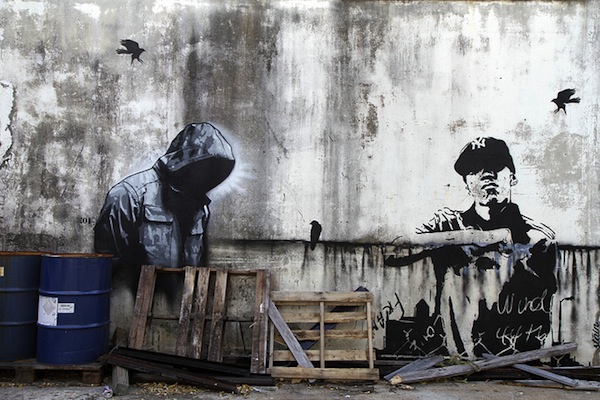
I’m not sure what exactly it is about this piece by C215: The image, the photograph, the placement, the technical abilities or a combination of all of those things, but for some reason this is my favorite new image from C215 in a while (and if this isn’t a new image, somebody please let me know. I don’t think I’ve seen it before though).
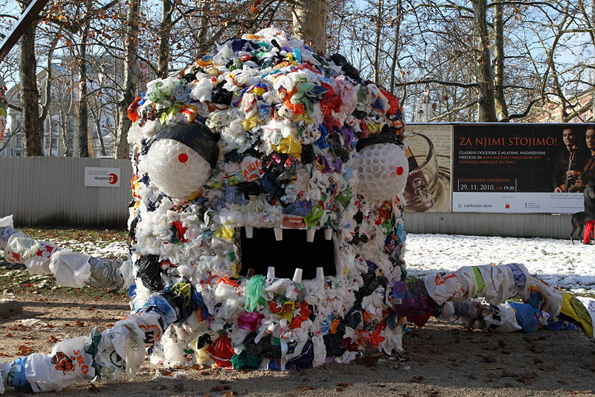
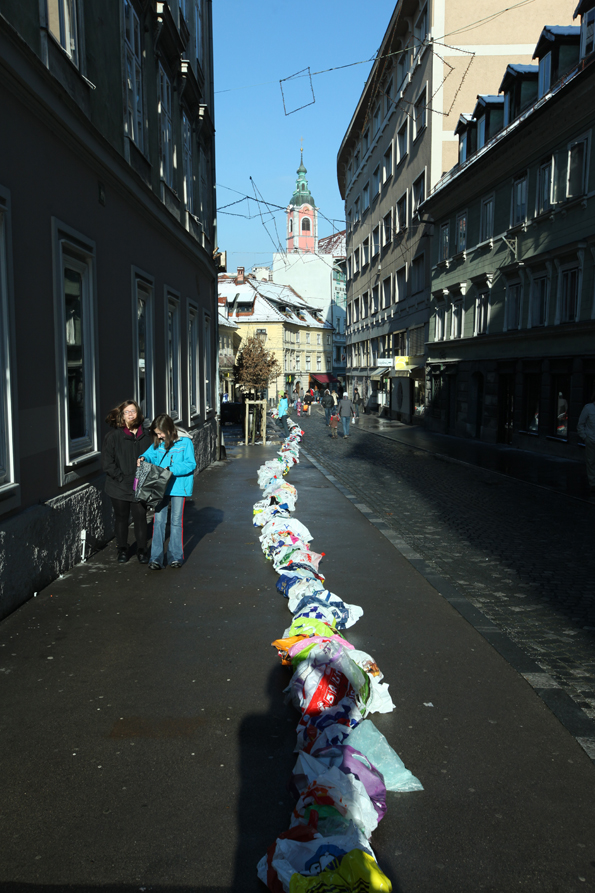
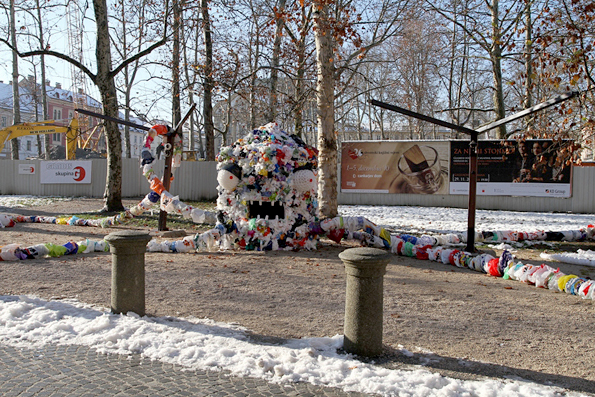
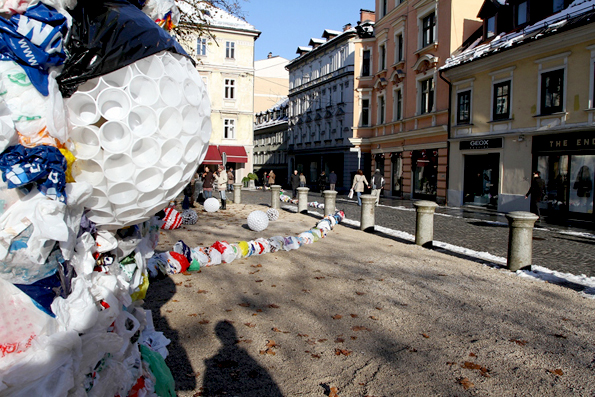
Together with Ekologi Brez Meja (ocistimo.si), Lukatarina and Eco Vitae we collected 40.000 used plastic bags and 7.500 used plastic cups from 12 kindergartens, 21 primary schools, 4 high schools and 3 faculties from the city of Ljubljana (Slovenia) and from more than 500 people from Ljubljana.
Plastic Bag Monster from Kongresni trg spreads its plastic tentacles through the streets of Ljubljana. It symbolizes the spreading of the consumerism and waste segregation. The monster itself has adjusted to the environment and therefore survived. It is supplanting us from the food chain. It just might succeed and it’s all up to us. It is reproducing with inconceivable speed and knows no mercy. It feeds on individuals’ sloth and irresponsibility.
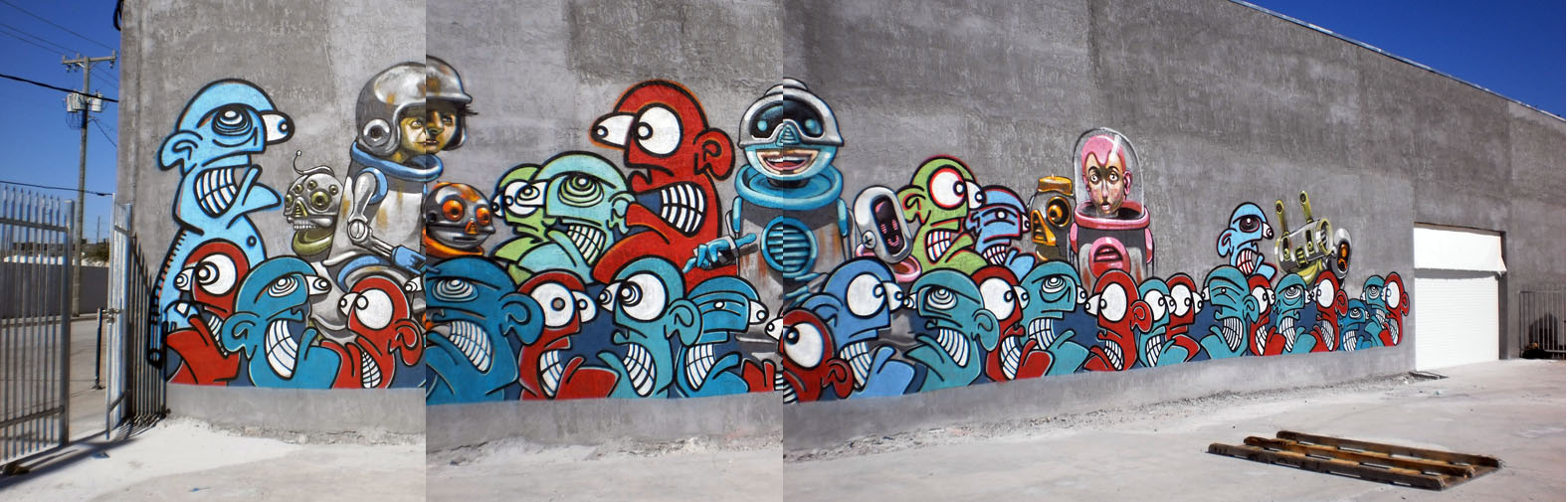
Galo and Pixelpancho in Miami (click to view large)
Well, I was expecting to see my family today, but snow in London have half of them stuck there. Luckily, snow where I am in Colorado is keeping me busy. Too busy to post very much unfortunately. Here’s what I’ve been missing:
Sometimes Mint and Serf (who work together as Mirf) do some interesting things. Other times that say crazy things. In an interview with Brooklyn Street Art, Mint said this “So back in April I designed the original Mirf poster and put a bunch of them in Russia. It was one of the first times I’ve seen graffiti being put up on the street but with wheat paste.” While he’s not taking credit for inventing wheatpasting for graffiti, he’s definitely taking too much credit for something that isn’t particularly innovative in 2010.
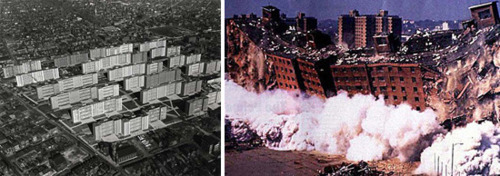
The most recent Rosler essay for E-Flux Journal #21 is a holistic portrait of the development of the modern city from its genesis with the Industrial Revolution to the complicity of the creative class in the process of urban succession. A must read for anyone interested in urban issues and the history of city space.
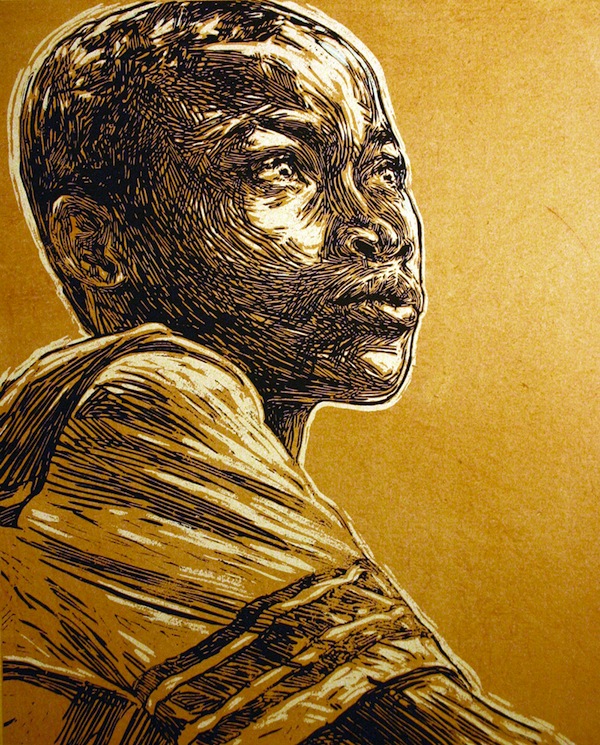
Swoon has a new print out this week at Upperplayground to raise money for The Konbit Shelter Project, the project where Swoon and some friends are constructing homes and other buildings in Haiti. The crew was in Haiti earlier this year, and that’s where Swoon met Walki, the boy who is the subject of this print. The Walki print is an edition of 300, measures 13″ by 21″ and is available only until January 1st for $125. 100% of the proceeds from the print sales will go to The Konbit Shelter Project.
The crew will be on their way back to Haiti next week to start building single family homes and the funds raised from this print will be used to fund the costs of constructing those homes.
Here’s the interior of the community center that the crew (made up of local workers as well as Swoon and her friends who flew in to help) made over the summer:
After today, I’m going to try to avoid posting or commenting about this whole Blu/Deitch/MOCA seriesofblunders until at least April because I think I’ve pretty much said I feel needs to be said. After having a number of discussions with some people I respect, some who agree and some who disagree with what I’ve said in the past about all this and who’s insights helped me to better strengthen and develop my own opinions, and with some new statements and facts coming out, it seemed worth writing a bit more about all this. Anyway, the actual post with my thoughts on all of this…
I think that those of us on different sides of this debate disagree less than some people realize. Mostly, we seem to see the responsibilities and rights of a museum differently.
What I’ve seen from all this are the difficulties of bringing street art into a museum context. It is important that art history and museums recognize the street art and graffiti movements, but it isn’t easy to do. A show of only work on canvas or screenprints or other “gallery art” clearly wouldn’t be a street art show, but the Tate Modern missed an opportunity by keeping things outdoors. So it seems that the solution would be a show that mixes outdoor projects with a gallery component, like MOCA is planning to do in April. Except that a museum cannot commission street art. They can commission public art by street artists, and there is a difference. Public art, such as that commissioned by MOCA, comes with certain responsibilities and considerations that do not exist in street art.
That’s why festivals like FAME, Primary Flight and Nuart are so important. Their focus is on bringing street art and graffiti to an area, and they don’t have the same considerations of museums. A lot of what goes up at FAME still goes up illegally and without anyone’s permission. While museum exhibitions are important for securing street art the place that many people believe it deserves in art history, those mural projects are of at least equal importance for actually bring new street art into the public space.
Blu says he was censored. I respect Blu for not bowing to the concerns of working in a museum context and not subjecting himself to “self-censorship,” but public art involves what Blu would term self-censorship. Until Blu’s statement, I had been under the impression, now obviously incorrect, that Blu might be returning to paint another mural for MOCA. That made me feel less upset about his wall getting buffed. Unfortunately, Blu will not be returning. It’s too bad, because as I’ve said before, a mural by him could have been a highlight of MOCA’s street art exhibition, but I respect Blu for sticking to his principles.
That doesn’t mean that Deitch was wrong to remove the mural though. It was a difficult decision well but within his rights as a curator and museum director. It is not the decision that I wish he had made and I highly doubt that Deitch took any joy in his decision either, but it may have been the right move for the exhibition and more importantly I can see why it would be the right move for the museum as a whole.
The (admittedly imperfect) analogy that I’ve come up with for this situation goes something like this: A curator at MoMA is putting on a show and wants to include a new painting by Murakami. Somehow through some crazy miscommunication with Murakami’s studio, a painting arrives that the curator hates or for whatever reason cannot be included in the exhibition. The curator screwed up. He should have communicated his thoughts more clearly to get something closer to what he wanted to include in the show. What does the curator do? He sends the painting back to Murakami and doesn’t include it in the show. That’s part of his job as curator.
Unfortunately at MOCA, that situation played out in public and in the artwork had to be destroyed instead of being sent back. MOCA removed a mural that they had not approved to have painted (they asked Blu to paint a mural, but mistakenly did not approve a specific design beforehand) in the first place. In that sense, I can certainly appreciate the argument that MOCA buffed a piece of street art, and that’s ironic and not desirable.
Probably the person who has expressed his balance of support for Deitch with disappointment in the destruction of the mural best is Shepard Fairey (and I’ve used some of his ideas in this post). Here’s some of what he said to The LA Times:
However, a museum is a different context with different concerns. It would be tragic for the break through of a street art /graffiti show at a respected institution like MOCA to be sabotaged by public outcry over perceived antagonism or insensitivity in Blu’s mural. Graffiti is enough of a contentious issue already. The situation is unfortunate but I understand MOCA’s decision. Sometimes I think it is better to take the high road and forfeit a battle but keep pushing to win the war. Street art or graffiti purists are welcome to pursue their art on the streets as they always have without censorship. I think that though MOCA wants to honor the cultural impact of the graffiti/street art movement, it only exists in its purist form in the streets from which it arose.
No matter how hard they try or how much some people wish this were not true, institutions are not the streets. Once upon a time, Banksy put this very well on the side of the National Theatre in London:
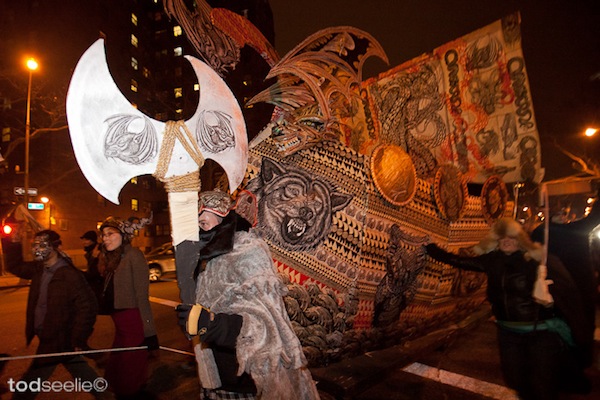
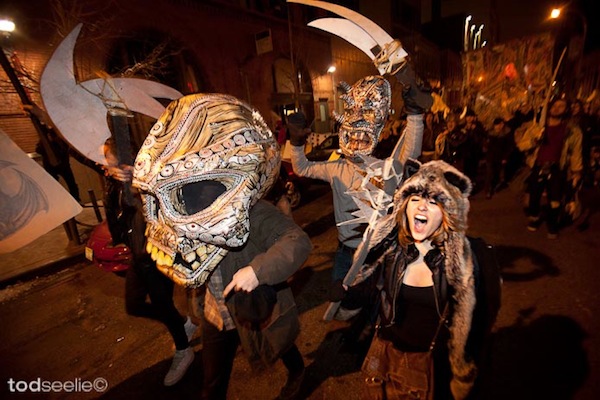
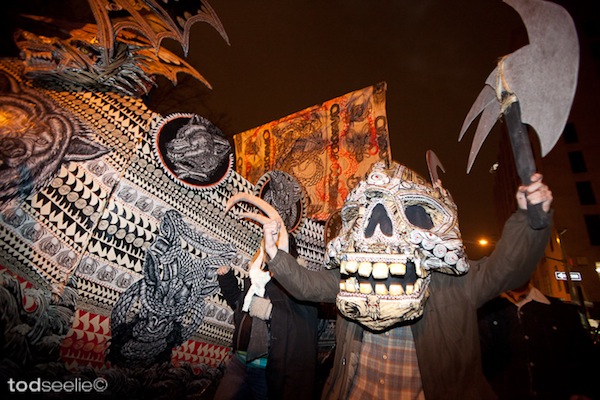
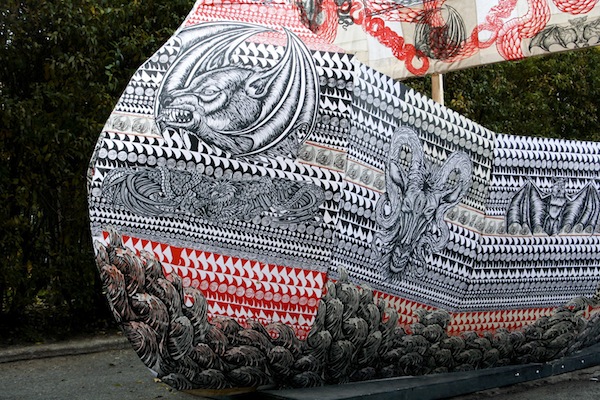
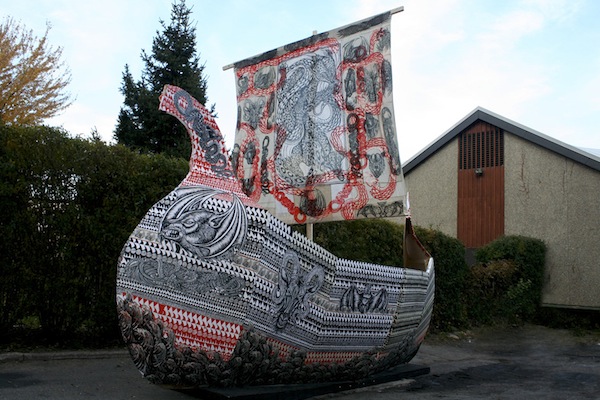
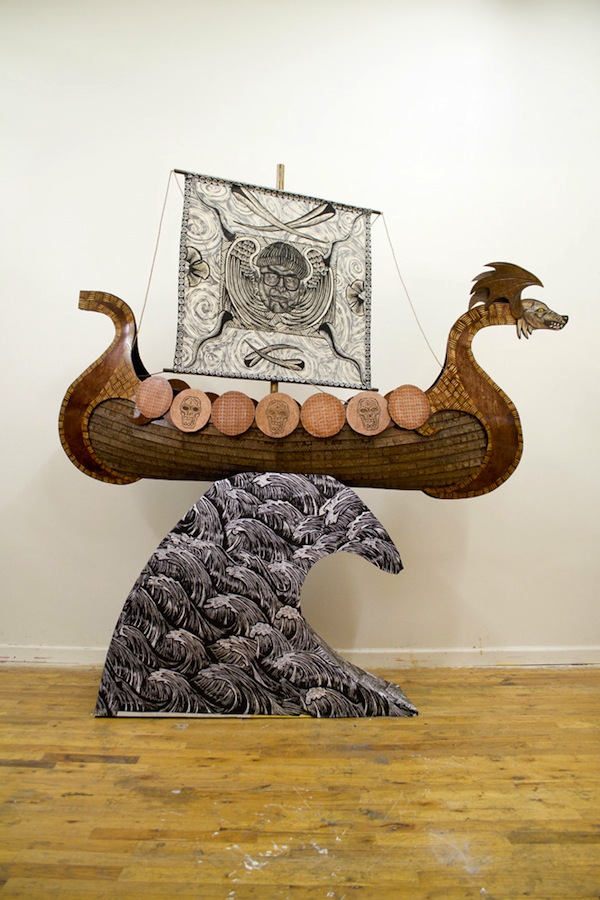
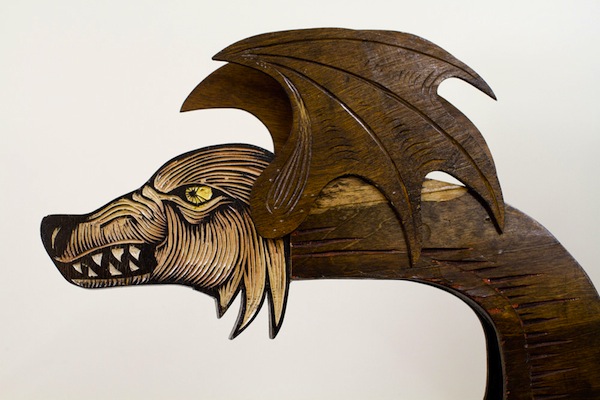
New Yorkers, there is one place to be this Thursday night: Out with Dennis McNett making sure the rest of the city is alive. Dennis has a solo show opening at Joshua Liner Gallery, and that show will open with a parade through Chelsea with one of Dennis’ 26-foot long viking ships (shown above and below). The Passing of The Wolfbats promises to be quite the event. It’s described as a parade “to wake up the city’s sleeping spirits of creativity, expression, and personal soulfulness.” There will be costumed participants, McNett’s wolfbats, drummers and other musicians, dancers and of course, members of the public who want to join in the festivities. The parade will be taking place in West Chelsea this Thursday evening.
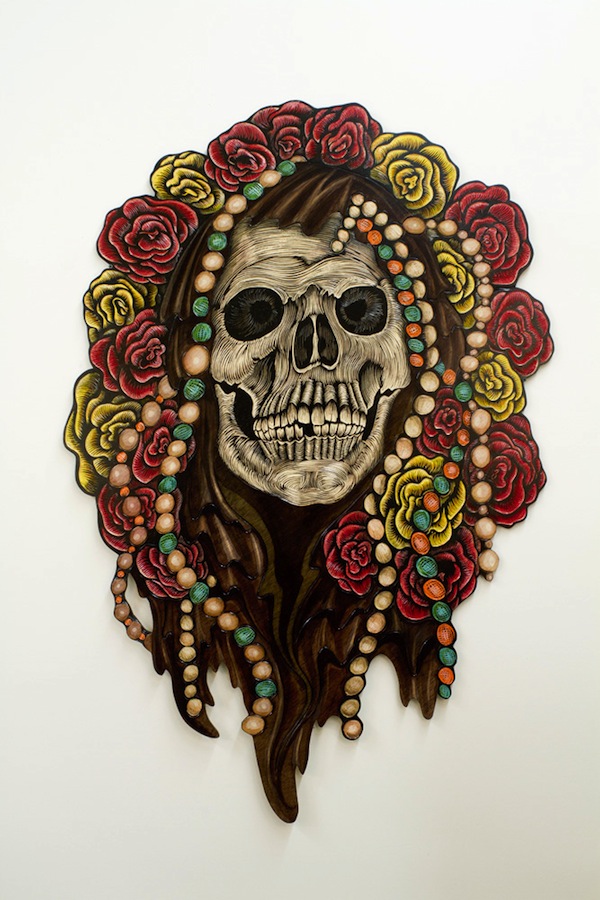
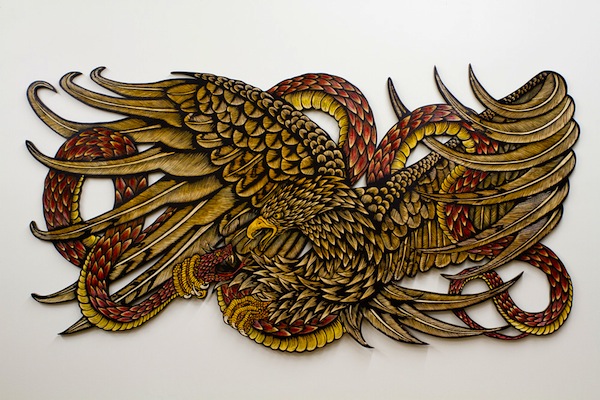
In addition to the parade, McNett also has a show inside at Joshua Liner Gallery opening on Thursday and I’m loving what I’ve seen from it so far. I think it is hard to dispute McNett’s technical brilliance in many things, and he’s developed a powerful and interesting iconography that he continues to develop.
Here’s a preview of the show:
I think that this show, particularly on Thursday in conjunction with the parade and the energy that should bring, has the potentially to be something very powerful. Until today, I was planning to take a bus to NYC on Thursday and another back to Philadelphia that night just to see it, but unfortunately school work has gotten in my way. Expect more photos on Vandalog next week after this has opened.
Joe Iurato and Chris Stain. Photo by Becki_FullerRemed (in progress). Photo by Luna ParkMr. Jago, Ron English and Tristan Eaton. Photo by Jeremiah GarciaEugene Good and Tina and Jim Darling
I’m about to get my virtual ass kicked with this post. This might get more negative comments than anything I’ve ever written before. I know that. Any yet, here I am.
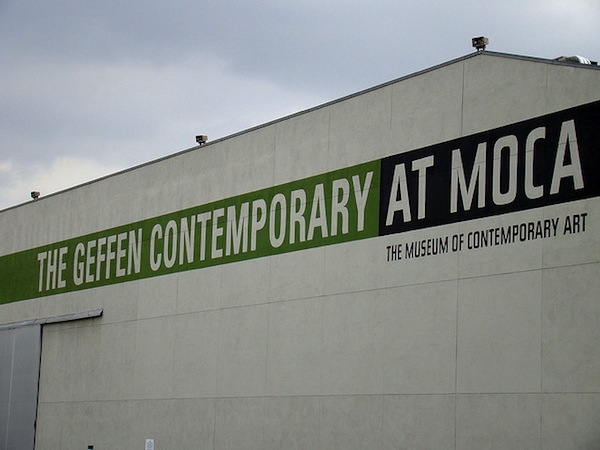
On Thursday, word hit the internet that Blu had painted a mural on The Geffen Contemporary at MOCA in LA but that it had been whitewashed. On Saturday, Vandalog was the first site to publish any official comments from MOCA. And late on Monday, The LA Times has finally published some substantive comments from museum director Jeffrey Deitch about the whole series of events.
Here’s a selection from the article:
Reached by phone while traveling, MOCA director Jeffrey Deitch confirmed that he made the decision because the mural was “insensitive” to the community.
“This is 100% about my effort to be a good, responsible, respectful neighbor in this historic community,” Deitch said. “Out of respect for someone who is suffering from lung cancer, you don’t sit in front of them and start chain smoking.
“Look at my gallery website — I have supported protest art more than just about any other mainstream gallery in the country,” he added. “But as a steward of a public institution, I have to balance a different set of priorities — standing up for artists and also considering the sensitivities of the community.”
He rejects the talk of censorship. “This doesn’t compare to David Wojnarowicz. This shouldn’t be blown up into something larger than it is,” he says, describing a curator’s prerogative to pick and choose what goes into a show. “Every aspect of the show involves a very considered discussion.”
The unfortunate thing, he acknowledges, was the timing, as the artist began the mural while Deitch was out of town earlier this month for the art fair in Miami. “Blu was supposed to fly out the second-to-last week in November, so we could have conversations about it in advance,” Deitch said. “But he said he had to change his flights, so he ended up working in isolation without any input.”
When he returned from Miami and saw the mural, then more than halfway completed, Deitch said he made the decision to remove it very quickly, unprompted by complaints. “There were zero complaints, because I took care of it right away.” He asked Blu to finish the work so it could be documented as part of the exhibition and appear in the accompanying catalog.
I’ve got to stand by Deitch 100% on this. Besides the very legitimate reasons he mentions for removing the mural, his appointment to MOCA was a very controversial one. We don’t live in a perfect world, and this was a pragmatic move which takes into consideration the larger concerns of MOCA and the LA community. Yes, this whole thing was a poorly managed series of unfortunate events resulting in a great artist’s work being destroyed (after, what I assume was extensive documentation which is how the vast majority of street art and probably art in general is viewed these days), but Deitch made the right move for the wider museum. Things shouldn’t have gotten out of hand, and they did, but Deitch has acknowledged that. Look at the situation from Deitch’s perspective when he showed up in LA to a half-finished mural that he knew would not work.
Deitch made a curatorial, respectful (of the LA community) and politically pragmatic decision to remove a work from an exhibition that he had not approved for inclusion in the show. If he had seen a sketch beforehand (as he should have), let the wall get painted and then removed it, this would be a very different discussion. Although some have suggested that this signals disaster ahead for his upcoming street art exhibition in April, I am not so sure. Sebastian at Unurth and I have a friendly bet going based on the average of reviews of MOCA’s street art show in the LA Times, Unurth and Vandalog: If the reviews are positive, he buys drinks next time we see each other and if the reviews are negative, I have to buy the drinks. So we’ll see how that turns out in a couple of months.