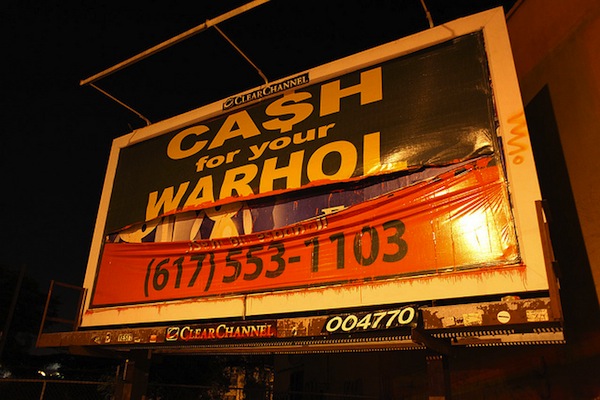
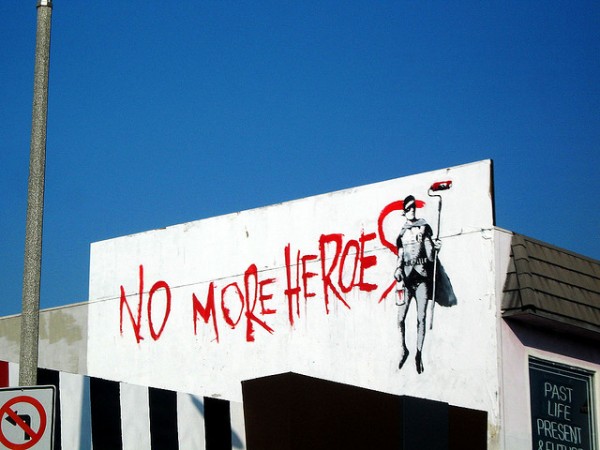
PosterBoy recently posted this photo on his flickr. It’s described as a “collaboration” with Hargo, who does the Cash For Your Warhol billboards and signs. Besides reminding me of Specter‘s sidebusts, it brings up some interesting questions. Like a lot of work that critiques advertising and a capitalist art world, Cash For Your Warhol’s work seems to have become, to a small community, an advertisement for the art as much as a critique of the art world. While I like what Hargo does, I think there’s also a lot of value in PosterBoy modifying the billboard. Jordan Seiler, someone I consider an authority on this subject, has said that the best advertising takeovers are those where there are no identifying features to turn the disruption into an ad of its own, and Hargo’s work certainly doesn’t fallow those rules. Nonetheless, the vast majority of art-fair visitors who say the above billboard outside of Scope this year in Miami would have had no idea about Hargo and not seen the work as advertising.
And of course, I could be misinterpreting this and PosterBoy could essentially be agreeing with Hargo’s sentiment about the absurdity of the art market by ripping apart the billboard as if it were a real ad promoting a sort of Warhol pawn shop.
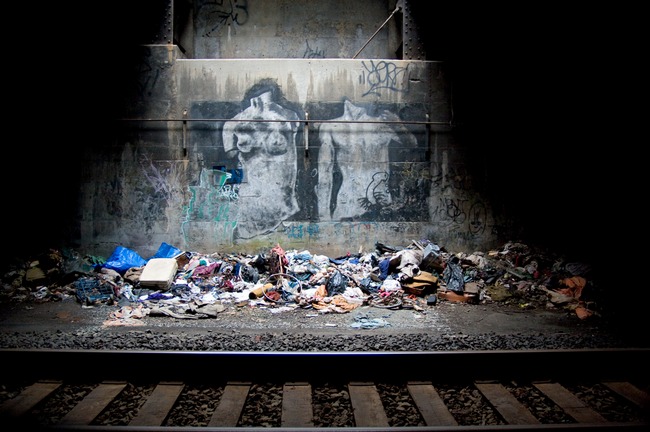
UNDERCITY is a really interesting and daring documentary by Andrew Wonder, in which he follows urban historian Steve Duncan in to the belly of the New York Underground system.From the tops of bridges to the depths of sewer tunnels, Steve’s explorations of the subterranean environment are said to help him “puzzle together the interconnected, multi-dimensional history and complexity of the great metropolises of the world.”. You really have to admire Steve’s love and appreciation for the city’s lost urban infrastructure and the dangerous lengths of which he goes to in order to be one of the very few to experience it. On the other hand I do kinda think he’s a little insane, but I think that probably helps when your hobby is an extremely illegal one! A very insightful and eye opening watch!
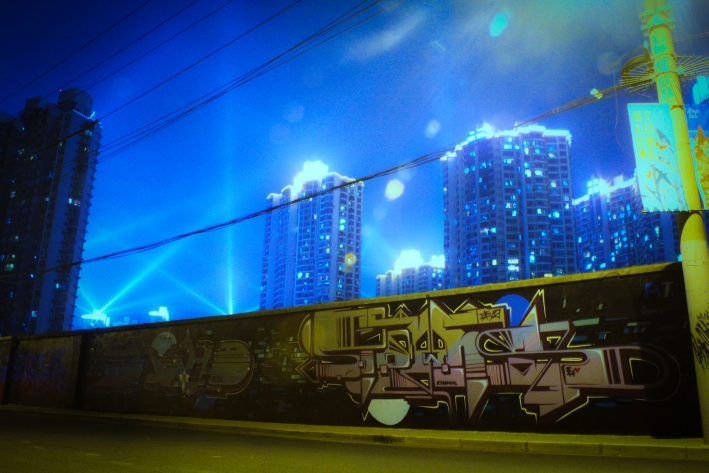
Check out this nice little video featuring London’s very own graffiti natives Towns & Roid, who recently took a trip to the far East for a graff vacation. They delivered a hand full of European delights in both Shanghai and Ningbo. (Seen below)
Head over to Plastic Bones for a nice set of flicks accompanying the visit!
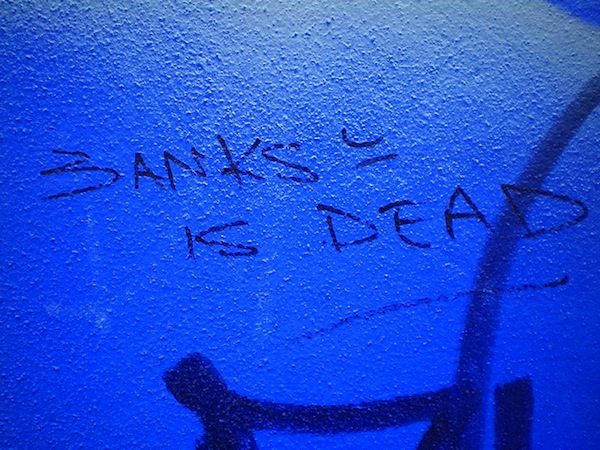
Can Banksy die? I’ve got no doubt that the man who was writing the name Banksy on Bristol’s walls in the 1990’s can and will, at some point, die. That’s not what I’m wondering though. Keith Haring has been dead for more than 20 years, but you can still buy new products with his imagery. Similarly, Basquiat’s estate released prints after his death. But those artists had names and faces. Even after their deaths, products can still be made using their images, but there’s not going to be any new imagery. But Banksy (the brand, not the man) doesn’t have those same constraints. Disney didn’t die with Walt Disney. Is Banksy one man or many people?
While he is anonymous, Banksy is publicly portrayed as being one person. But what does that one person actually do these days when it comes to making art?
It’s ridiculously risky for Banksy to paint his own street art…
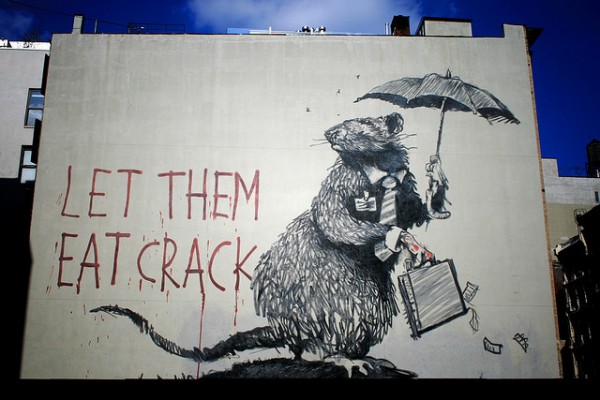
A Banksy billboard/artwork in NYC. Photo by caruba
Does Banksy paint his own street art? Shepard Fairey has said that he doesn’t (thanks to Mischa for the link to that article) and, in the latest issue of Very Nearly Almost, Eine says that he used to paint street pieces for Banksy. Given his high-profile status and the risks associated with painting outdoors, it probably makes legal sense for assistants to paint Banksy’s street pieces. If I were in Banksy’s position, I wouldn’t risk painting all of my own outdoor work. Even if Banksy does paint his own street pieces today and has always done so up until today, it would be difficult, if not impossible, to notice if that situation changed tomorrow.
There’s no way to know if Banksy paints his own gallery art…
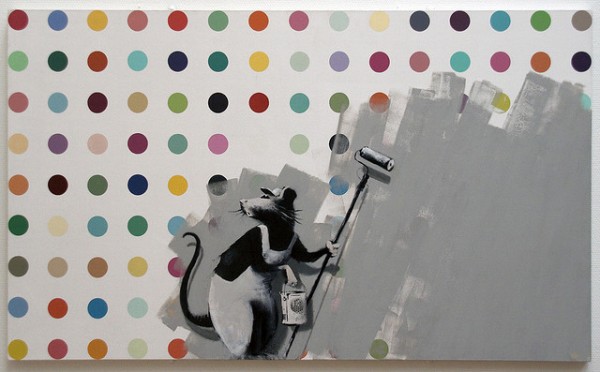
Collaboration between Damien Hirst and Banksy. Photo by ahisgett
What about his indoor work? Maybe Banksy still paints everything himself, but I’m doubtful of that. While hiring assistants might be more difficult for Banksy than Jeff Koons, it’s clear in Exit Through The Gift Shop that Banksy has a staff. At the very least, I think it’s safe to assume that Banksy isn’t executing the creation of any his sculptures himself (no matter what this video purports to show). And there’s little reason to think Banksy doesn’t have assistants completing part or all of his paintings. Banksy has said that he paints his own pictures, but how would anyone outside of his team know if he was telling the truth or not? Assistants who work on paintings for an artist are a widely accepted practice. As an extreme example, Damien Hirst has said that his best spot paintings were the ones painted entirely by Rachel Howard, his former assistant. Even if Banksy paints all his own pictures today, it will be difficult, if not impossible, to know if that practice changes in the future. Again though, some use of assistants for painting is probably what almost any artist in Banksy’s position would do.
There isn’t just one man who can come up with funny stencils…
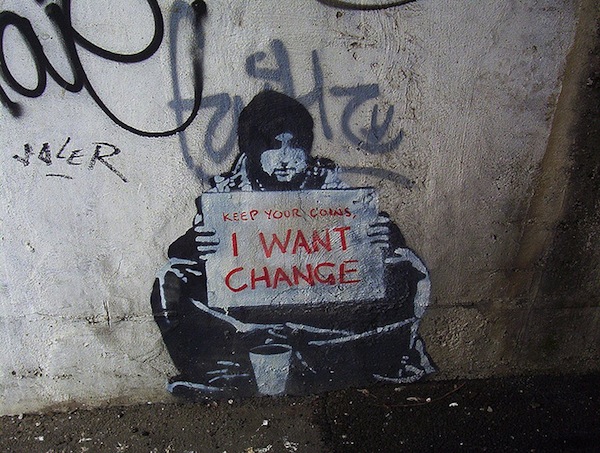
Stencil by Meek. Photo by Joshua Rappeneker
But regardless who who physically executes the artwork, conceptual artists have long contended that the artist is the one who comes up with the idea of the art, not the one who makes the art. By that standard, what makes a Banksy a Banksy is that he came up with the idea, but he isn’t the only one who could do that. Countless artists emulating Banksy, as well as generations of political cartoonists, have shown that coming up with clever 1-liners isn’t a skill possessed only by one man. Admittedly, I think most people find Banksy’s average success rate with his jokes to be higher than that of a lot the people he has inspired, but that is probably as much about being careful with what you put out there as it is about being clever. Maybe it’s true that no one person will ever be as good as Banksy at his brand of humor and commentary, but a dozen people working together probably could be. But I’ve already made an assumption here: Today, there is only one individual who comes up with all the ideas behind Banksy’s artwork. Again, we have no way of knowing how true that assumption is. Banksy’s cloak of anonymity means that the public really has no idea how many people contribute ideas to the Banksy identity. Today and in the future, the ideas behind Banksy’s art could come from one man or a team of 50 with no input from the original individual who called himself Banksy. How could we tell the difference?
Life after death…
Photo by Jake Dobkin
I’m inclined to think that Banksy, the man, is a hard working guy who does involve himself in the making of the artwork that he signs. But given all the possibilities for others to be involved in the Banksy brand without the public knowing a thing, it is clear that the Banksy brand can continue to create artwork indefinitely with or without the original man behind the name. Like the many boys who took on the role Batman’s sidekick Robin (oh, haha okay I came up with this metaphor days ago and only now as I write it down do I realize the irony given Banksy’s supposed identity. I’m an idiot), an anonymous artist’s name and image can be taken up by any number of people. If the man behind Banksy ever leaves the Banksy organization, or when he dies, will the public ever know? It’s possible that my grandchildren will be able to see “original” Banksy artwork completed a century from now. Banksy seems to have reached the absurd hyperbole of conceptual art: the original artist may not even need to conceive the artwork for it to bear his name. Banksy has finally achieved what Warhol and others set out to: the artist is truly a brand without a human identity.
This isn’t to say that Banksy’s death is impossible. It may happen one day. It seems only right that Banksy the brand dies with Banksy the man and it may very well end there, but it would definitely be possible for his team to continue the brand without the man. Then, the questions become would we notice, would we care and how would Banksy the brand change itself from the original intent of Banksy the man?
What do you think? Does Banksy’s death promise a new frontier for art? Have I completely misunderstood the brand/man that is Banksy? This is a post of questions I’ve been thinking about more than it is a post of answers and opinions, so I’m looking forward to reading other people’s thoughts in the comments.
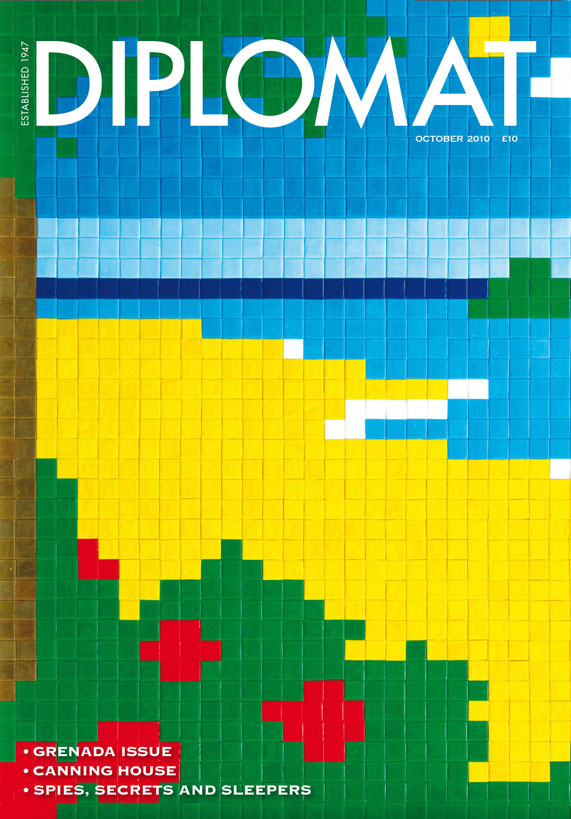
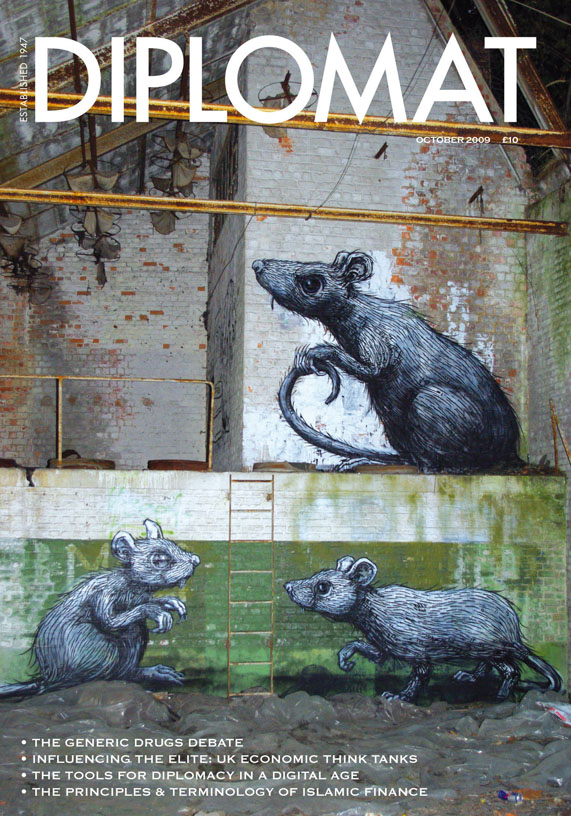
Sometimes street art end up in odd places. The cover of Diplomat, a magazine targeting the community of diplomats in London, probably qualifies as one of those most unlikely places. And yet, their creative director Jeannine Saba has been working to bring street artists to the diplomatic community. In October 2009, before hardly anyone knew about him, Roa was the first street artist to make a cover for Diplomat. And this October, Invader was on the cover.
I asked Jeannine about Roa’s cover and she said that Roa was asked “to depict the pharmaceutical industry in the East and the West.” Here’s what he came up with:
I don’t quite see it, but I’ll trust Roa on this one. I just love the idea of having that magazine sitting on some MP’s desk.
Diplomat has more street art and graffiti planned for covers in 2011 too, including possibly Isaac Cordal, which would be awesome.
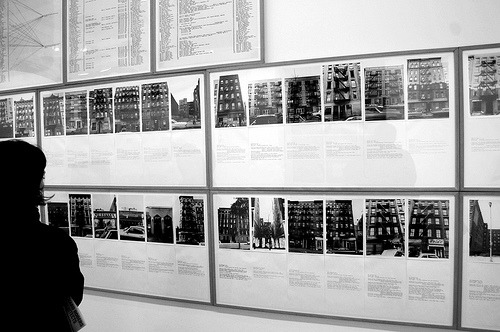
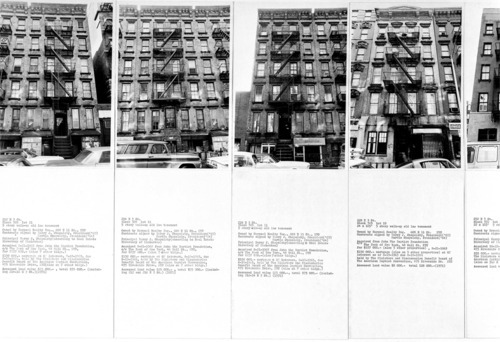
Considering a majority of Street Art exists in the shadow of neglect and finds its most receptive canvas on the facades owned by slum lords, I thought it would be pertinent to share this piece in particular. “Shapolsky et al., Manhattan Real Estate Holdings, a Real-Time Social System as of May 1,1971” was an exhibition of Hans Haacke’s work canceled six weeks prior to its opening by the Guggenheim Museum in New York because it exposed the questionable real estate speculations of a prominent board member Harry Shapolsky. Each property was detailed, photographed and mapped to expose the slum lord activities of this powerful broker. The Whitney literature on the show elaborates:
“Shapolsky et aI., Manhattan Real Estate Holdings, a Real Time Social System, as of May 1, 1971,” is the product of Haacke’s research into the real estate holdings of the Shapolsky family in Manhattan. Harry Shapolsky had attracted Haacke’s attention because he was the landlord who owned more slum properties than any other landowner in New York. Haacke’s research—all culled from public records—reveals how Shapolsky’s business worked, different properties being held under different company names. The series of 142 photographs of the facades of tenement buildings, accompanied by typewritten data sheets, added up to a biting indictment of the monopoly of one family of wealthy proprietors over the slums of a particular area. Due to be displayed in an exhibition at the Guggenheim Museum in New York entitled Hans Haacke: Systems, the work was deemed “inappropriate” by the museum’s management, and the Guggenheim decided to close down the exhibition. The curator, who defended the work, was fired. As a result of the ensuing furore, “Shapolsky et al.” became one of the most talked about works of the early 1970s.
Apologies for the meta-ness of this post. It’s kind of a blog post about blog posts, and not everyone likes that.
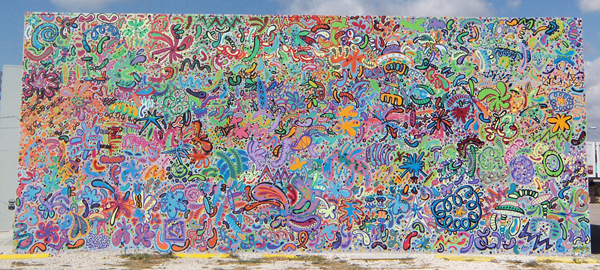
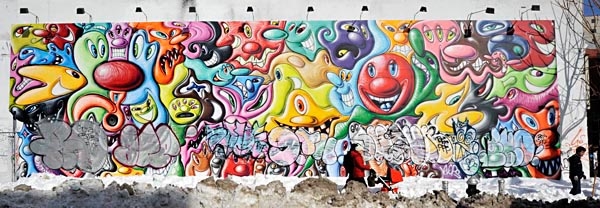
A little over a month ago, Kenny Scharf painted a mural at the Houston and Bowery mural space in NYC. I’m usually pretty indifferent to Scharf’s work, but in this instance, painting that spot was a homecoming. Kenny, LAII, Keith Haring and a few others painted a mural in the same spot back in the early 1980’s. About a week ago, the mural was dissed, as shown in the above photo. I’d say that’s pretty much the reality of painting outdoors. It sucks, but it’s life. What I’ve found more interesting has been the reaction to all of this…
Over at Animal, Bucky is insulting and provoking people because that’s pretty much all he’s good for. He might’ve even had some good points to make, but it’s hard to get past him acting like a dick.
The Hole‘s Kathy Grayson (The Hole is the gallery that is currently “curating” the murals on that wall) snapped this photo of the mural having been fixed up by someone. She also said “graffiti does mean no rules and pissing people off, but this was pee the wrong spot. makes them look bad. and lame.” So, yeah… Not quite sure what to make of that comment.