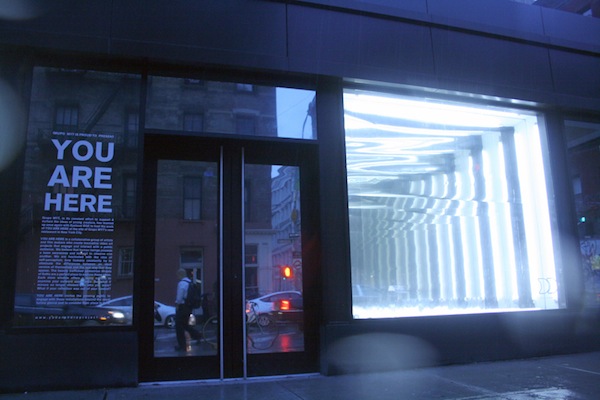
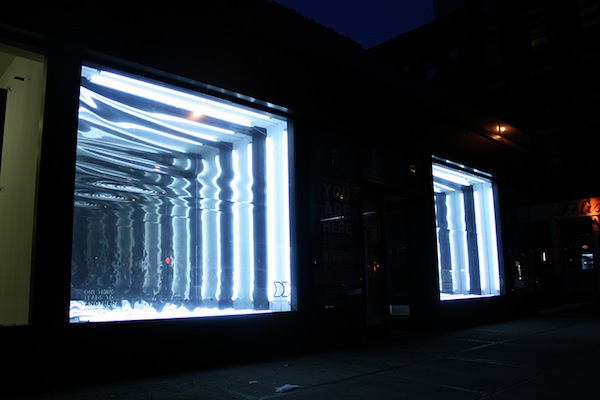
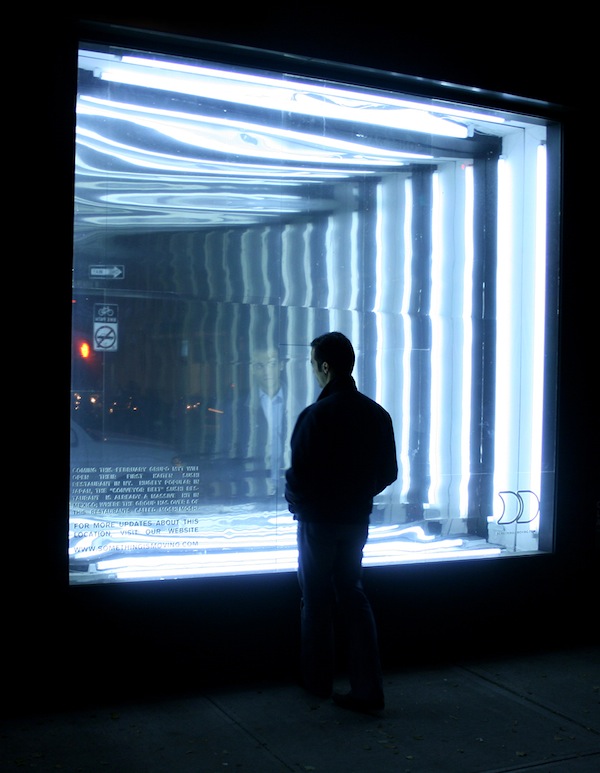
Inspired by Gaia’s recent seriesofposts, I thought I’d point out some more traditional contemporary artists are using the ideas of street art today. You Are Here is a collaborative group of artists who recently put this installation in the windows of an empty store in New York City. Although the work might be stronger without any signage, I imagine it’s still an interesting sight for anyone who walks by. According to the artists, “During the day, the windows just look like mirrors, but at night the fluorescent lights and 2 way mirrors create the illusion of deep light-filled hallways.” If you want to check it out in person, go to West Broadway and Grand Street in NYC.
Chicken Milk (the street artist with the weirdest name since the Neckface, Armsrock, Elbow-toe saga) is an artist that I haven’t covered before on Vandalog, but probably should have. From the simple to the complex, Chicken Milk has been doing some interesting (but sometimes NSFW) and controversial art in California. Keep an eye on this guy.
Dave the Chimp takes a little look at “the buff”, it’s uses and misuses, and where it can head in the future.
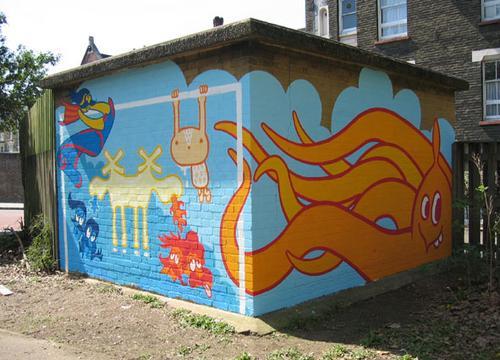
I used to live by a small park. Kids walked through the park to take a short cut to school. Drug dealers worked the same route. There was a garage there covered in tags. I had the idea to paint the garage with some friends, covering the tags with a brightly coloured mural. The idea was to make the space a little brighter, a little less like a spot where drug dealers would hang out. I made a fake letter from my local government authority giving me permission to paint the garage, just in case anyone asked, and set to work. This is the result:
One of my neighbours saw me painting and later told me she thought I was doing “community service”, which in England is an alternative to a prison sentence!
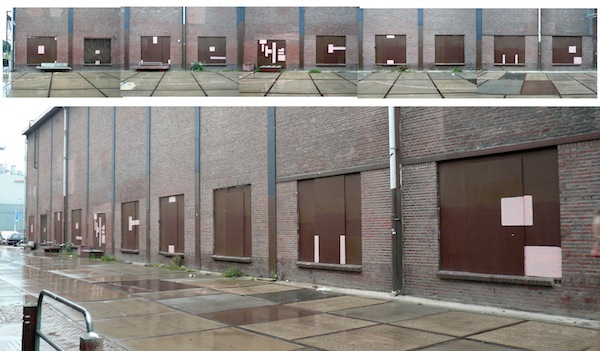
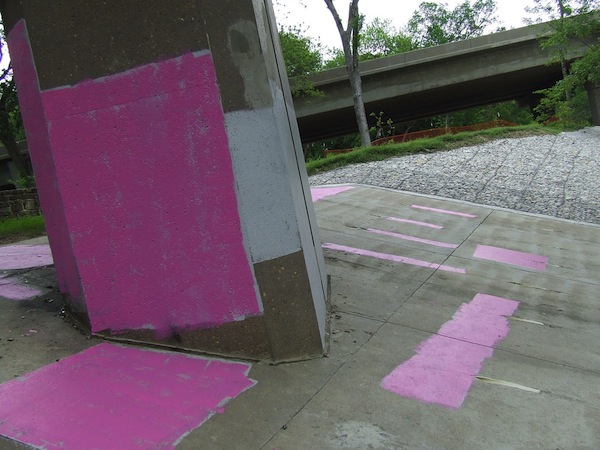
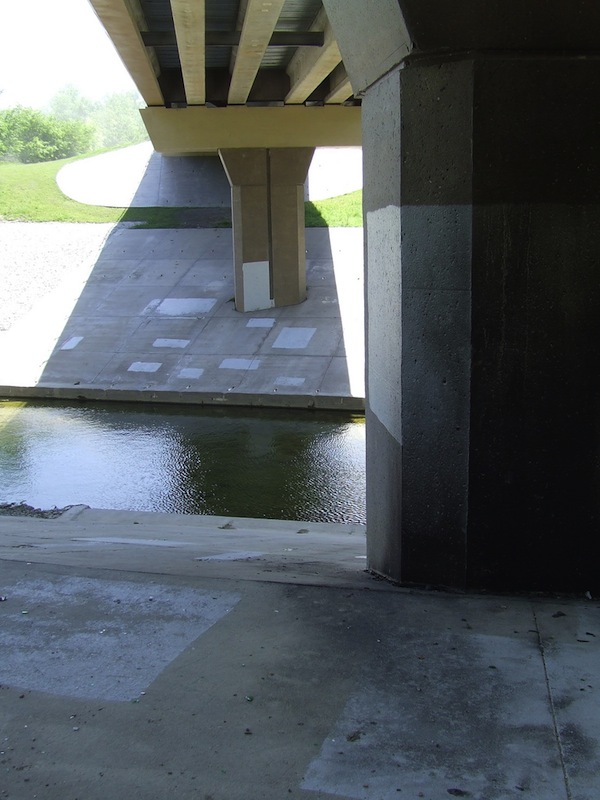
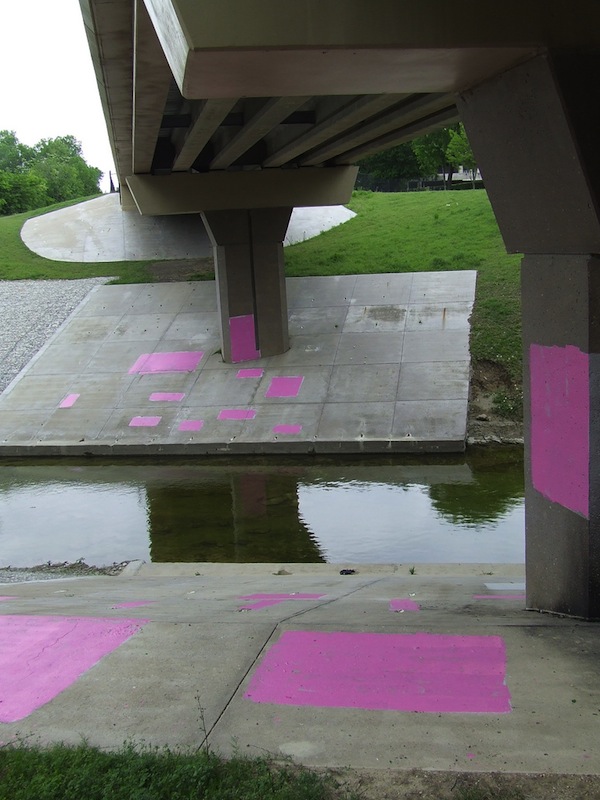
ESPO made his own “community service” projects as a way to get his name up, starting with his “Exterior Surface Painting Outreach” program in New York (those infamous shutters), and later with his “Community Service” project in LA, where he buffed graffiti in the way we are all familiar with today (blocks of colour) so that the buff-marks spelt his name.
What I like about this latter project is that it uses the anti-graffiti weapon as the weapon, like a martial artist using their enemies’ strength against them. It also sits nicely with the way graffiti is abstracted so that it becomes a code that can only be read by certain members of society. And it’s incredibly amusing.
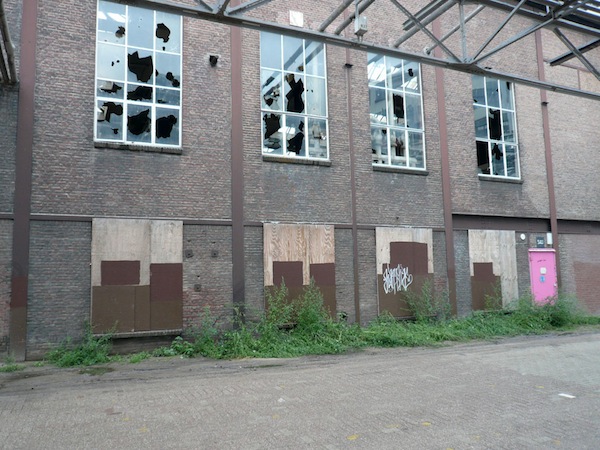
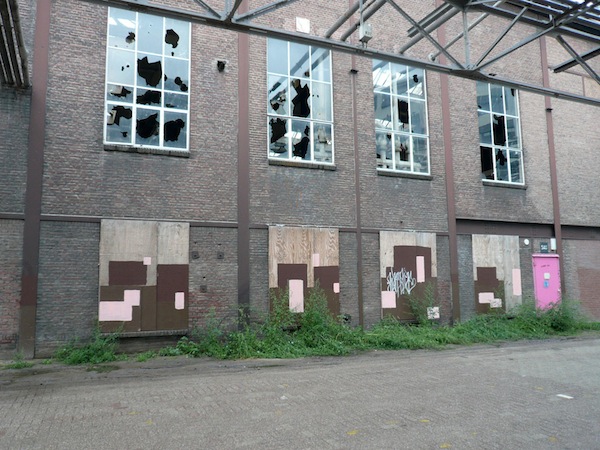
Here are some photos of some abstract compositions I made earlier this year by adding my own buff marks to a wall that had been buffed, and other buff marks that I added to spell my name, much like ESPO did, though I created huge letters by only painting the negative spaces in the letters. I didn’t think much about this piece. I had a bucket of paint that was left over from another project I was working on at the time, and I just walked outside to see how I could use it, and this was the result. I’m sure with more thought better pieces could be created with this method. Feel free to take this idea further.
Another body of work utilising the buff was the Toasters‘ Bluff Buff, which inserted the shape of their toaster into areas of buff, as a comment on the inaccurate colours used to cover graffiti: here and here.
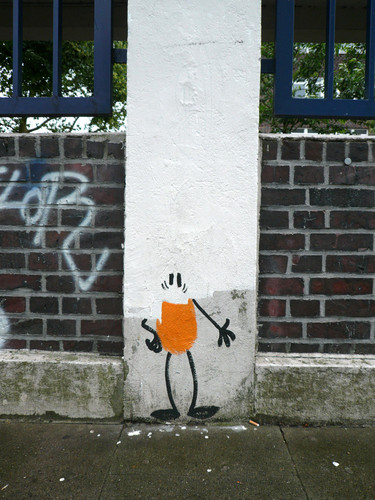
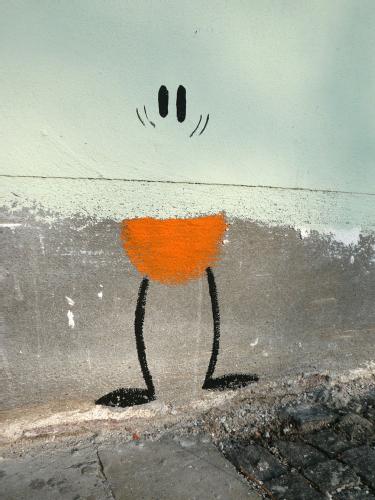
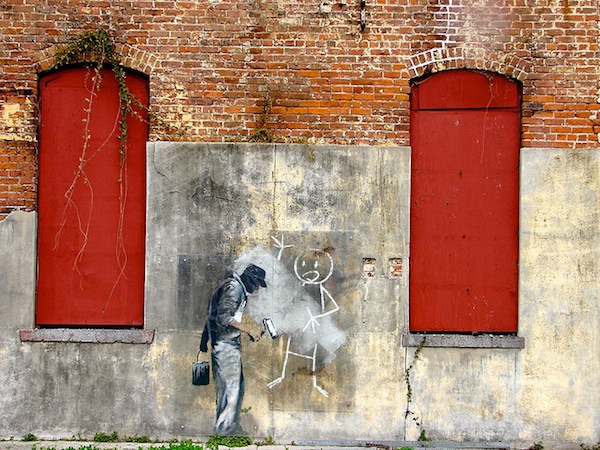
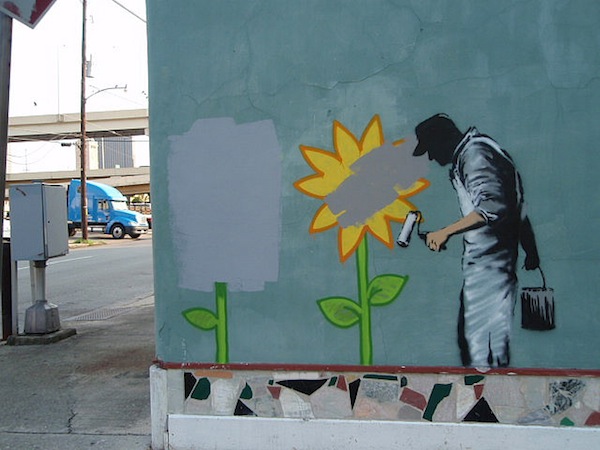
I painted characters so they looked as though they were behind areas of buff in Berlin and Hamburg, and turned the actions of the buffer into comedy:
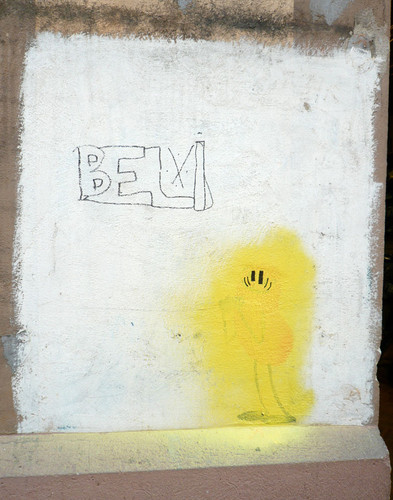
And in this case, the original piece was buffed for real, so I pulled out a marker and turned the buff into fog:
Earlier this week we saw a piece by Mobstr which became a game, with his opponent being the buff man. Comments posted suggested further ways to play the game.
Banksy took a shot at New Orleans famous buffer Fred Radtke AKA The Grey Ghost when he visited the city:
He is featured in an upcoming documentary, along with other buffers such as the “Silver Buff” from Berkeley, California, who believes there is too much “visual noise” on the streets. Watch the trailer here. Something I found interesting is that one buffer in the movie talks about how buffing makes him feel “in control” of life. This suggest that the actions of graffiti and street artists can make people feel like they have no control, making them victims. This is something to consider next time you hit the streets.
Photographer Chris Brennan documents the layers of colour haphazardly applied to the city walls to cover up layers of colour that were made with more thought. His photos often look like the work of abstract artists. One of the photos we see at that link puts me in mind of the work of Mark Rothko, though I doubt the buff in the street can ever be as effecting as being in a room with one of his huge, deep paintings.
Another weapon in the buffers armoury is the pressure washer, that cleans off graffiti. It can also be used to clean dirt off of walls, a fact ZEVS put to great use. Other versions of “clean graffiti” can be seen here. I’m sure we’ve all seen advertisers use this technique too, usually to place logos on city sidewalks.
It’s not unusual to see advertisers use street art techniques, just as it’s not unusual to see street artists fight back against advertising.
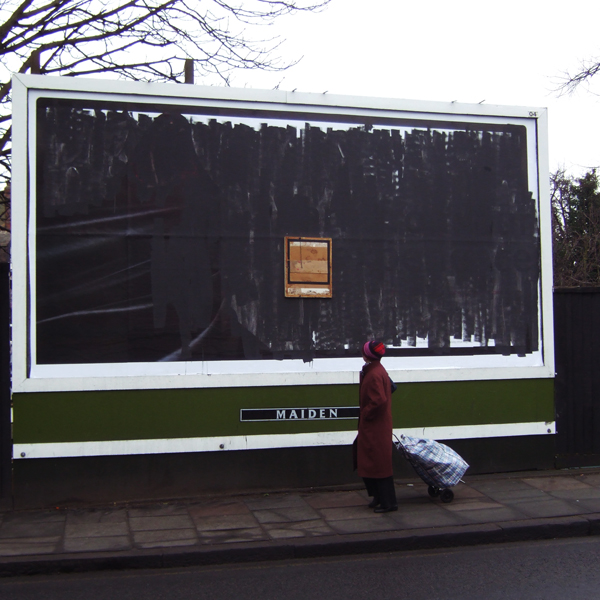
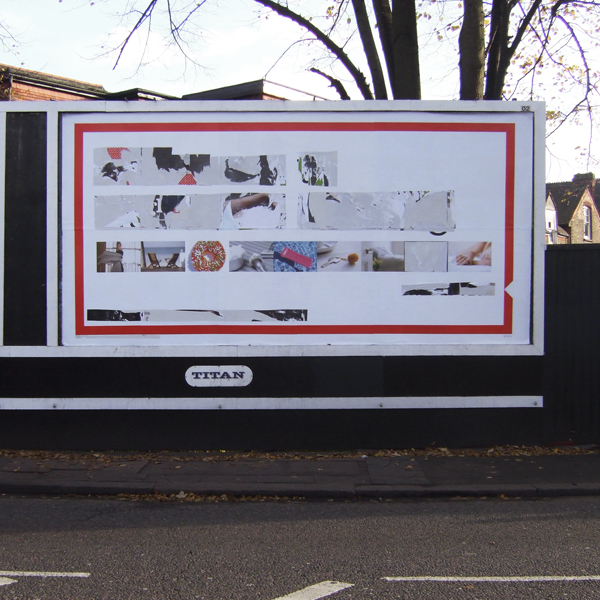
I like these pieces by the Thought Police member Eric Pentle, who will happily cut out your carefully constructed copy, or simply paint your whole billboard black. Unlike other artists, such as OX, that use advertising space as their canvas, there appears to be no clever message in Pentle’s billboards. He simply removes their ability to be effective. He is reacting to the lack of control he has in a world full of messages constantly being shouted at him, and thus makes his environment quieter. This is much the same as the Silver Buff does with graffiti. I find this very interesting, as I live in a country where I understand little of the language, and so advertising has no effect on me. It creates a more peaceful daily experience to not be told what to do all the time. See Pentle defuse more advertising here.
As we can see, the buff is nothing to fear. In fact, let us embrace the buff, and see where we can take it. Let us use this negative energy and turn it into a positive force.
One of the advantages of the buff is that, with a little effort, you can get the materials for the job for free. Try ESPO’s technique and tell the city you want to cover the graffiti in your neighbourhood, and are willing to work for free if they give you paint. Failing that, many cities have “paint recycling depots” where unused paint is taken to be disposed of. My friend Ekta in Sweden gets most of his paint for free by going to his local recycling depot and simply asking for the paint. Also keep your eyes open to see where legitimate painting work is happening. Brushes and rollers are often thrown away as people don’t want to make the effort of cleaning them. Soak them in water and the paint soon comes off. Or if they use an oil-based paint and you don’t want to mess around with turps trying to clean them, just wrap them in a plastic bag, they’ll be good for a few more days. Free brushes and rollers! Sorted!
As buffing requires little skill, this fun activity is open to everyone. No need to spend hours cutting stencils, screen printing posters, or learning how to draw – just grab your roller and a bucket of paint and make your mark in the world. The streets are a playground for everyone! I would suggest though that you have an idea before leaving the house, otherwise your efforts will be as destructive and unattractive as The Grey Ghost and his friends.
So come on kids, lets get buffing! Maybe by employing the buff as one of our weapons, applying it liberally around town, we can confuse city authorities so much that they start employing artists to paint art over all of the ugly buff marks in our cities. They can pay us to do what they paid themselves to undo.
GroundedTV has a great series of photographs from a recent visit to Toronto. Sometimes it feels like certain cities (New York, London, San Fransisco…) have multiple people who are obsessively photographing and documenting the street art and graffiti while other cities with plenty of street art don’t get nearly that much attention. There’s some great art in these photos, but I hadn’t seen any of it before. Although maybe I just wasn’t looking for it. Either way, it says something about a flaw that seems apparent in much of the street art community. I was speaking to somebody at Haverford recently about street art in Atalanta. He told me that there is a significant street art scene there, but I’d only ever connected street art and Atlanta after the Living Walls Conference, which consisted mostly of artists from outside of Atlanta painting there.
If you live in a city or town that has a street art scene that isn’t getting much attention, let me know by email or by commenting on this post. I’d love to see some art from the many cities that I haven’t spent enough time learning about.
Ron English just finished a mural and sculpture garden sort of installation in Miami as part of Wynwood Walls. I’m not a huge fan of pop surrealism myself (although I really respect what Ron and other artists in that genre do), but damn those Ron English fans must be going crazy right now looking at this thing. It’s a mural that then extends off the walls and includes some of his camo-dear sculptures (which I love). Hi Fructose has more images.
Click to view large
And Shepard Fairey has finished his installation at Wynwood Kitchen & Bar, as mentioned the other day. The restaurant isn’t open yet, but it should be ready for Basel Miami week at the start of December.
The City of Miami has taken a giant step forward by recognizing the value of street art and officially designating the Wynwood Arts District as the “Wynwood Mural Museum”. Under the auspices of Primary Flight, artists will be descending en masse during Art Basel 2010 to paint an unprecedented number of walls.
I recently had the immense pleasure to speak at the Phillips Collection in DC on a panel with three figures who I have always looked up to since beginning a street practice, Chris Mendoza, David Ellis and Romon Kimin Yang. The conversation was opened and framed by curator Klaus Ottmann with a passage by Wittgenstein that I feel succinctly embodies what I have personally been striving to achieve within my own work: “Ethics and aesthetics are one.” In such light, good art, is the balance between ethics and aesthetics, between the depth and appearance.
Yet this post is not about that weekend, it is the presentation of two works by renowned multidisciplinary artists Alfredo Jaar. I have personally attended a lecture of his works and I can attest that not only is he erudite, and an exceptional public speaker, but his work is truly a successful marriage of ethics and aesthetics. So, following up on the last post regarding the Times Square projects, without further ado, here are the pieces in two parts Lights in the City (1999) and Why (2008), which I will present a little later
“Lights in the city, 1999
Mois De La Photo a Montreal
Montreal
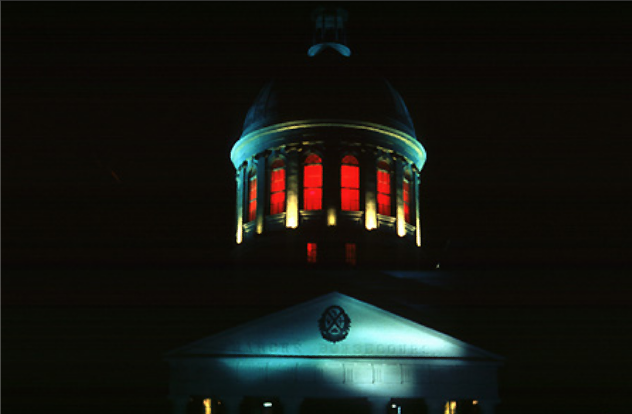
Approximately a hundred thousands watts of red lights have been installed in the Cupola of the Marché Bonsecours, a landmark monument in the old Montreal.
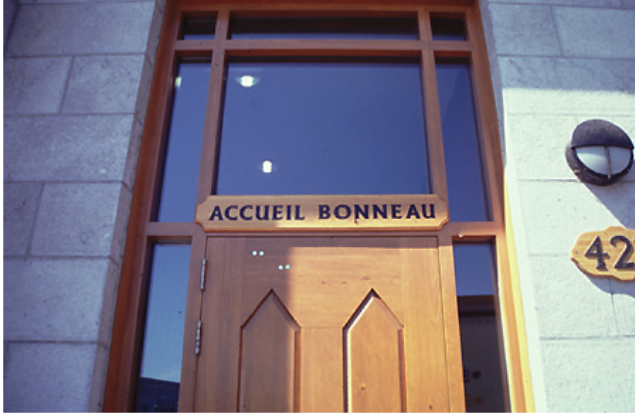
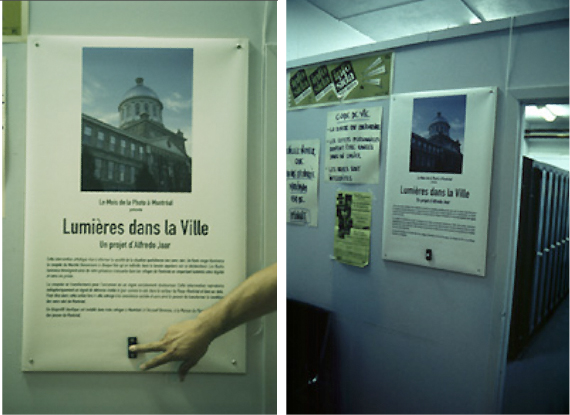
Detonating devices have been placed in the Accueil Bonneau, la Maison Eugénie Bernier and la Maison Paul Grégoire, homeless shelters located within 500 yards of the Cupola. Every time a homeless person enters any of these shelters, they are free to push the buttons and the red light will flash in the Cupola.
This project can be read in many ways:
First, a “photograph” is taken every time a human being asks for help (a light flashes as if a photograph is being taken). This “photograph” respects the privacy and dignity of the “homeless” person (there is no “material image”) while at the same time sends a sign (a red light) to society about his or her condition, a condition that is clearly unacceptable within the context of one of the richest cities in North America.
Second, the red light also can be read as a threat of fire, like all the successive fires that destroyed the Cupola of the Marché Bonsecours more than once during the course of its history. This sign of “fire”, which has meant tragedy for the Cupola, is now a sign of another tragedy, homelessness. And this time, tragedy (fire) is threatening not the Cupola, but society itself.
A last utopian thought:
Eventually all the shelters for homeless people in Montreal could be wired and connected to the Cupola. This way, a major landmark and historical monument in the city would be acting as a non-stop lighthouse, producing endless, painful distress signals to society.
With enough media coverage and public outrage and support triggered by these ongoing distress signals, homelessness could be completely eradicated from Montreal.”
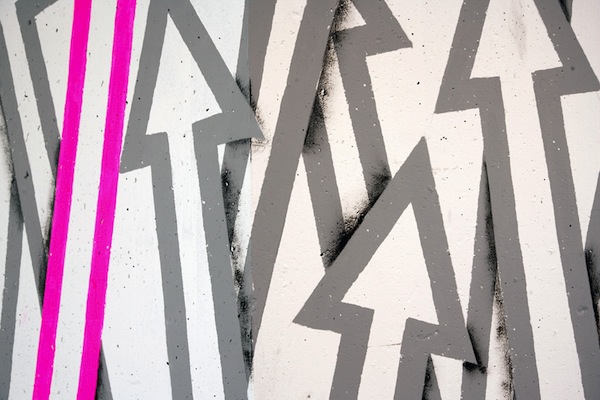
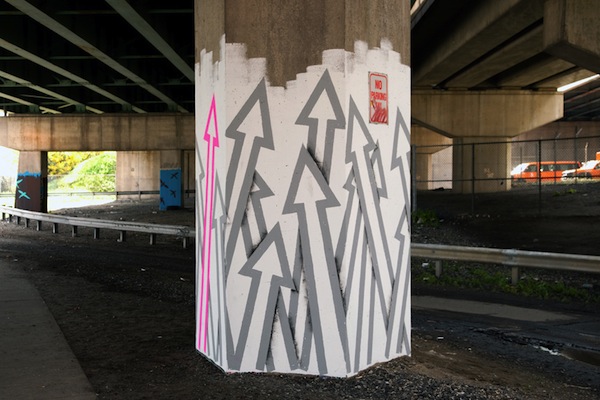
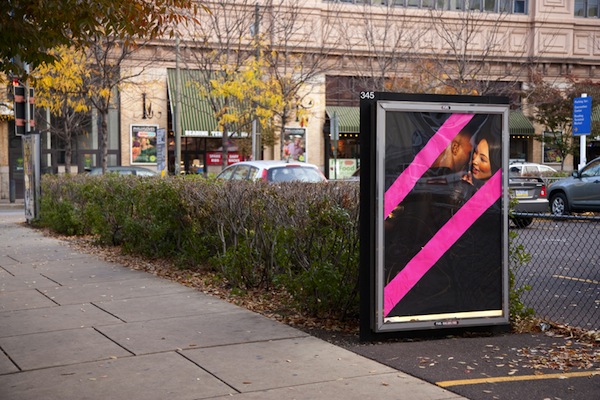
Last week, Jordan Seiler from PublicAdCampaign was here in Philadelphia for Taking From The Tip Jar, his solo show at Vincent Michael Gallery. While in town, Jordan didn’t just hang his show. He also put up a few pieces outdoors. The piece below is, I think, Jordan first street piece that isn’t over advertising.
Outdoors, Jordan brought his usual energy and made the streets of Philadelphia a brighter place. I think his art going over advertisements is one of the most important things that street art can do. Often, people (including myself) have said that good street art is something that brings a smile to your face or makes you think because something has been added to your environment, but Jordan’s art can have just as powerful an effect (but not an impact) by removing branding from the environment. An example: Advertising can make people feel like crap about themselves and convince them to buy crap they don’t need to feel better about themselves. By removing that advertisement, somebody might not feel better about themselves, but don’t feel worse. They have a better day without even realizing it.
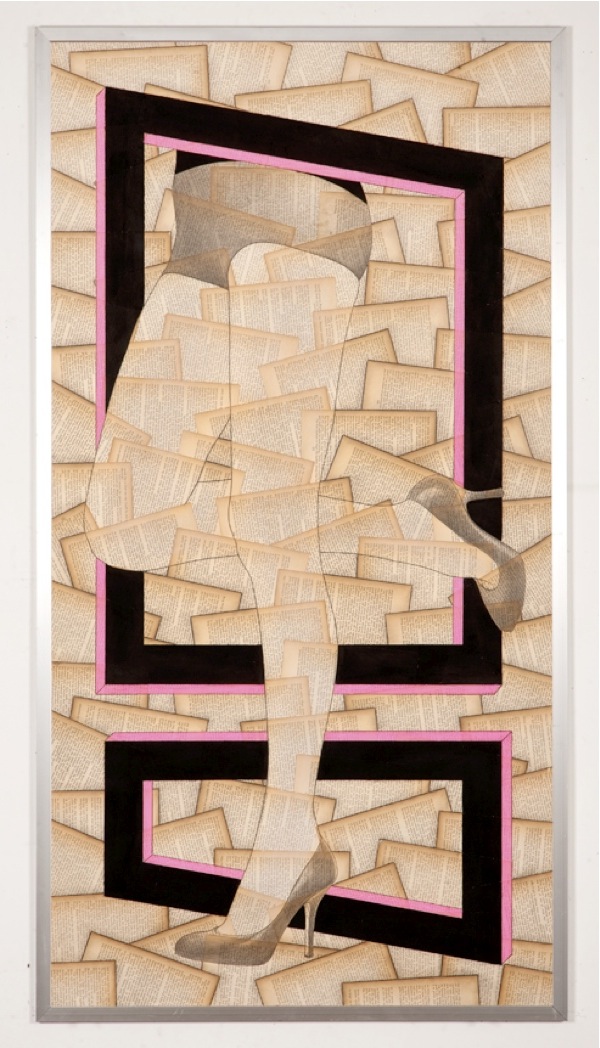
Indoors at Taking From The Tip Jar, the artwork was extremely conceptual, which was not immediately apparent. At first, the glance, it’s a drawing of a girl in high heel or underwear, so of course I’m drawn in to look at that. Clearly, Jordan has thought about advertising long enough to know that sex sells. Or he’s been listening to Bill Hicks. Realistically though, the drawings are average. Would they make good street art? Yes. Are they an improvement over the advertisements in phone booths? Hell yes. But the drawings just don’t have that much to offer if you intend to look at them for more than a moment or two. But the drawings aren’t what Jordan’s show is about. It’s about the frames. My favorite work in the show may have actually been an empty frame on the wall.
Everything in Taking From The Tip Jar is framed the same way: in stolen phone booth advertisement frames. Even with his indoor art, Jordan has been able to continue his mission of disrupting public advertising. Once you’re aware of the frames, the entire show is changed. Now it’s about how the frames should be used both indoors and outdoors, if at all. For this reason, Taking From The Tip Jar is one of the stronger shows I’ve seen this year. It actually got me thinking.
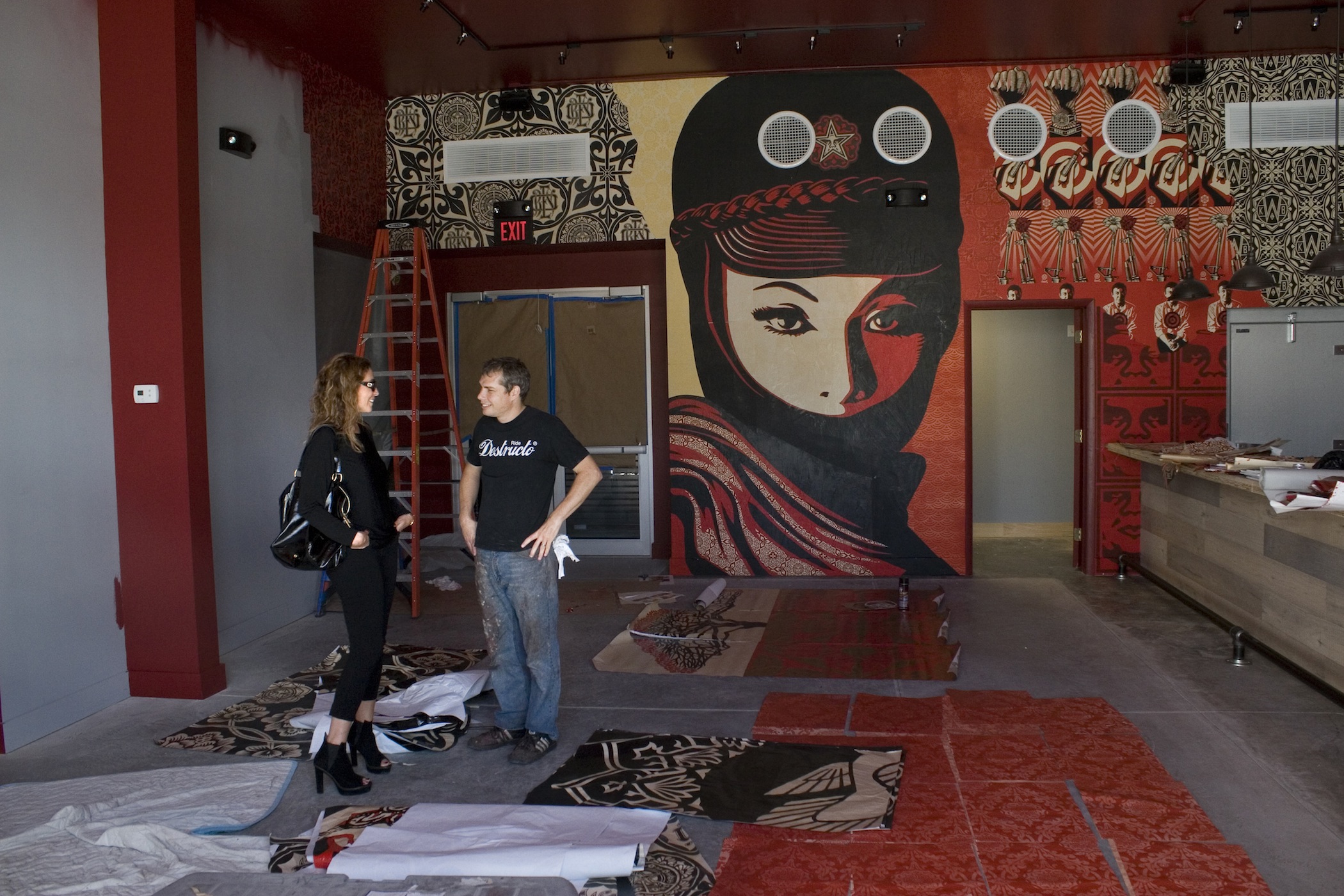
Jessica Goldman and Shepard Fairey. Click to view large.
Shepard Fairey has begun working on an installation at the soon-to-open Wynwood Kitchen & Bar in Miami. The installation is part of this year’s Wynwood Walls project.
Photo courtesy of Wynwood Walls/Goldman Properties