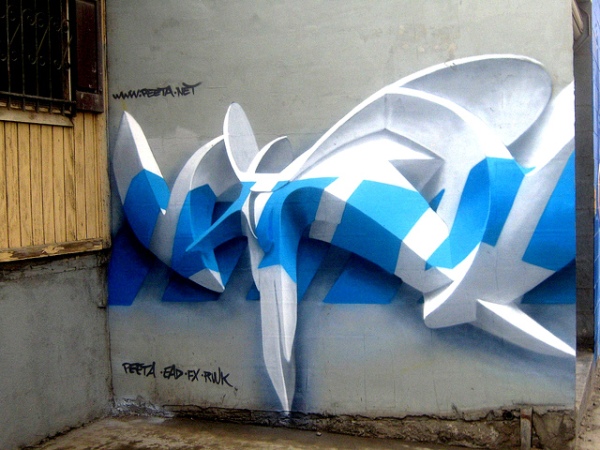
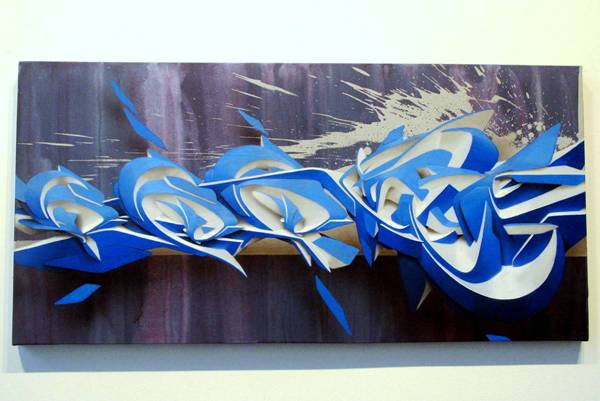
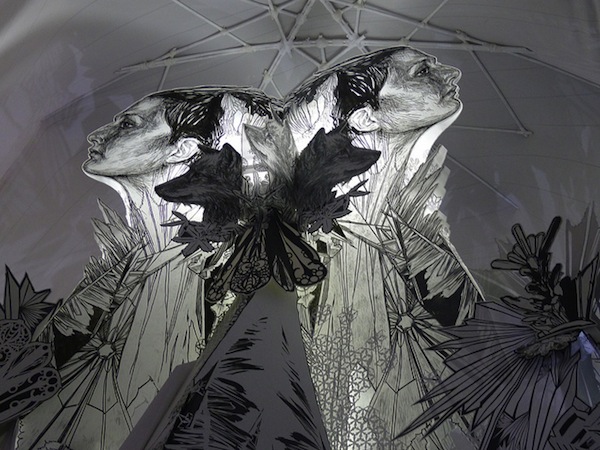
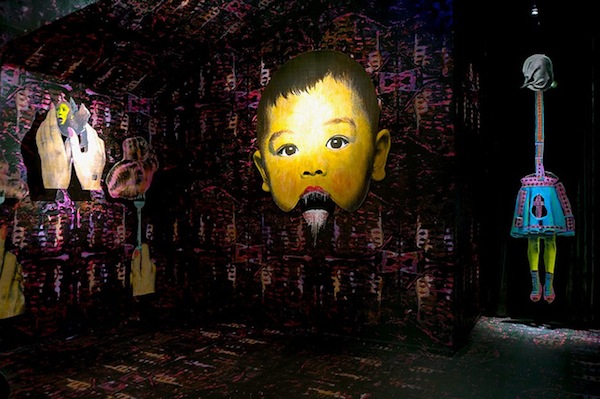
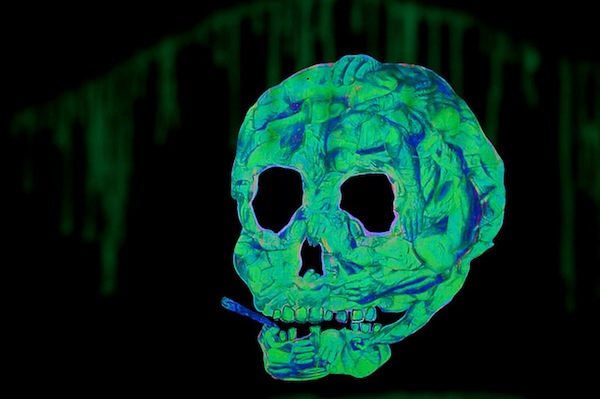
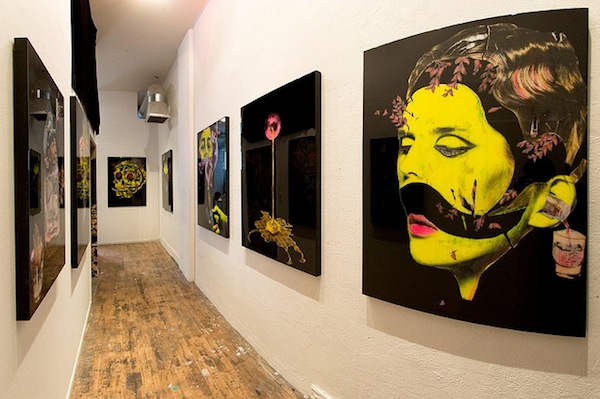
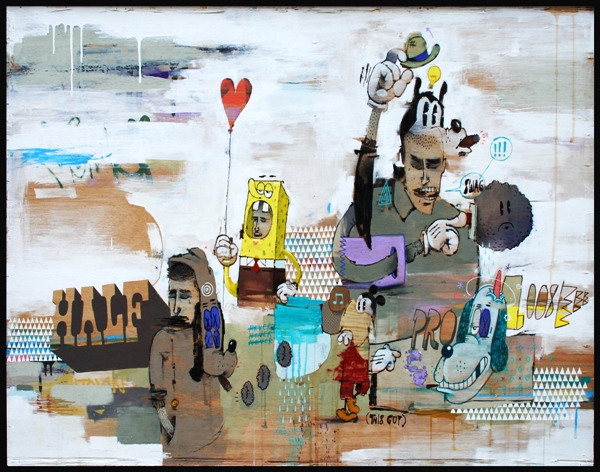
I’ve always been mesmerized by 3-D graffiti and Venice, Italy’s Peeta is one if its masters. I’ve seen his pieces on the streets of Brooklyn and at 5-Pointz in Queens, but I wasn’t quite sure how his artwork would transfer to a canvas. Thanks to the recent Robots Will Kill exhibit at the Vincent Michael Gallery in Philadelphia, I found out. The canvasses captivate — almost as much as the walls do! The exhibit continues through Saturday at 1050 North Hancock Street.
One of my favorite UK artists, Sweet Toof, has a solo show opening at one of my favorite American galleries, Factory Fresh, this Friday. Dark Horse opens on Friday, but Sweet Toof is already in NYC working on murals on and around Factory Fresh. Check out more photos of those at The Street Spot. The opening is from 7-10pm, and the show will run through May 22nd.
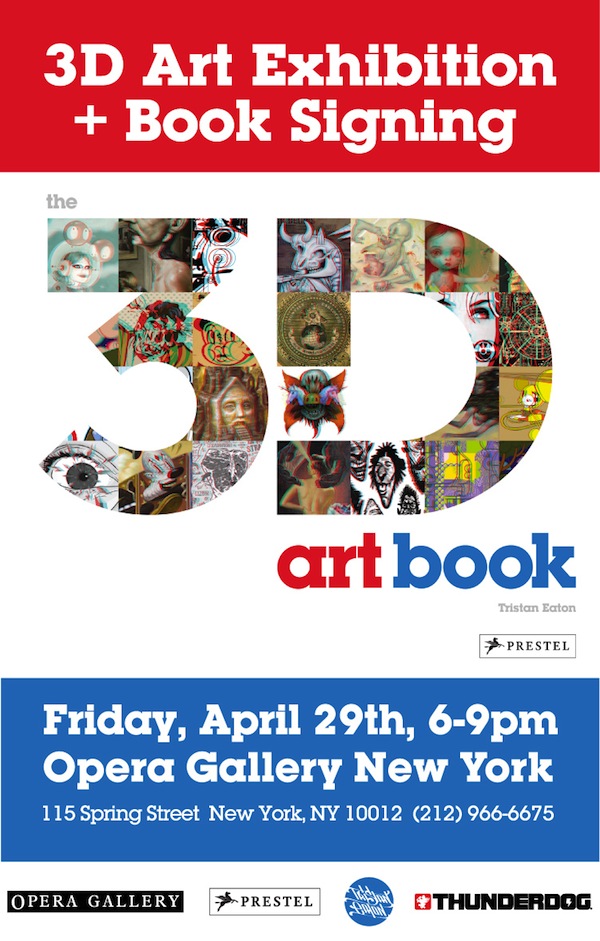
Tristan Eaton‘s new book, The 3D Art Book, is being launched this week with a show at Opera Gallery‘s NYC location. Andrew Bell, Stephen Bliss, Kevin Bourgeois, Ron English, Mat Eaton, Tristan Eaton, Filth, Haze, Travis Louie, Tara McPherson, Kenzo Minami, Mint, Serf, Dr. Revolt & Tom Thewes will be in the show, and the book includes over 100 artists. I haven’t seen this book in person yet, but I’m looking forward to checking it out.
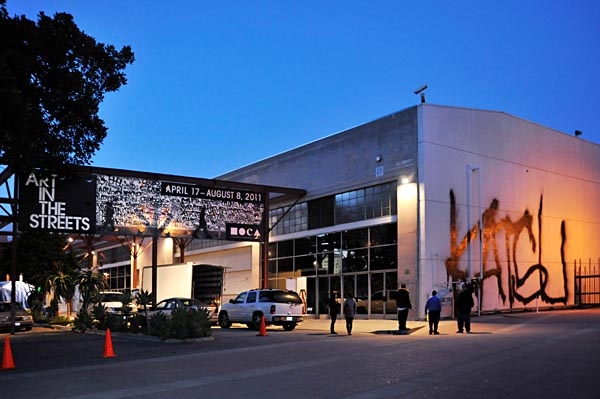
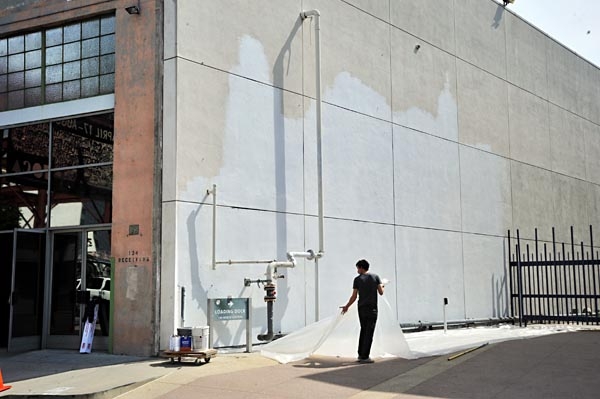
Over at her blog on 12ozProphet, Martha Cooper has a series of photos documenting the work of Katsu, Blade, Rime, Freedom and Os Gêmeos at MOCA. Cooper had a behind-the-scenes look at how things transpired after Katsu hit the MOCA building with a fire extinguisher tag just a few days before Art in the Streets was due to open inside. That night, the wall was buffed, and then it looked like this:
Photo by Martha Cooper
Of course, that wouldn’t do. Os Gêmeos had been scheduled to paint a mural on that wall, but they decided that they did not want to go over Katsu, which is how they ended up painting the MOCA ticket booth. A replacement had to be found.
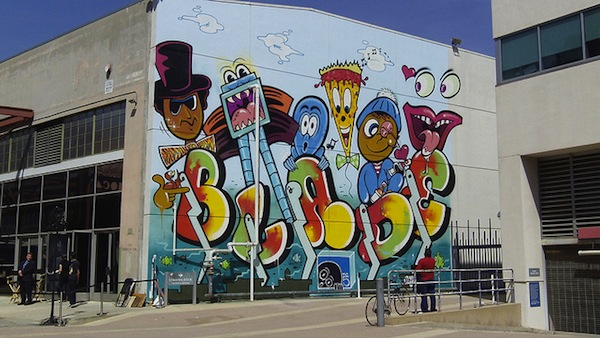
Similar to the wall that Lee Quinones, Futura, Cern, Push, Risky and OG Abel collaborated on just on the other side of the building which had originally been the site of Blu’s buffed mural, repainting over Katsu’s spot would have to be a collaborative effort. Freedom sketched a tribute piece to Blade, using some of his most iconic images. A few people painted the outline of the Blade tribute, and Rime came in to add the color. For more detail on the story and images of the entire process, check out Martha Cooper’s blog.
Photo by LindsayT
I don’t want to say that Blade does not deserve a tribute mural (he is one of my favorite early writers, particularly for the very piece that makes up the core of this tribute mural), but I think it is telling that no one writer would go over Katsu alone. MOCA has every right to do what they want with their own walls, which is why I don’t think the covering of Blu or Katsu’s pieces should be considered censorship, but I definitely wish that Katsu piece had stayed. The man is at the top of his game and a trailblazer in 21st century graffiti, so he deserved mention in the show as part of the next generation of great writers, and it just would have given the show a gritter feel. On the other hand, I don’t want to begin to imagine the problems that keeping that piece would have caused… At least Blade got some added props in the show and Os Gêmeos still painted something.
Last week, The Los Angeles Museum of Contemporary Art opened an exhibit of street art and graffiti that promised to go down in history, Art in the Streets. It’s a massive exhibit of over 100 street artists and graffiti writers. I visited AITS three times, and still wasn’t satisfied that I’d appreciated the show fully. I think MOCA has delivered something special, but maybe did not quite fulfill that original promise.
I want to spend a good amount of time addressing criticisms of AITS, because that should not be ignored, even if they are far outweighed by the good of the show.
This isn’t the show that I would have put on. This isn’t the show you would have put on. AITS is the show that only Jeffrey Deitch, Roger Gastman and Aaron Rose would have put on. Artists that I would have included without a moment’s hesitation (Judith Supine, Faile, Brad Downey, Jenny Holzer…) were oddly absent, and some artists in the show were out of place or allotted too much space (Geoff McFetridge, Terry Richardson, Mr. Cartoon…). For a show attempting to paint the picture of a history, the historical timeline was given a strange second billing to a hodgepodge of individual artist installations.
The selection process for a lot of the show seems like it was a political battle rather than an ideal model of art curating. When the curators’ names were announced, a good chunk of the show’s line up could already be predicted based on their personal relationships. Luckily, the curators are connected to many of the same people that anyone would have put in a similar show to AITS. What would this sort of show be without a contribution from some Beautiful Losers and artists who had shown at Deitch Projects? The unfortunate thing is that there definitely could have been less of a focus on those well-connected artists, and the many talented artists who aren’t connected to the curators probably had a harder time getting invited to be part of the show (or weren’t invited at all).
Os Gêmeos. Photo by RJ Rushmore
Briefly, it’s worth mentioning the lack of strong political artwork in the show. Any political statements made were “safe” ones, and the most controversial (Blu’s message of “war sucks and people make money off of it”) was removed. But just as all illegal street art and graffiti is inherently political, putting work by street artists and graffiti writers in a museum is a political act, even if the content of the work is not explicitly political.
The outdoor murals and the way MOCA has generally dealt with truly accepting the “street” side of street art and graffiti has also been a bit of a mess, but I think that would be true of almost any institution of MOCA’s size. The buffing of Blu’s mural and then the buffing of Katsu’s tag both tainted AITS, regardless of MOCA’s right to do what they want their walls, and the murals that replaced those two are not fantastic (although Push and Futura’s contributions to Lee’s mural work pretty well). And just this past week, Deitch’s inability to publicly defend and embrace illegal street art being committed near the museum has been laughable and depressing. Critics of the show are right to point out the hypocrisy of his position on the legitimacy of street art being produced today versus that of a few years ago. But just like it is the critics’ job to point out that hypocrisy, it is Deitch’s job to say politically wise things to reporters. Simply put, MOCA haven’t been very ballsy when it comes to the “in the streets” part of “Art in the Streets.” This minor fail is maybe what best points out what AITS is and what it isn’t.
In essence, the show has the wrong name. It is not “art in the streets.” It is “documentation of art in the streets or art by artists who began their careers by making art in the street but probably don’t do that too much now, or maybe they do but this is a different side of their artwork.” Yes, a lot of these artists still get up outdoors, but, for many but not all of the AITS artists, it’s a different sort of thing these days: OBEY posters are advertising, Banksy stencils are tourist attractions that last a few days before ending up on eBay and Steve Powers paints amazing murals for an organization founded with the expressed purpose of covering graffiti like his. I’m not saying that artists can’t or shouldn’t evolve, but many of the street artists and graffiti writers that AITS focuses on make “museum friendly” art. And that’s great for them. But AITS is not a show of art in the streets but art by artists who have, as I’ve heard a few people put it, “graduated” from the streets, even if they still get up a bit. As Unurth points out, there is a general lack of names from the last 10 years. So let’s reframe this for what the show is, and look at it that way. Putting aside the politics and minor flaws that only a street art or graffiti fanatic will pay much attention to, AITS is a huge hit.
AITS has two main components: it has a brief history of street art and graffiti, and it has mini-shows of fine art from some of the most acclaimed street artists, street culture documenters and graffiti writers over the last few decades.
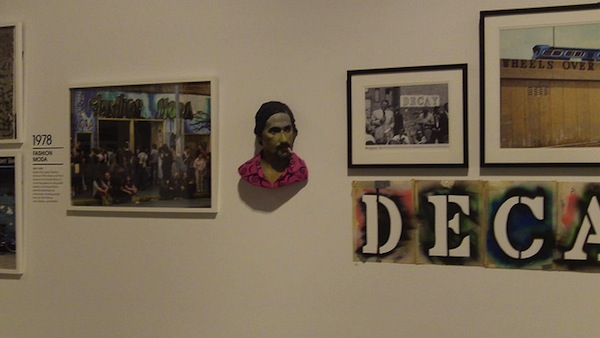
Part of the timeline. Photo by Lindsay T
The timeline is the most “museum-y” part of the show, and it should provide newcomers a history of what graffiti, street culture and street art are about, as well as give long-time fans some new insights. While visitors should also take a trip to see the show currently on at Subliminal Projects to get a better idea about 1980’s street art in NYC, the timeline definitely does its job as a brief overview of the history informing the rest of AITS.
Most of the highlights of the show can be found in the installations.
Three of the best installations make a point of acknowledging that their work is in a museum, even though AITS is meant to be about illegal outdoor art. I’ve said it before and I’ll say it again: Street art and graffiti is about good placement and understanding context. Neckface, Os Gêmeos and the trio of Barry McGee, Todd James and Steve Powers all understand this very well, and it came across in their installations.
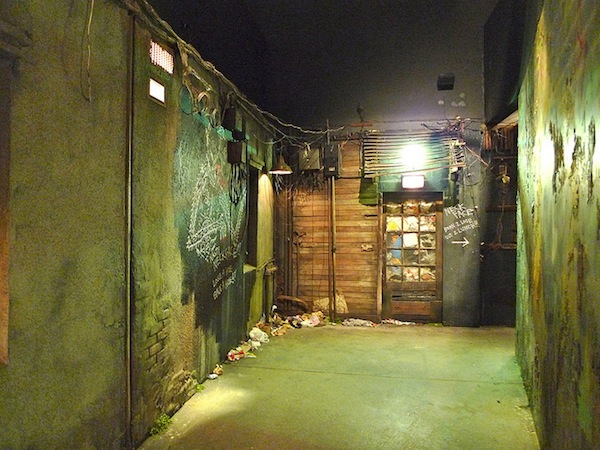
Neckface. Photo by Gelatobaby
Neckface’s section was billed as one of his “haunted house” installations, but ended up being a recreation of a dark inner-city alleyway (complete with a drunk, drugged up or just plain crazy homeless man) with some Neckface tags on the walls. Of course, suits and bloggers like me were lined up to check it out, but few of us would be smiling so much if we actually found ourselves alone in that sort of an alleyway at 3 in the morning. That’s the street, the thing MOCA is supposed to be celebrating. It is like a voyeuristic natural history exhibit for historically middle and upper class museum visitors, pointing out the impossibility and absurdity of bringing the streets indoors in the fashion that the title of the show suggests.
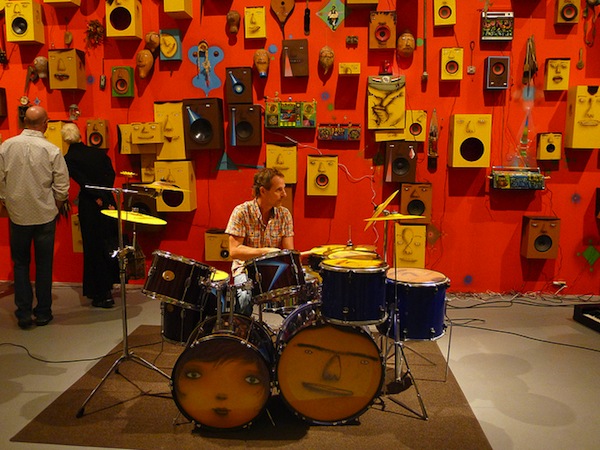
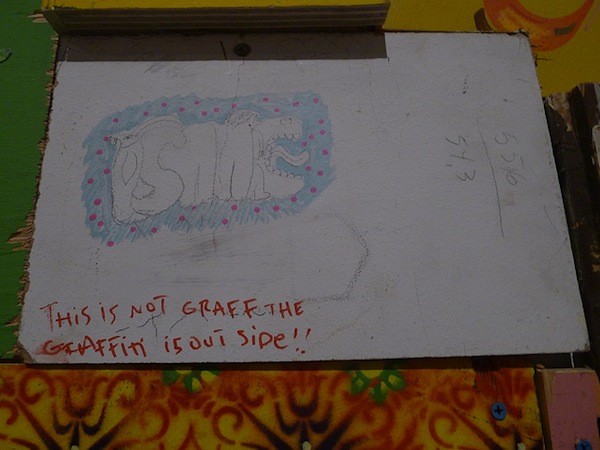
Os Gêmeos reinstalled a show that they had last year at a museum in Portugal. It was definitely a highlight of the show, with a little bit of everything from the twins. Hidden in a bit in their cluster of work was one piece of wood where it was written: “This is not graff the graffiti is outside!!” Simple. That installation is their fine art and it is awe inspiring and thought provoking and should be seen. The graffiti is outside. And so is the street art.
Os Gêmeos. Photo by RJ RushmoreStreet (Barry Mcgee, Todd James and Steve Powers). Photo by Gelatobaby
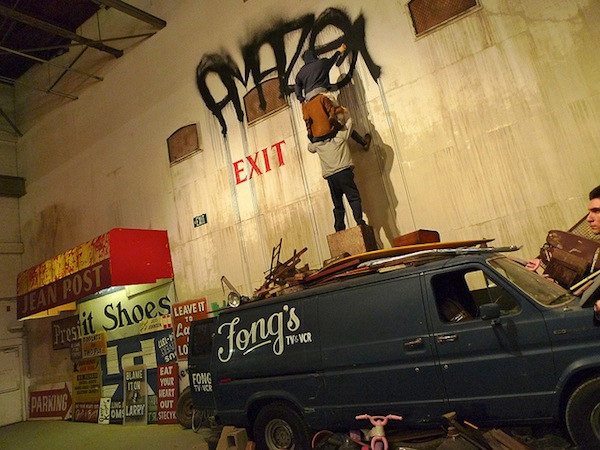
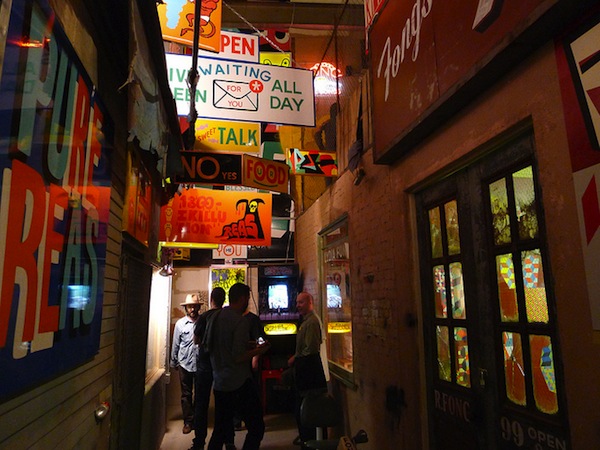
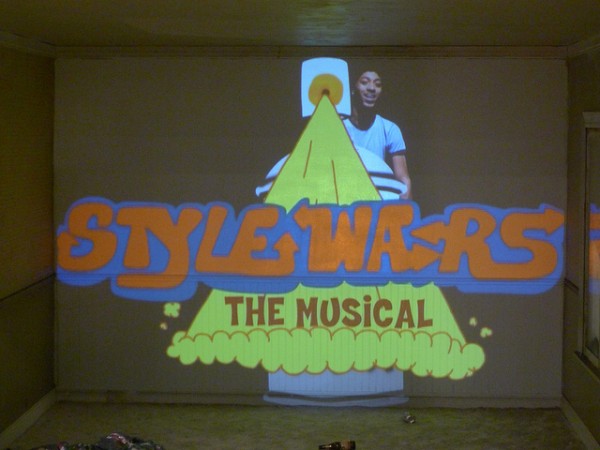
And then there is Street. Barry McGee aka Twist, Steve Powers aka ESPO and Todd James aka Reas reunited to make a new version of their historic Street Market installation, versions of which had previously been put on at Deitch Projects and the Venice Biennale. First of all, this might be the best installation in the show. Particularly when the area isn’t too crowded with other museum-goers, it’s like being transported into another, more Technicolor and mad, world. It’s a graffiti writer’s urban dreamworld where taggers can hide invisible bushes and bodegas sell cans of street cred. The space is an art-crowd friendly dreamworld of a street, where Style Wars isn’t a documentary but a musical without any real-world consequences. Again though, the installation touches on the impossibility of bringing a true street inside, going for the asurd illusion instead. Street is what would happen if graffiti writers could have a ride at Disneyland, and I mean that in the best way, but it’s still a ride at Disneyland rather than an actual street and the artists know it.
Street (Barry Mcgee, Todd James and Steve Powers). Photo by RJ RushmoreStreet (Barry Mcgee, Todd James and Steve Powers). Photo by RJ Rushmore
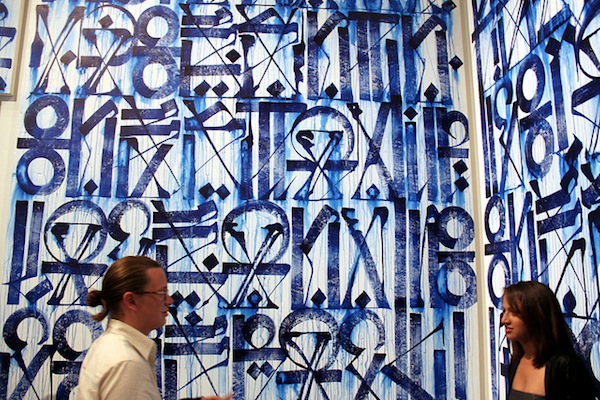
The show is just too massive to write about everything. This review is already far too long. Sections by Margaret Kilgallen, Roa (who again, understands that he is in a museum), Invader (who plays with the fact that he is in a museum), Shepard Fairey, Banksy, The Fun Gallery, Rammellzee, Retna, Chaz Bojorquez, Swoon, Kaws, Ed Templeton and many others add together to be the most substantial gathering of art by this group of artists that has ever been assembled. I rediscovered artists I’d overlooked, found new favorites and enjoyed revisiting the work of my old favorites. The show is so massive that a pessimist will undoubtedly find something that they do not like and many visitors will be overwhelmed, but it would be difficult to go through the entire show and not find a few gems, no matter your taste in art.
Swoon. Photo by RJ Rushmore
For a moment, forget about the BS and the politics and the buffing and Deitch-hating and Alleged Gallery controversies from a decade ago and the lack of this person and that person and why this person got an installation and that person painted a mural and blah freaking blah. Outside of our art-world BS political pissing contest context where AITS can and will be criticized on many levels, people are going to visit AITS and they’re going to see some amazing art by artists who were and are pillars of street art and graffiti history. I expect that the vast majority of visitors will like what they see and they will learn something. And that’s important. This is street art. It’s supposed to be for “the people,” and “the people” will still enjoy this show even if my or your 4th favorite artist was snubbed or whatever other minor flaw you can find. And if you go and visit the show and you can put aside your minor internal art world squabbles for a couple of hours, AITS should be a magical experience for you, just as it was for me. I highly recommend setting aside a day to visit AITS.
It’ll be interesting to see if Mr. Brainwash reacts to this. By the way, I met him last week and he signed my black book. As terrible as I think he is, I couldn’t pass up the opportunity. Maybe one day I’ll put the page on eBay and retire on the proceeds. Hopefully not. To be fair though, he was a super nice guy even though I think he knew that I hate his artwork, so that’s big of him.
Interesting commentary on Art in the Streets from Eddie Colla I guess, but I can’t ignore that he signed the work and even included a QR code. I’m pretty sure he would’ve participated in Art in the Streets had he been invited. In fact, he is part of a group show that opened on the same weekend as MOCA’s show.
Sickboy and Paul Insect have a one-night-only collaborative show opening today (April 21st) at One Thirty 3 in Newcastle. It’s only open tomorrow night from 6:30-9:30pm. There will be an installation, one original painting and a series of 33 prints (see above). Sounds very cool. The prints will also be available online.
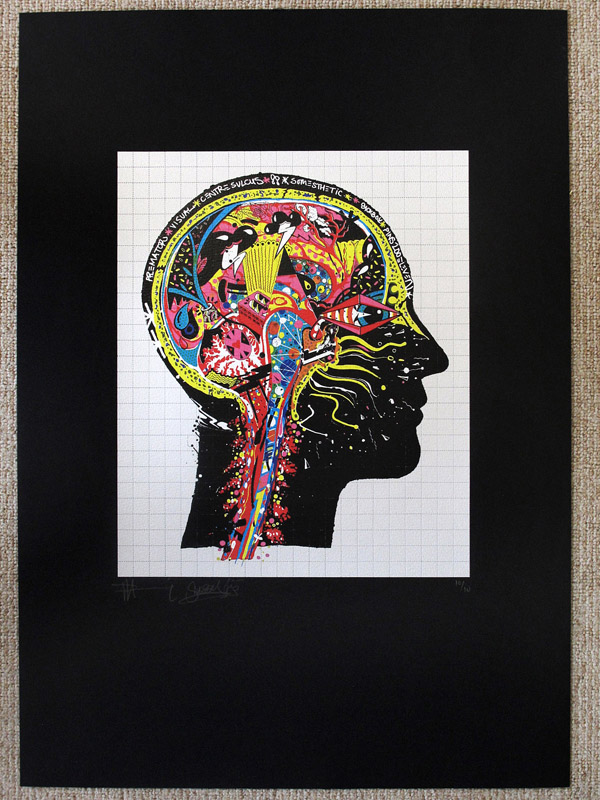
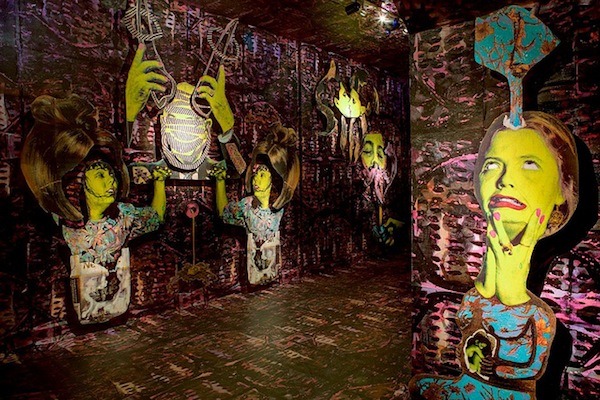
Last week I had the chance to check out Judith Supine’s solo show at New Image Art. While it probably doesn’t quite live up to the hype, Ladybody is definitely worth checking out. Supine’s head is a mysterious cacophony of strangeness, and the installation mostly left me confused, but I’m not sure if that’s my fault or Supine’s. Either way, it was interesting to see his art in the environment that he seems to prefer showing it. One part of the installation which is an exception and a highlight is this sculpture:
Smoke creeps out of the baby’s open mouth, and when you look inside, this is what you see:
Photos can’t really do justice to the creepiness of this piece and it is worth checking out Ladybody for this sculpture alone.
And then there were the more traditional pieces:
Whoever has the balls to hang the image of a doughnut dripping syrup onto a waffle in their home has my respect. It’s one of my favorite images from Supine in a while, but it’s definitely one of his most difficult to hang.
I discovered (and instantly fell in love with) Word To Mother when I was in London this past fall. I’m looking forward to Mallick Williams & Co.‘s upcoming Spectrum, a group show opening this Thursday, April 21, and continuing through June 3rd, 2011. Along with Word To Mother, featured artists include: Kiji McCafferty, Chor Boogie, Erik Otto, Kate Pane and Lu Gold. The gallery — that recently featured the amazing Hueless exhibit — is located at 150 11th Avenue in Chelsea.
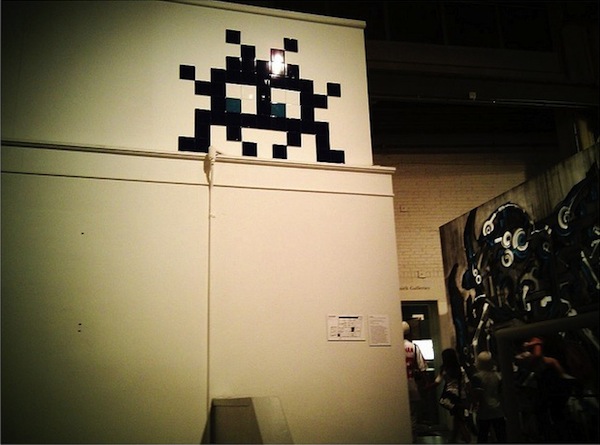
As I mentioned yesterday, the LAPD and LA residents are getting their feathers all ruffled because street artists and graffiti writers have been getting up in LA a lot over the last week or so, particularly in the Little Tokyo neighborhood where MOCA’s Art in the Streets show is located. When asked about this activity, museum director Jeffrey Deitch told Culture Monster that it could be attributed to, “some of the young taggers who are anarchic…. It’s a language of youth culture, and we can’t stop it. It goes with the territory.” Well, as I also pointed out yesterday, those young taggers include some of the most established artists in Art in the Streets (including Barry McGee and Shepard Fairey). Well now it looks like two artists (most likely Invader and an assistant) have been arrested(correction: detained but not arrested) for putting up some work in Little Tokyo. The two suspected vandals have French passports, and they “were each carrying plastic buckets and inside there was glue or grout, plastering equipment and tiles.” That sounds like Invader to me, whose art is part of Art in the Streets (see photo above), but nobody has confirmed that it was Invader so this is just speculation on my part. If Invader and a friend do get arrested, I wonder if MOCA will bail them out…
Sure, Deitch is trying to be diplomatic by calling street artists anarchic taggers, but I find it a bit insulting. Yes, a museum exhibit of street art and graffiti is going to lead to an increase in street art and graffiti near the museum, and I don’t think that’s a bad thing. I just wish Deitch could try to put a positive spin on the new street art in Little Tokyo. As it is, he sounds a bit absurd celebrating street artist who have moved their art indoors and dissing street art when it appears outdoors, its rightful location.
Anyway, good luck to Invader, or whichever Frenchmen were arrested(correction: detained) for suspected vandalism.