The Electric Windows Project in Beacon was a great success this year, getting out some great art and bringing together Brooklyn hipsters and longtime Beacon residents…
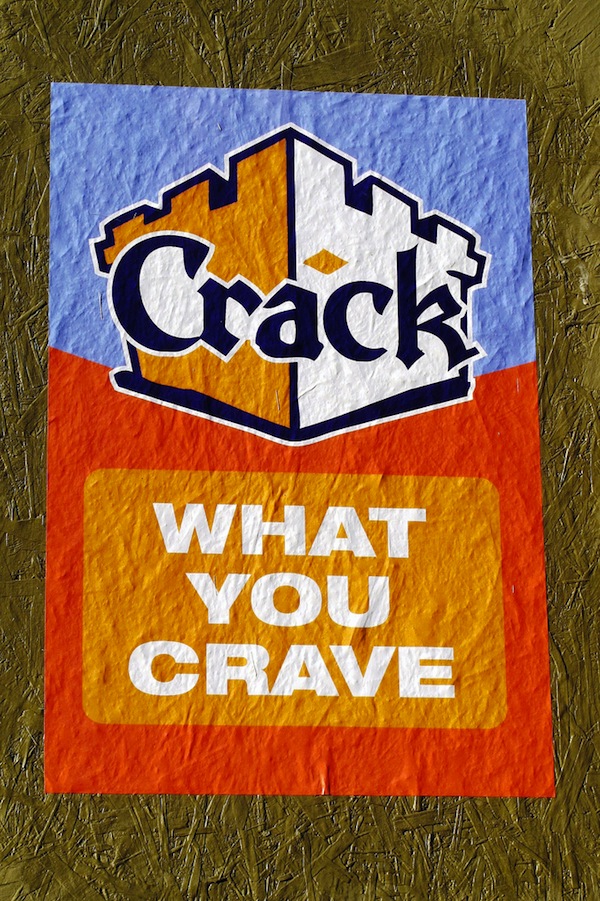
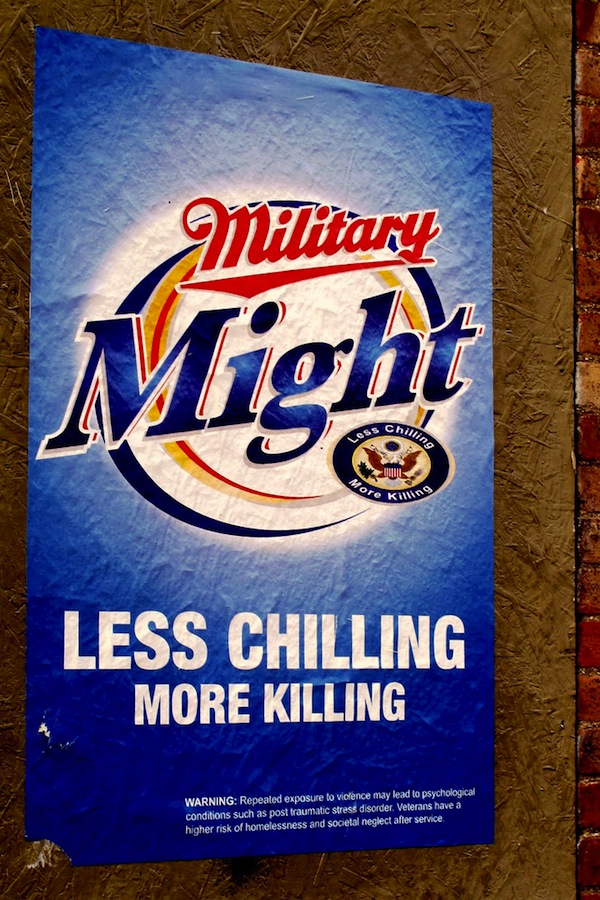
But by Tuesday, dozens of outraged townies assembled at the Beacon city planning board meeting to protest a couple of pieces I did. After a quick briefing in closed session with the city attorney, who went over the first amendment with planning board members, the board announced that although it had no legal right to order the work taken down, it would allow the public to express their outrage over the fact that I used Jesus as a corporate spokesmodel and “Crack” as a criticism of fast food in a couple of “subvertisements.”
The board let me speak first, and I expressed surprise that my work created such a furor. I’m always surprised when this kind of thing happens… which is often and usually propagated by people who don’t understand or fully take in the work but instead attach their own agenda to it.
After I spoke, a wave of angry Christians took their turns at the mike. One woman wanted to know why she couldn’t paste up the photos of dead fetuses that she routinely held up at the health clinic. Others wanted to know what gave me the right to comment on the most powerful religion on the planet. And one board member expressed outraged that I was promoting crack… to the children. Afterwards, a teacher got up to helpfully explain that children don’t understand metaphor.
Then a self-professed stateside noncombat post traumatic stress-afflicted veteran informed me that he had notified Miller High Life about my offensive parody of their brand..
So English returned to Beacon and modified the posters. Check out the new posters on his Juxtapoz blog.
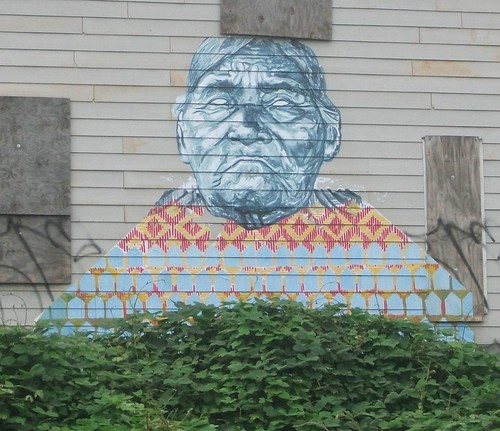
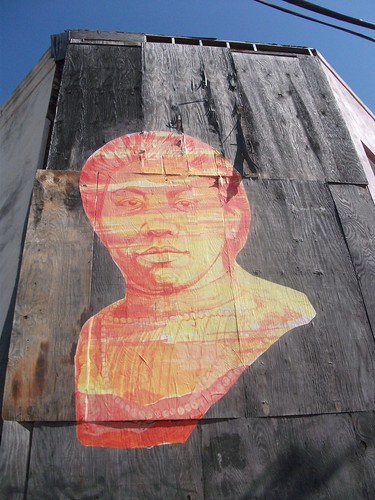
So Now that everything has settled down and I am back in New York, it’s time to sit down and adequately give an overview of the street, gallery and legal works produced for the Living Walls Conference. The focus of these works was a hybridization of the Cherokee and Suburbia, both entities that occupy the American imagination but are seemingly different. The photo references employed within these portraits are women of the Cherokee nation, which was one of the first Native American tribes to embrace the encroaching Western frontier. These photographs capture a people in transition who retain their traditional values while simultaneously assimilating to a new, oppressive lifestyle. In the largest of the four street pieces, the Cherokee weaving pattern transitions into the homogeneity of suburban sprawl, an issue that has defined Atlanta’s contemporary development. The romance of establishing autonomy closer to nature, away from the turmoil of the city, is joined with the domesticity of the Cherokee portraits, the romantically free people tamed by invasion. A more comprehensive overview of the other projects will be coming soon! More photos and details after the jump
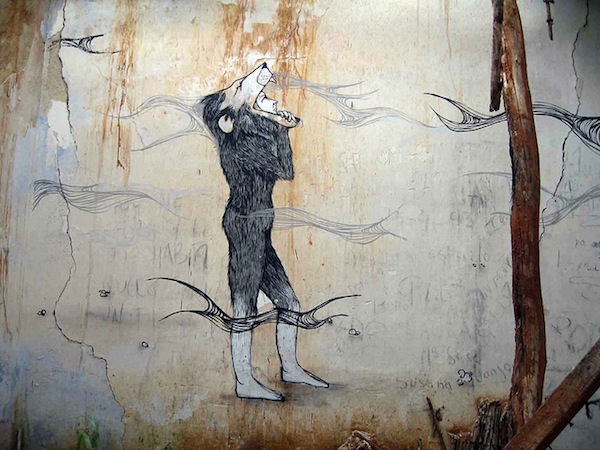
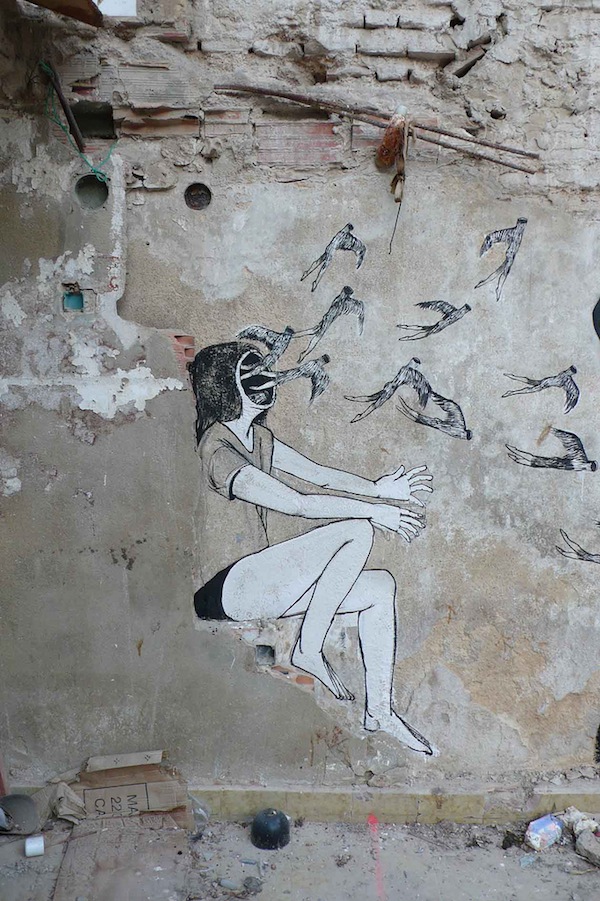
After The Citrus Report posted photos of the latest collaboration between Escif and Hyuro, I realized that I hadn’t written anything about Hyuro for quite a while. And that just seemed like a bit of a mistake given all that Hyuro has been up to since March. So here are two of my favorite recent characters from Hyuro.
Am I the only one who wants to see Hyuro collaborate with Miso and/or Ghostpatrol?
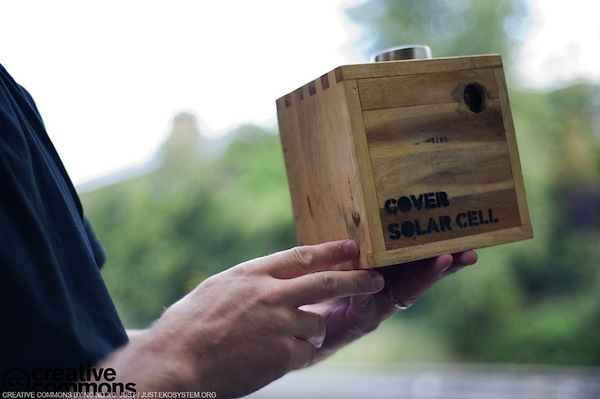
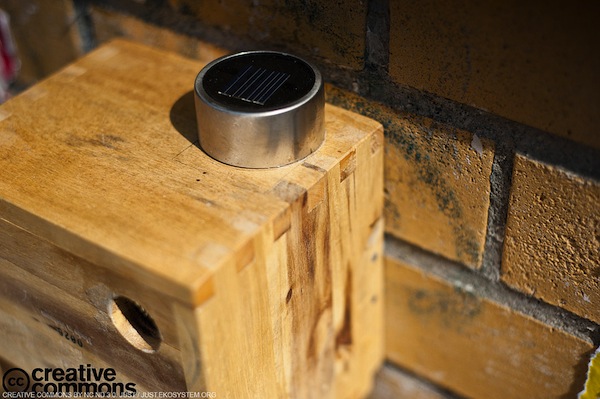
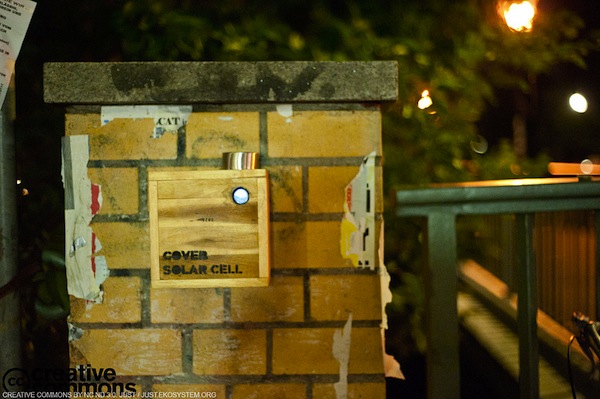
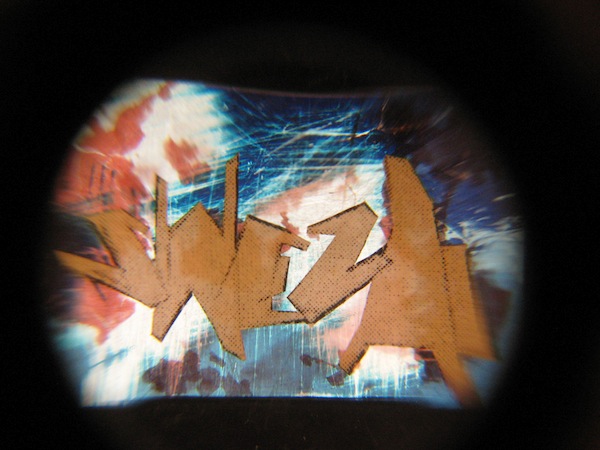
Sweza, probably best known for his Graffyard project, recently installed one of his latest pieces with Just there to take photos. Solarlichtraum is a small wooden box with an LED backlit piece of graffiti on the inside. During the day, the solar cell on top of the box charges the LED, and when the solar cell is covered (or the sun sets), the LED turns out and you can look inside the box to see Sweza’s mini graffiti-style piece.
Solarlichtraum was installed on the streets of Berlin.
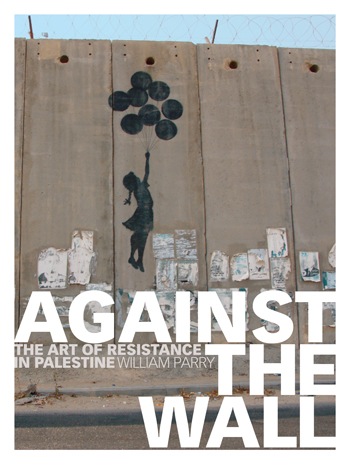
This week, I read a very different sort of street art book. In fact, I’m not sure it should be considered a “street art book.” Against The Wall by William Parry is a book about the separation walls in being built by Israel. In the street art world, the wall is known for the Banksy-organized Santa’s Ghetto event in 2007 where he and a number of other street artists painted the wall, but, of course, that’s really not what the wall is famous for and there’s a reason that Santa’s Ghetto took place in Bethlehem. As Banksy has said, “The wall is illegal under international law and essentially turns Palestine into the world’s largest open prison.”
In Against The Wall, Parry has revisited the wall after all the world-famous artists have left. Parry documented not only the artwork painted by Banksy and his cohorts, but the mostly-anonymous art and political graffiti that covers much of the wall. The artwork in Against The Wall is of similar historical importance to the art on the Berlin Wall. The art may help to bring the wall down, but when that finally happens, it’s going to disappear and Parry’s photos will remain as probably the best documentation of the art so far.
But this book isn’t just about art. After all, most of the art on the wall isn’t just for the sake of art. So most of the book is actually about the wall and how it has changed the lives of the Palestinians it has been created to oppress. There are probably a dozen better books on this same topic that go into much more detail, but I doubt you can read any of those in an afternoon. Parry tells powerful personal stories and uses photos to tell the collective story of how the wall is affecting the Palestinian people, and he keeps the entire book down to under 200 pages.
If you have a heart, if you think that art can change the world or if you just want to learn more about the struggles of the Palestinian people for basic human rights and dignity, you should get a copy of this book.
Against The Wall is available from Pluto Press for much of the world. Unfortunately, the book isn’t available in the USA yet, but it should be published here by Laurence Hill Books in the spring.
I should add that while, like on most Vandalog posts, I’m allowing comments here, I’m personally not going to get involved in any political debates on this issue. Maybe that’s lazy or one-sided or whatever, but I don’t really care. Internet flame wars have never changed anyone’s mind about this sort of thing. That’s what art and books like Against The Wall are for.
Most days, I’m a fan of Shepard Fairey. He’s been getting up longer and harder than almost anybody else in street art, he’s a talented artist and few others have done more for the street art scene. But nobody’s perfect, and the bigger the star, the more bigger those imperfections. Every once in a while, I do a post like this about the latest crazy things Shepard has said or done.
Joaquin Phoenix
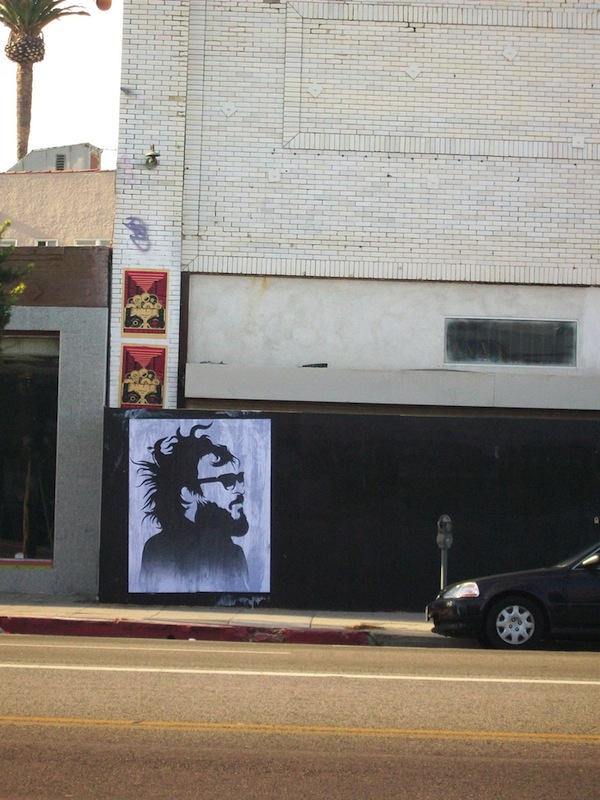
1. There are the posters depicting Joaquin Phoenix which have been popping up in a few major US cities. Forget about this being illegally place guerrilla advertising for some film, they’re pretty unappealing to look at. Even if they were straight up street art, they’d be pretty unremarkable, unless you were remarking on their poor design. Well, according to New York Magazine, these posters were designed by Shepard Fairey and they are presumably being placed by his street team. The poor design of this image is EXACTLY WHY people criticize 1-layer stencils and Shepard’s poster style as nothing more than failed art students putting a photo through Photoshop. And that’s not what all 1-layer stencils or Shepard Fairey images are. Some of them are brilliant (I think). Then again, the rumor about this Joaquin Phoenix documentary is that the last two or so years of Joanquin’s life have been some elaborate performance piece about a man gaining fame through a career path that he has no business being on. Kind of like the ending that everyone was hoping for with Mr. Brainwash in Exit Through The Gift Shop, except that Joaquin is trying to be a rapper. So if the rumors are true, maybe this sub-par poster is just another component of the hoax.
2. Last week, a mural Shepard recently put up in San Diego was partially tagged over by a fire-extinguisher-wielding writer going by the name of Polo Joe. It was a nice mural. It’s a shame to see it written on so swiftly. I’m sure plenty of people will disagree with me on that point, but I liked the mural. Unfortunately, pieces getting covered, written over, removed or even just decaying is part of street art and graffiti. Every artist that I know accepts this as part of the culture. Typically, street artists are more open to this than graffiti writers. And yet, I’m not that shocked by Shepard Fairey releasing a statement about this wall getting written over. After all, a lot of people who enjoy that mural might have expected it to last longer. What did surprise me a bit was what Shepard said in his statement: “The endeavor fulfills some need for the heckler but has no redeeming value to any of the other participants, but I firmly believe in street art as a democratic forum. In street art, tenacity always wins and I’m not going away.” That just sounds a bit supercilious to me. Polo Joe is not merely a “heckler” who should be completely ignored. He was making a statement with his tag. I wouldn’t expect Shepard to agree with Polo Joe, but since Shepard has been involved in street art for longer than I have been alive, I figured he wouldn’t just brush aside such an important part of graffiti and street art culture so simply. Like Team Robbo writing over Banksy, Polo Joe might be annoying and ruining a piece of art history and I might wish he didn’t do it, but he has as much right to tag over a Shepard Fairey mural as Shepard has to put up a poster without permission. I think it’s unfortunate that Shepard agree (or if he does, won’t admit that he does).
Photo by Nolionsinengland (Specter did the paste-up of a piece of fabric)
With Specter‘s recent solo show at Pure Evil Gallery, I thought it would be the perfect time to ask Specter a few questions.
RJ: You were just in London (or are you still there) for your solo show at Pure Evil. What do you think of the city?
Specter: London has a vibrant energy to it. I only got to see a small chunk of the city but have nothing but good things to say about it and the people. Pure Evil was a great host.
Photo courtesy of Pure Evil Gallery
RJ: The work at your solo show is part of a new series. Can you explain the series and how it came about?
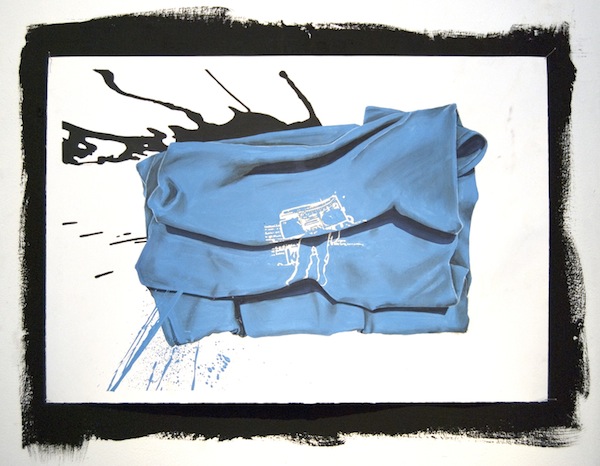
Specter: The series is based on people who personally influenced me artistically. Instead of painting the subject’s face I decided to paint a garment that tells a story about them.
RJ: On the whole, your street art is more conceptual than that of most street artists. Have you found it challenging to execute and be appreciated for conceptual street art when so much popular street art is, at one level, very graphic and literal? How have people reacted to pieces like your ready-mades?
Specter: I don’t think about it often, but whenever you work outside the framework people have trouble grasping it. I transition between painting and sculpture often and rarely sign my pieces, so it’s sometimes hard for enthusiasts to recognize my work. With hand drawing, painting and constructing everything I put out and commonly taking weeks to find the right spot I get less coverage than your average poster or stencil artist.
A ready-made. Photo by Specter
RJ: Why do you work outside, and how does your street art connect to your gallery art?
Specter: I work outside because it is all I know and love. I was introduced to art through graffiti and have been working on the streets for over fifteen years. It is my strongest passion and I take it very seriously. I try to be very honest with the street because the street knows when you’re faking. Showing in galleries requires a new approach to one’s work, and it’s a choice I’m happy I made. Adapting concepts to an indoor and controlled environment can be a challenge and you’re also starting from a blank canvass. The transition from the street to the gallery doesn’t work for a lot of artists but for me I feel it is just another venue to express concepts.
From the Manage Workflow series. Photo by Specter
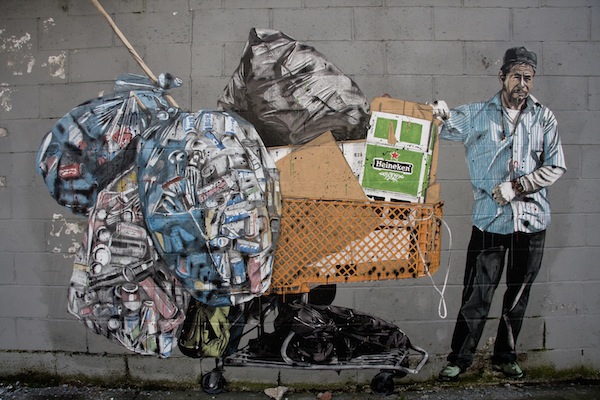
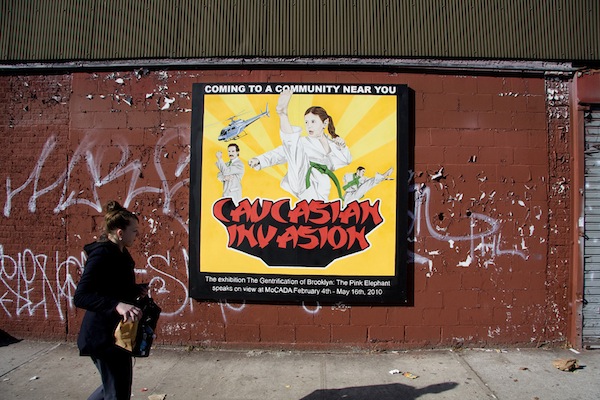
RJ: Earlier this year, you took on the issue of gentrification in Brooklyn, and you have consistently depicted homeless people in your art. On the one hand, you’re raising awareness of these issues, but on the other hand, street art is bringing about gentrification. How do you deal with this apparent contradiction? Do you think that your art has had a positive impact in the communities you’re working in?
Specter: I don’t believe those contradictions apply. I put up work where I want to. The neighborhoods are chosen because they are beautiful and the people appreciate and empathize with the subject matter.
From the Gentrification Billboards series. Photo by Specter
RJ: What do you hope to accomplish through your art?
Specter: To get people talking.
The controversial wheatpaste from the If I Saw You In Heaven Series. Photo by Specter
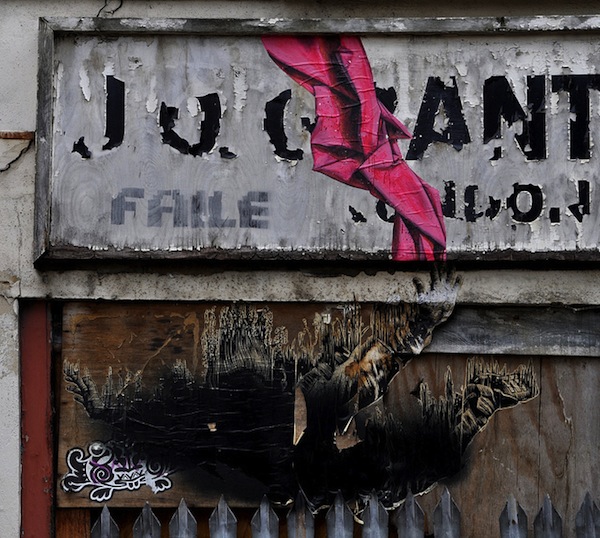
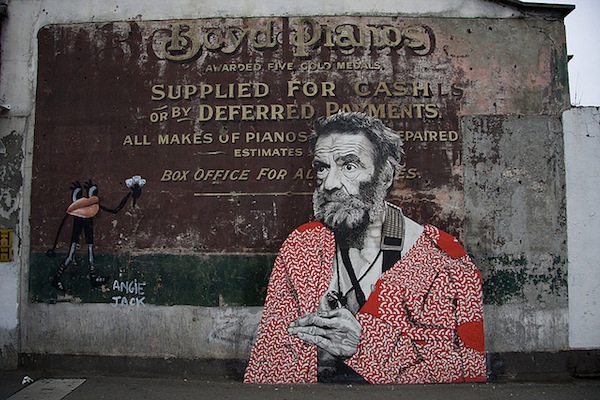
RJ: One particular street piece that you did in London has turned out to be pretty controversial. At first, people generally seemed to love it, but then it was pointed out that you had partially covered an old hand-painted sign. I guess I’d like to hear your thoughts on why you put the piece there and give you a chance to respond to the negative things that people have been saying about it.
Specter: At its essence graffiti and street art is both the work by the artist and the public space in which it is put up. As an artist every wall in the public sphere is fair game. I go to great lengths scouting locations for my work and often look for hand-painted signs and walls to revive in the collective eye with my hand-painted installations. I have absolutely no remorse for any placement of my work.
I choose that spot for a reason. I like to involve my pieces in a dialogue with their surroundings. The art is not just my painting it is the entire environment, the interaction of all parts.
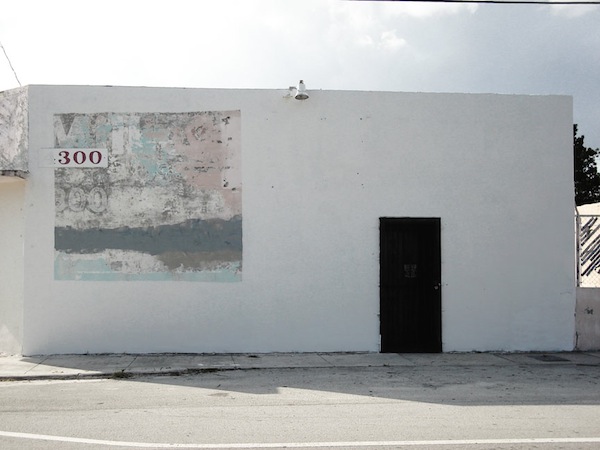
I identify very strongly with these old signs and feel that my additions are just part of the evolving cycle of their lives. My incorporations are changes to their ephemeral existence, often highlighting their under appreciated being.
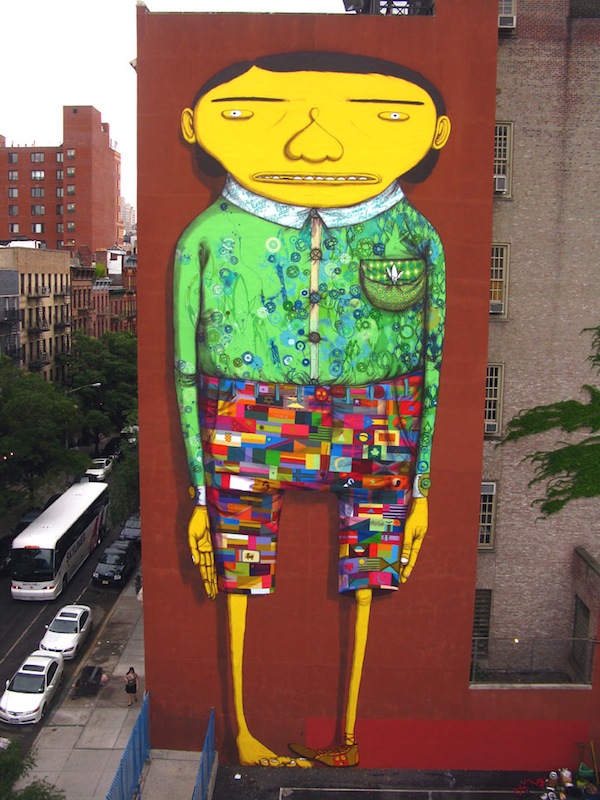
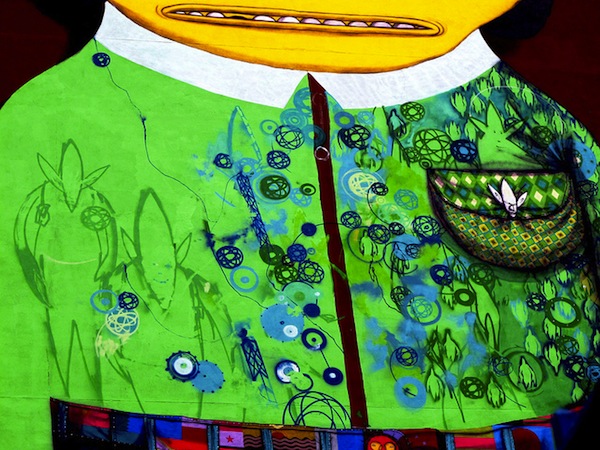
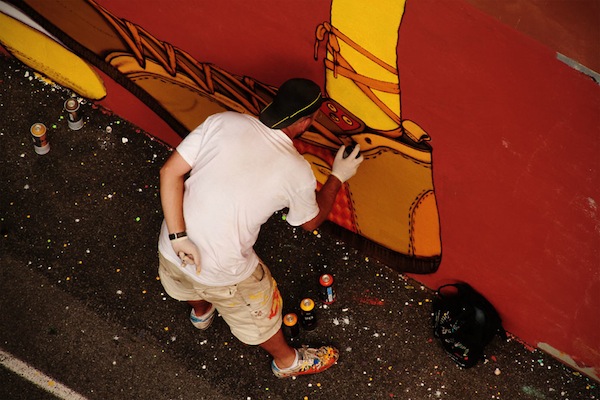
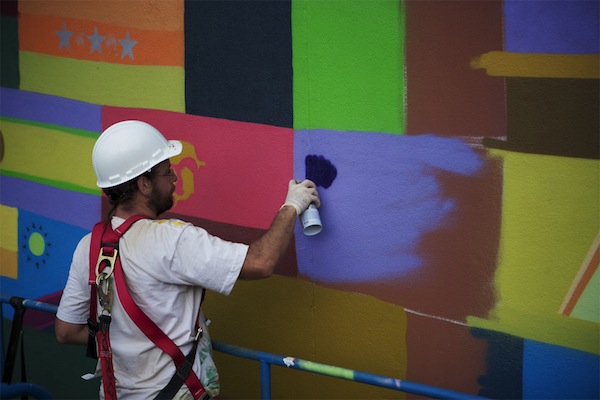
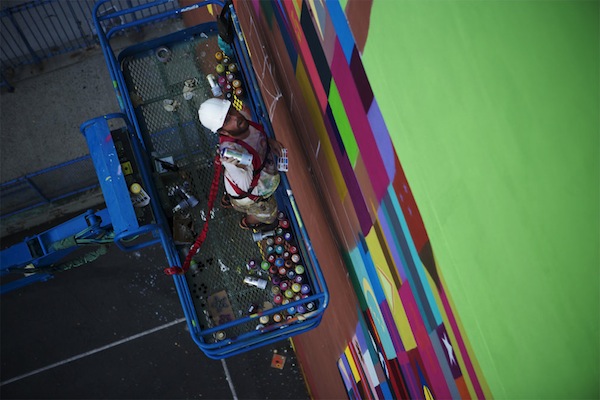
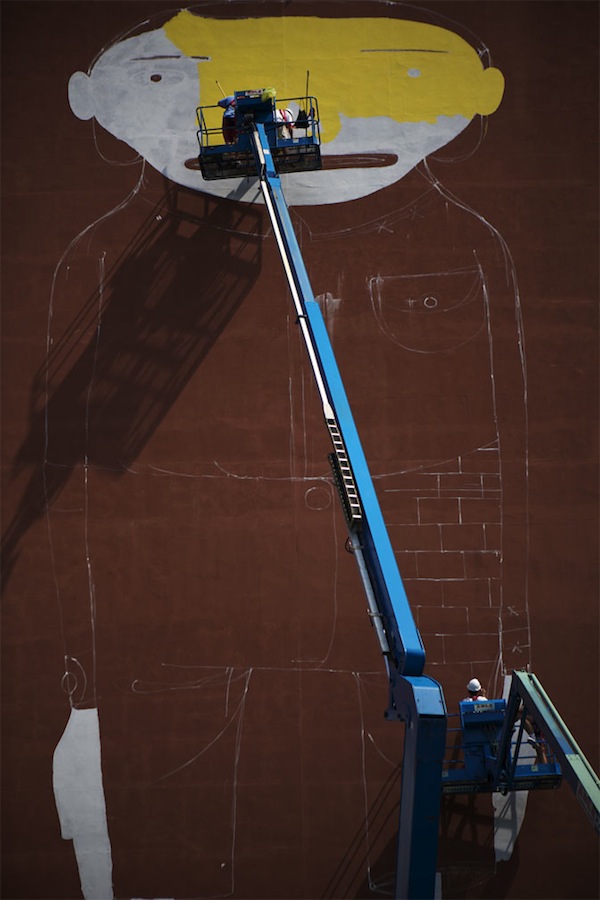
As I mentioned earlier this week, Os Gêmeos and Futura were working on a massive wall at PS 11 in NYC. Today, I’ve got a few more photos of the wall in progress to share. The wall was finished on Thursday or Friday and you can check out photos of the finished piece on Unurth, but I’m waiting to see if I can get some more of these really high quality photos of the finished piece, so expect to see some of those on Vandalog in the next few days.
And how did this massive wall come about? It was organized by 12ozProphet and AKANYC, a creative agency that had worked with Deitch Projects (the organizers of the twins’ last mural in New York).