RJ Rushmore has been involved in contemporary art as a writer, curator, photographer, arts administrator, and fan since 2008. With a focus on street art, graffiti, and public art, RJ facilitates and promotes catalytic and ambitious art outdoors, in galleries, and online. He founded the street art blog Vandalog and has worked at The L.I.S.A. Project NYC, Mural Arts Philadelphia, and Creative Time. Currently, RJ is Co-Curator of Art in Ad Places.
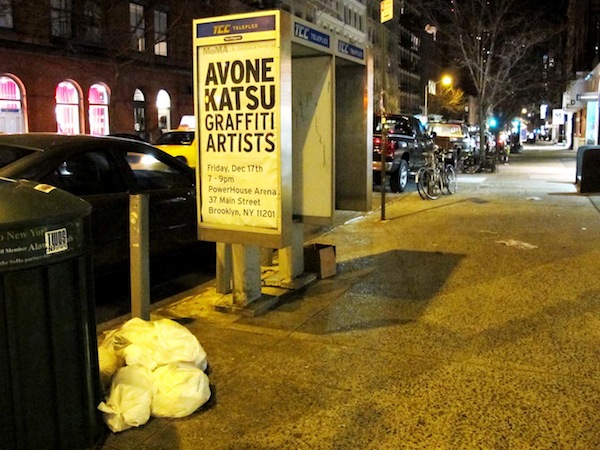
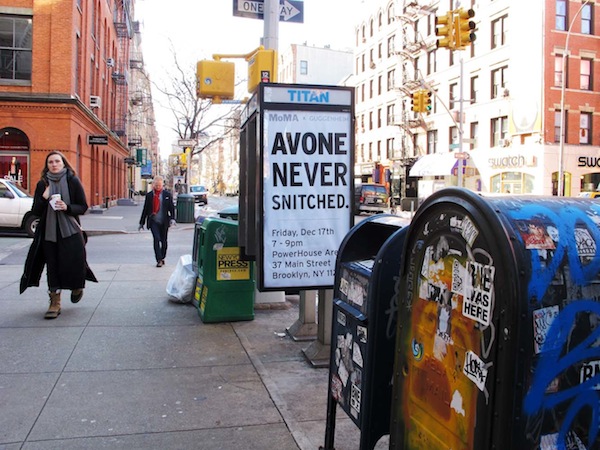
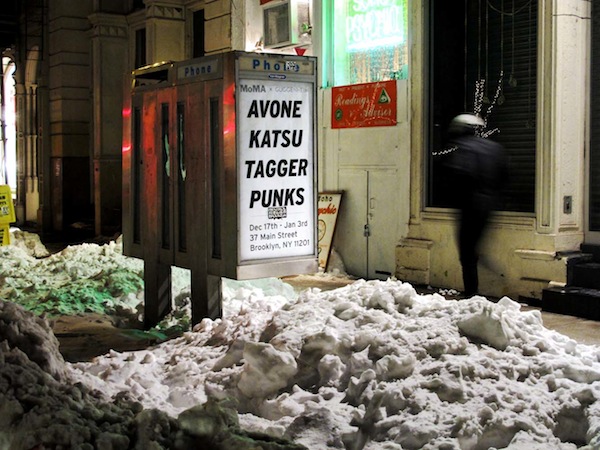
Katsu and Avone aka Destroy & Rebuild have a show on now at PowerHouse Arena in Brooklyn. To promote the show, they took over a number of phone booth advertisements in NYC. In the past, I’ve been known to criticize street artists for putting of posters promoting gallery shows when they could be doing street art, but I’m not sure I can criticize Katsu and Destroy & Rebuild in the same way. There are a few reasons for that: They went over already existing advertising, they are graffiti writers and graffiti is already about advertising a name and the general vibe of the work seems to me to be more about getting up and graffiti than advertising. I look at these posters and see clever graffiti in an advertising setting. Nonetheless, if you think I’m being a hypocrite for liking these posters (and hey, maybe my respect for these guys is clouding my judgment), let me know.
Also, their show ends on January 10th, so there’s still a couple of days left to see it.
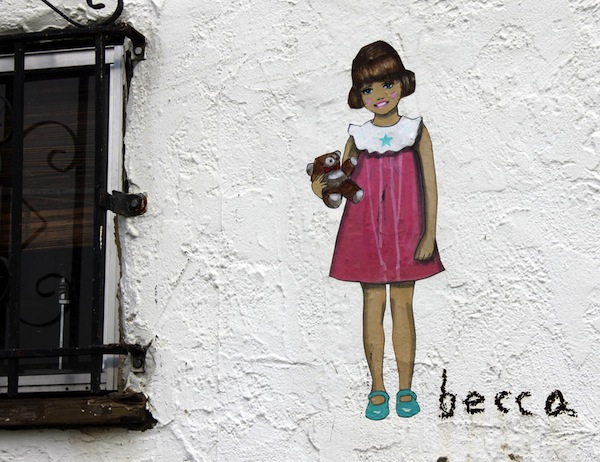
becca, an LA street artist who has been getting up since the late 1980’s, has just launched a website. When I first started seeing becca’s art online, I didn’t really care for it. It’s not the sort of thing I would normally be drawn to. But after a few people mentioned her art to me, I gave becca the benefit of the doubt and just figured there was something I wasn’t seeing or that people can have different but not “wrong” tastes. Then, last summer, I finally saw some of her artwork in person at Jonathan LeVine Gallery. In the flesh, there is a certain indescribable quality like care that comes across in the work. Immediately, I fell in love. For me, becca is just one of those artists whose work I need to see in person to really appreciate it. So I guess, if you’re like me when it comes to becca’s work, all I can say with this post is this: please make every effort to see it in the flesh at some point. Of course, it couldn’t hurt check out becca’s new website or read this interview with becca.
Well I’ve been back in London for about a week now, and I am beginning to understand why people think it’s so grey. When you live here, you get used to it, but wow I’ve only been away for a few months and already I think the constant greyness is annoying. Still, it’s good to be home. Here’s what the world has been up to while I’ve been watching it rain.
A group of artists protested the removal of Blu’s mural outside of MOCA this week by projecting images onto the buffed wall. Here’s a news story and a video.
José Parlá has a new book coming out and a solo show in New York next month. Arrested Motion has more info on both those things and the book is currently available online.
Kyle Chayka went on a bit of a rant about Banksy’s possible Oscar nomination, but he makes some good points.
Also on the topic of Exit Through The Gift Shop, the NYTimes is reporting that a man who has come forward as an original editor of Mr. Brainwash’s film Life Remote Control wants some credit for making the film that eventually sort of morphed into Exit.
Carolina A. Miranda wrote the latest cover article for the magazine ARTnews about the future of street art and it moving away from figurative work. You can read the entire article online. On the one hand, a move away from pop-art and figurative art seems to be counter-productive to the “art for the people” ethos at the core of so much street art, but it’s also certainly easier to turn a pop-art image into a marketing campaign while an abstract painting may do a better job of brightening up a grey wall without the artist and the viewer immediately thinking of dollar signs. I think street artists will just have to be careful to not become so conceptual that the possibility for people to understand or appreciate the art on some level without an artist’s statement is lost.
A mural by Shepard Fairey was partially painted over in LA by some other artists/writers. No big deal right? Happens all the time, right? Wrong, apparently. The mural was painted over by another artist showing at a gallery nearby. According to JetSetGraffiti, the artist has since apologized and will be paying for Shepard to repair the wall with a new mural. Okay, so should that mural still be there untouched? Maybe. Sounds like the local neighborhood liked it. Can it suck when things get dissed or buffed or written over accidentally or whatever else? Yeah. Should the artist have to pay for damages? Hell no! That’s the sort of thing that happens when you get arrested by the police for graffiti or street art, not something that art lovers should impose upon each other. The mural didn’t last forever. That’s the nature of street art. It sucks sometimes and there are ways to deal with it, but don’t make the vandal pay for damages!
NBC has done a really disturbing promotion in NYC’s parks for their new superhero show. Publicadcampaign explains.
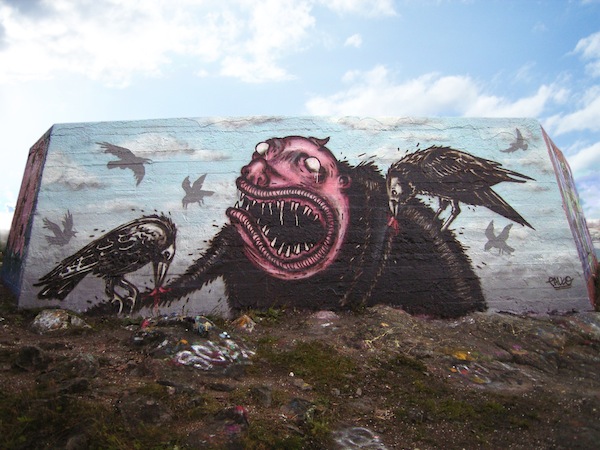
Pallo sent over some photos of what he’s been painting in Finland. I wish Romanywg could photograph some of Pallo’s work, they could be a great combo. Either way, Pallo’s painting some fun creatures.
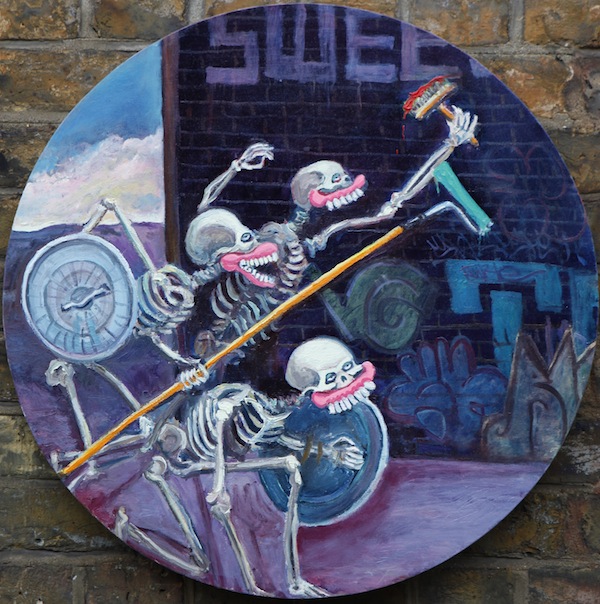
Sweet Toof and Shan Hur have a show next week in London at Arch 402. The show opens on the 11th from 6-9pm, and runs through February 3rd. I’ll definitely be there. Sweet Toof will be showing some new oil paintings. Here’s some of what he’s been up to…
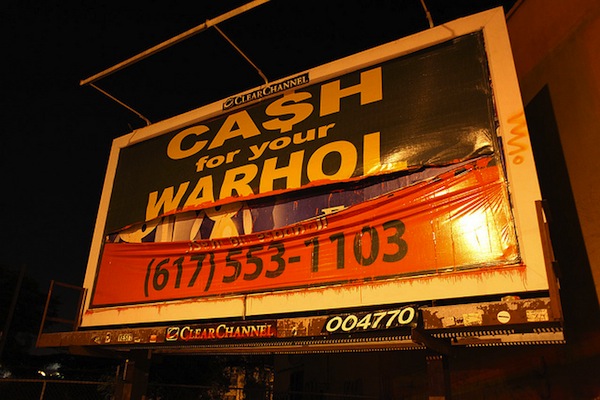
PosterBoy recently posted this photo on his flickr. It’s described as a “collaboration” with Hargo, who does the Cash For Your Warhol billboards and signs. Besides reminding me of Specter‘s sidebusts, it brings up some interesting questions. Like a lot of work that critiques advertising and a capitalist art world, Cash For Your Warhol’s work seems to have become, to a small community, an advertisement for the art as much as a critique of the art world. While I like what Hargo does, I think there’s also a lot of value in PosterBoy modifying the billboard. Jordan Seiler, someone I consider an authority on this subject, has said that the best advertising takeovers are those where there are no identifying features to turn the disruption into an ad of its own, and Hargo’s work certainly doesn’t fallow those rules. Nonetheless, the vast majority of art-fair visitors who say the above billboard outside of Scope this year in Miami would have had no idea about Hargo and not seen the work as advertising.
And of course, I could be misinterpreting this and PosterBoy could essentially be agreeing with Hargo’s sentiment about the absurdity of the art market by ripping apart the billboard as if it were a real ad promoting a sort of Warhol pawn shop.
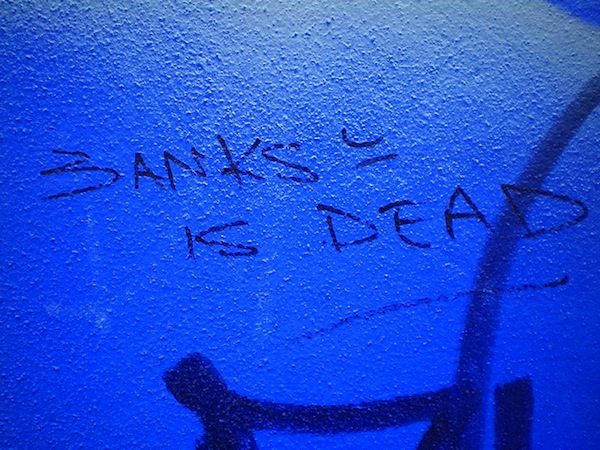
Can Banksy die? I’ve got no doubt that the man who was writing the name Banksy on Bristol’s walls in the 1990’s can and will, at some point, die. That’s not what I’m wondering though. Keith Haring has been dead for more than 20 years, but you can still buy new products with his imagery. Similarly, Basquiat’s estate released prints after his death. But those artists had names and faces. Even after their deaths, products can still be made using their images, but there’s not going to be any new imagery. But Banksy (the brand, not the man) doesn’t have those same constraints. Disney didn’t die with Walt Disney. Is Banksy one man or many people?
While he is anonymous, Banksy is publicly portrayed as being one person. But what does that one person actually do these days when it comes to making art?
It’s ridiculously risky for Banksy to paint his own street art…
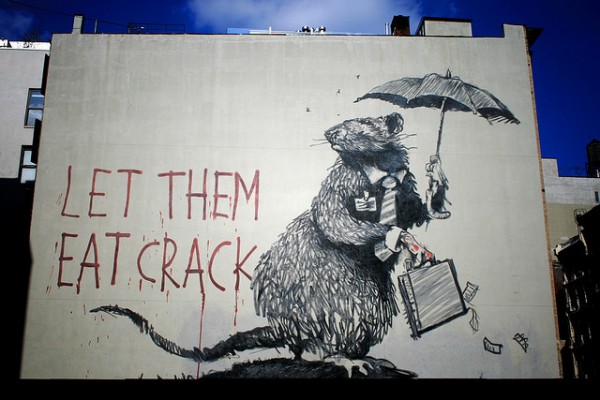
A Banksy billboard/artwork in NYC. Photo by caruba
Does Banksy paint his own street art? Shepard Fairey has said that he doesn’t (thanks to Mischa for the link to that article) and, in the latest issue of Very Nearly Almost, Eine says that he used to paint street pieces for Banksy. Given his high-profile status and the risks associated with painting outdoors, it probably makes legal sense for assistants to paint Banksy’s street pieces. If I were in Banksy’s position, I wouldn’t risk painting all of my own outdoor work. Even if Banksy does paint his own street pieces today and has always done so up until today, it would be difficult, if not impossible, to notice if that situation changed tomorrow.
There’s no way to know if Banksy paints his own gallery art…
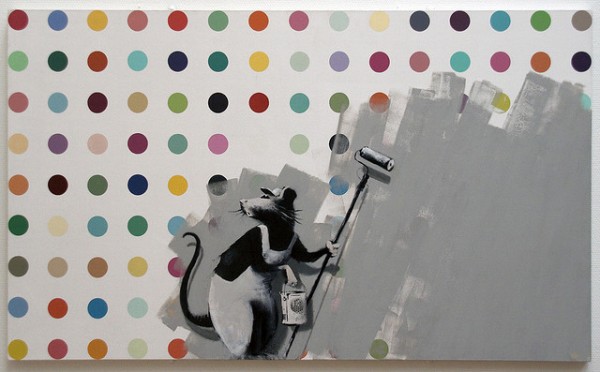
Collaboration between Damien Hirst and Banksy. Photo by ahisgett
What about his indoor work? Maybe Banksy still paints everything himself, but I’m doubtful of that. While hiring assistants might be more difficult for Banksy than Jeff Koons, it’s clear in Exit Through The Gift Shop that Banksy has a staff. At the very least, I think it’s safe to assume that Banksy isn’t executing the creation of any his sculptures himself (no matter what this video purports to show). And there’s little reason to think Banksy doesn’t have assistants completing part or all of his paintings. Banksy has said that he paints his own pictures, but how would anyone outside of his team know if he was telling the truth or not? Assistants who work on paintings for an artist are a widely accepted practice. As an extreme example, Damien Hirst has said that his best spot paintings were the ones painted entirely by Rachel Howard, his former assistant. Even if Banksy paints all his own pictures today, it will be difficult, if not impossible, to know if that practice changes in the future. Again though, some use of assistants for painting is probably what almost any artist in Banksy’s position would do.
There isn’t just one man who can come up with funny stencils…
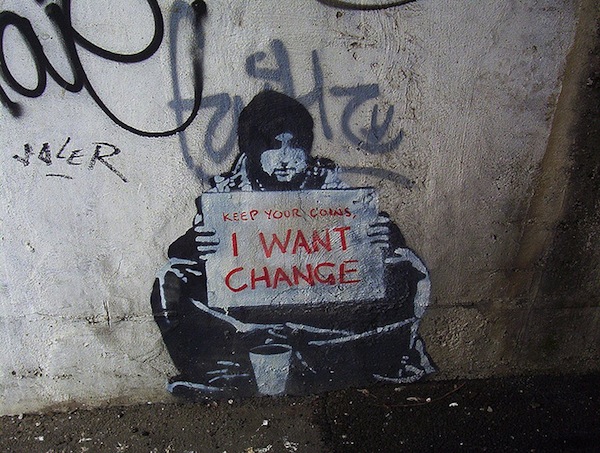
Stencil by Meek. Photo by Joshua Rappeneker
But regardless who who physically executes the artwork, conceptual artists have long contended that the artist is the one who comes up with the idea of the art, not the one who makes the art. By that standard, what makes a Banksy a Banksy is that he came up with the idea, but he isn’t the only one who could do that. Countless artists emulating Banksy, as well as generations of political cartoonists, have shown that coming up with clever 1-liners isn’t a skill possessed only by one man. Admittedly, I think most people find Banksy’s average success rate with his jokes to be higher than that of a lot the people he has inspired, but that is probably as much about being careful with what you put out there as it is about being clever. Maybe it’s true that no one person will ever be as good as Banksy at his brand of humor and commentary, but a dozen people working together probably could be. But I’ve already made an assumption here: Today, there is only one individual who comes up with all the ideas behind Banksy’s artwork. Again, we have no way of knowing how true that assumption is. Banksy’s cloak of anonymity means that the public really has no idea how many people contribute ideas to the Banksy identity. Today and in the future, the ideas behind Banksy’s art could come from one man or a team of 50 with no input from the original individual who called himself Banksy. How could we tell the difference?
Life after death…
Photo by Jake Dobkin
I’m inclined to think that Banksy, the man, is a hard working guy who does involve himself in the making of the artwork that he signs. But given all the possibilities for others to be involved in the Banksy brand without the public knowing a thing, it is clear that the Banksy brand can continue to create artwork indefinitely with or without the original man behind the name. Like the many boys who took on the role Batman’s sidekick Robin (oh, haha okay I came up with this metaphor days ago and only now as I write it down do I realize the irony given Banksy’s supposed identity. I’m an idiot), an anonymous artist’s name and image can be taken up by any number of people. If the man behind Banksy ever leaves the Banksy organization, or when he dies, will the public ever know? It’s possible that my grandchildren will be able to see “original” Banksy artwork completed a century from now. Banksy seems to have reached the absurd hyperbole of conceptual art: the original artist may not even need to conceive the artwork for it to bear his name. Banksy has finally achieved what Warhol and others set out to: the artist is truly a brand without a human identity.
This isn’t to say that Banksy’s death is impossible. It may happen one day. It seems only right that Banksy the brand dies with Banksy the man and it may very well end there, but it would definitely be possible for his team to continue the brand without the man. Then, the questions become would we notice, would we care and how would Banksy the brand change itself from the original intent of Banksy the man?
What do you think? Does Banksy’s death promise a new frontier for art? Have I completely misunderstood the brand/man that is Banksy? This is a post of questions I’ve been thinking about more than it is a post of answers and opinions, so I’m looking forward to reading other people’s thoughts in the comments.