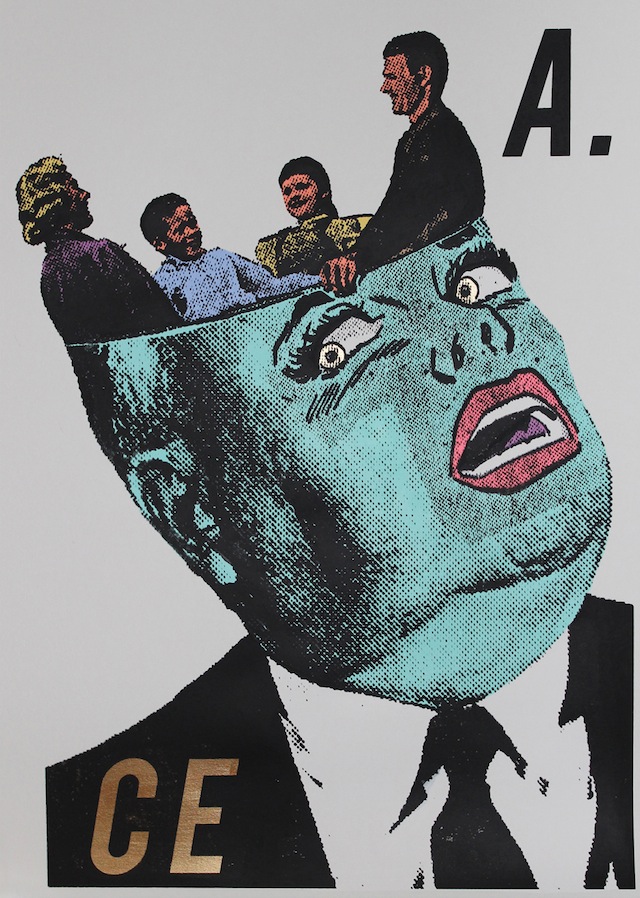
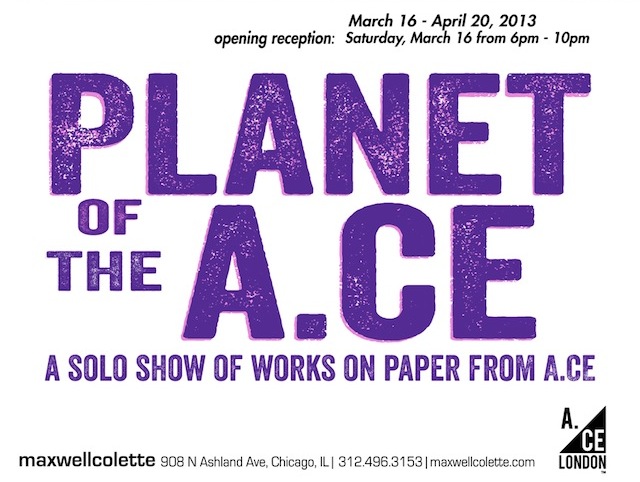
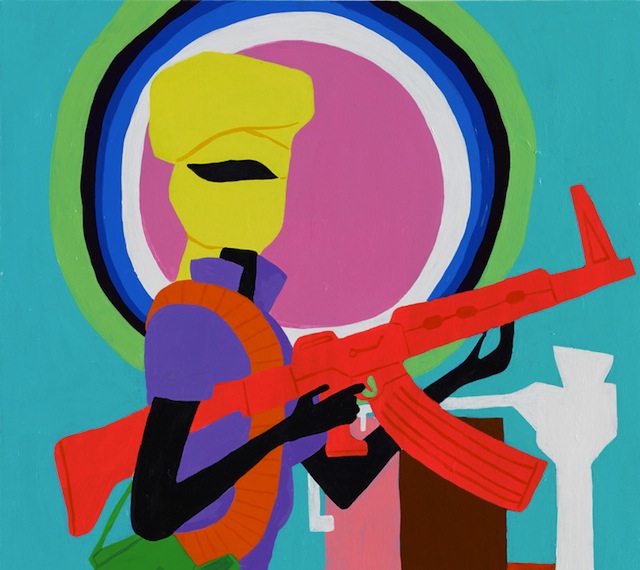
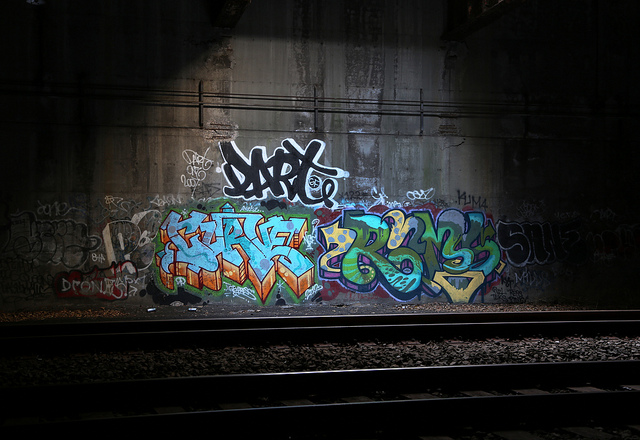
I’m excited to see that London’s A.CE is having a solo show at Maxwell Colette in Chicago this month. A.CE has been putting up posters in London since before I began looking at street art, and I’ve always enjoyed his work. There’s no denying that there are some similarities to Bast, but I compare him to Bast rather any number of other artists along those lines in part because we all know Bast is talented and I think A.CE is too.
Planet of the A.CE opens March 16th and runs through April 20th.
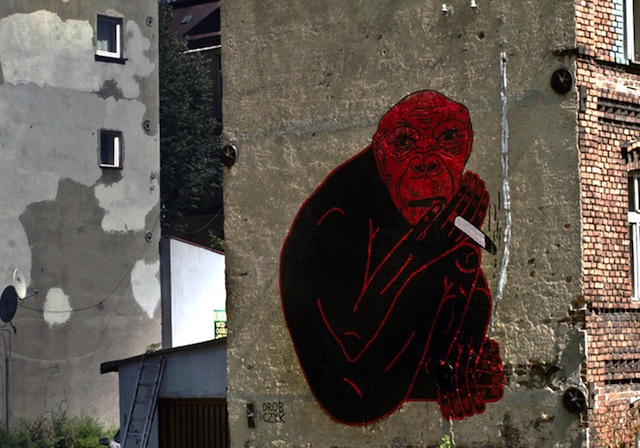
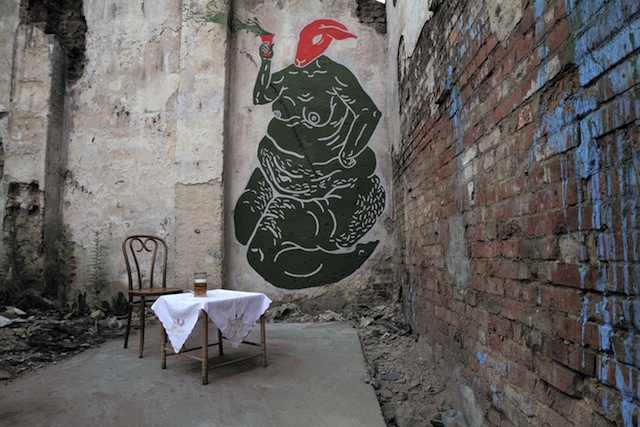
Wow. Came across the Polish street artist Drobczykthanks to Ekosystem (still one of the best places on the web for finding new street artists). Most of Drobczyk’s work is in Katowice, Poland. I love the folk-art aesthetic mixed with contemporary imagery.
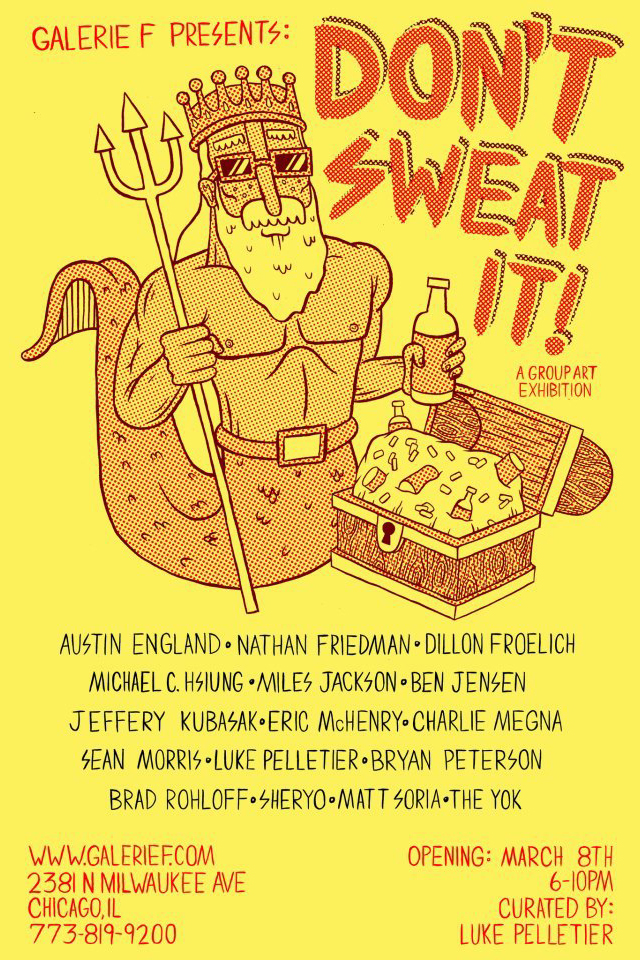
Chicago’s Galerie F has a group show opening tomorrow and it looks really fun. Don’t Sweat It is curated by Luke Pelletier and features work by The Yok, Sheryo, and many more artists.
As you can see from the video teaser below, the premise show is pretty straightforward: It features artists to draw cool stuff well.
Todd James‘ latest solo show opens this week at Lazarides Rathbone Place in London. The show, World Domination, will of course have some new works on canvas and paper, but the really exciting bit is that it will include a recreation of The Vandal’s Bedroom, part of James’ contribution to Street at Art in the Streets at the LA MOCA in 2011 (Street was a collaboration between James, Stephen Powers, and Barry McGee).
World Domination runs March 6th through April 11th.
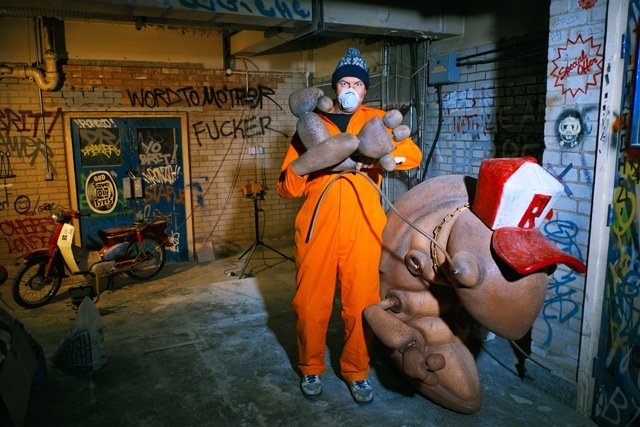
Tim Hans visited London recently, where he met up with seven artists for our continuing “Tim Hans shoots…” series, where Tim photographs some of the world’s most interesting street artists and graffiti writers. First up from Tim’s London trip is Ronzo, for which Laura Calle conducted this accompanying interview:
Laura Calle: Can you tell us a brief story of what inspired you to create materials for public urban spaces?
Ronzo: Sometimes you just get new ideas from walking through the streets and talking to people. Most inspiration comes through that and through other artists, what’s happening in world right now, music, film, popular culture and many other things. You see spots in the city and you see opportunities. You think: This would be a great spot to do something… It’s a great gift to have but also a bit of a curse. Ones you start – you can’t stop!
LC: What’s it like to set up a large scale sculpture in such a densely populated city like London?
Ronzo: It’s good fun. You need a truck with a big crane. Also pray that the roof doesn’t collapse and a massive monster crushes everyone walking by. But once it’s up, the sun rises and people on their way to work stop, thinking “WTF – Where did this come from?” It’s beautiful.
LC: What are the main differences you experience when making sculptures for the streets versus murals in public? Do you think the public interacts with those mediums differently? How so?
Ronzo: Sculptures are just a bit more of a niche. They take 1000 times more work to do. That’s why nobody does them I guess. But that’s great – It that makes them more special when you spot one. Also cool – You can walk around them. You can’t really do that with a painting. (But paintings are cool too)
LC: Does your audience influence your art or the approach you take to your pieces?
Ronzo: Tricky one. The feedback you get from an audience always filters back into new work of course. Although I want to do keep doing what I think is dope. And not the other way round. Of course your audience finds it interesting too in the end.
LC: What’s next for Ronzo?
Ronzo: Big tingz. New paintings, new sculptures, new installations. Details are classified top secret at the moment but will be revealed through the year. Please stay tuned…
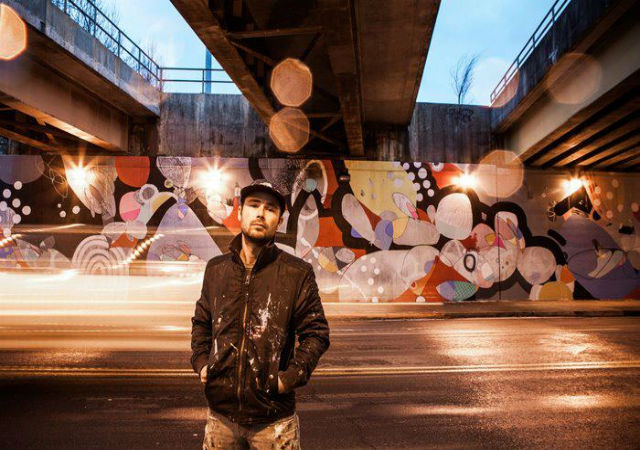
Hense has been committed to growing as an artist for nearly two decades now. The Atlanta native sticks to his guns by constantly showing support and advocating for the art scene in Atlanta. He’s done murals for the Atlanta Contemporary Art Center, the Museum of Design Atlanta, and recently transformed a historic church in Washington DC into a colorful, multi-surfaced piece of public art. Hense has exhibited his work nationally and internationally in solo and group shows, and has a long list of public art projects, commissions and collections. His abstract paintings and murals can blend precise line work with bright colors, shapes, and gestures.
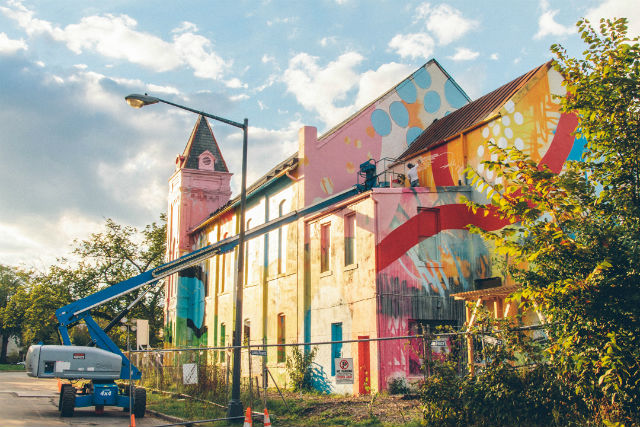
Nico Glaude: Let’s kick things off with the church you painted in Washington. First of all, congrats on the massive amounts of attention that the project got on blogs and art sites, well deserved. If you can just talk about how that project came to being and your overall experience painting such a historic piece of architecture?
Hense: The project in Washington DC was probably the most interesting structure I’ve ever painted. I worked with a small crew to complete it. The project was a private commission which was located in SW Washington DC across the street from the Rubell’s proposed Contemporary Art Museum. The area in DC is a part of town that has huge potential to be the next art district and this project is the first step in bringing some life and color into the area. Taking an existing object like the church and painting the entire thing recontextualizes it and makes it a sculptural object. We really wanted to turn the church into a three-dimensional piece of artwork. With projects like this one, we really try to use the existing architecture as inspiration for the direction of the painting. I did several concept drawings for the church to present to the owner as rough ideas of aesthetic direction. I knew that visually, I wanted it to be drastically different from what it looked like before painting it. I also wanted to use very bright and bold colors to catch a viewers attention from far away. Most of my works are done in layers. The first step was to just get paint and color on every side and surface of the building. We then started developing large shapes and marks that would takes days to paint. The entire process took several weeks of layering and working. I’m very happy with the outcome of this project. I really enjoyed working on such interesting architecture. I also love working large and with multiple surface changes. When I’m working in my studio I usually am starting with a blank piece of paper, canvas or wood, and with projects like these I’m starting with an already beautiful piece of architecture to add color to.
Historic church in Washington DC
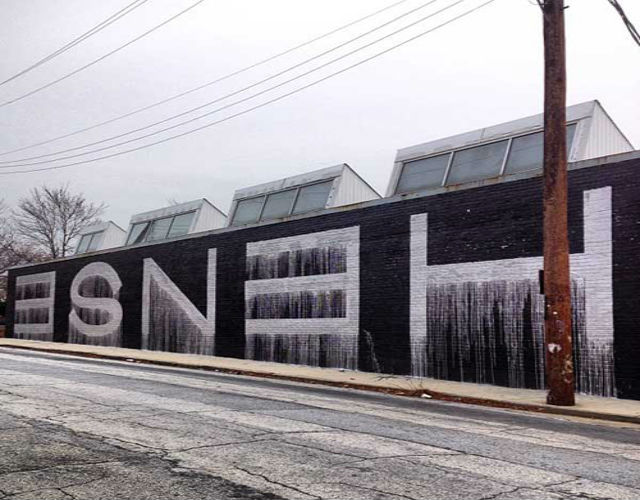
NG: Moving on to another mural you made for the Atlanta Contemporary Art Center. This mural is a complete departure from your most recent work; it’s a call back to letterform, minimalistic, comprised of only two colors and we get to see your name painted across a building. What was the inspiration behind the piece and why such a drastic change in style compared to previous murals?
Hense: I actually had another piece on the Center prior to this one and felt like it was time for an update. We were working on another exterior project right down the street for the Westside Cultural Arts Center which was very colourful and decided to do something totally opposite of that. I enjoyed taking it back to the pure essence of getting up. Silver and black, drippy block letters.
Atlanta Contemporary Arts Center
NG: Your murals always tend to be vast in terms of scale, and covered with a wide range of colors and shapes. What’s approach to doing a mural?
Hense: It really depends on the project. Right now I’m very influenced by interesting architecture. That could mean historic or contemporary. I enjoy working on flat surfaces of course, but a structure that has multiple planes and angles is much more dynamic visually before any paint is applied. It’s like having a blank canvas that is already layered and ready to go. Depending on the scale, I may have assistants work with me on projects.
Almost everything I work on is completely spontaneous and I rarely use a preconceived sketch or concept. I’ve been recently experimenting in treating my exterior works similarly to my paintings. Color is another important aspect of my work. I like to use bold, bright colors that make a statement and really pop.
The work is purely based on abstraction and the physical process of painting. I want to constantly push myself and the viewer as to what can be defined as a painting. I enjoy the experimental process of painting in my studio or outdoors and I never want to know ahead of time what the final outcome of the piece will be. For me, the exciting part of the creative process is the unknown and the experimenting that takes place to get from one stage to the other.
I worked large early on with my letter-based graffiti, so painting entire buildings was a natural progression. I used to write my name in big block letters 100 feet long and 50 feet high using silver and black oil-based paint. I think that has helped me understand how to execute large exterior works which can also have multiple surface changes. Working large for me is the best. As much as I enjoy painting in my studio, I can easily say that working on large exterior projects has been the most exciting. One of the major challenges of working on that scale is the material application to the surface. We need lots of tools and lots of paint. The marks and shapes need to be larger than most studio tools can make which means we have to invent new tools or methods for the particular project.
NG: The great debate of graffiti writers moving into gallery settings will always be contested, but it’s something that’s becoming the norm of late. How was your transition from the streets to the gallery and any advice for artists trying to make that same switch?
Hense: I would say to do what feels right, go your own route and be original.
NG: You’ve traveled a lot in the past because of your work. What is it that draws you to, and keeps you in Atlanta?
Hense: I enjoy Atlanta for many reasons. I think I’ve kept Atlanta as my home base because it allows me to grow as an artist and lets me hold down an affordable, nice studio.
I’m able to travel for projects whenever I need to and the City still has a great sense of originality and culture.
NG: So there’s the story of you getting booked bare foot while on the run from the cops, any other interesting stories that have happened to you whilst getting up?
Hense: That story your referring to is probably the most ridiculous of them. I’ve had my share of chases, bookings and incidents.
NG: What’s your favourite kind of spray paint to use?
Hense: I like them all.
NG: Do you have an all time favourite mural you’ve made?
Hense:
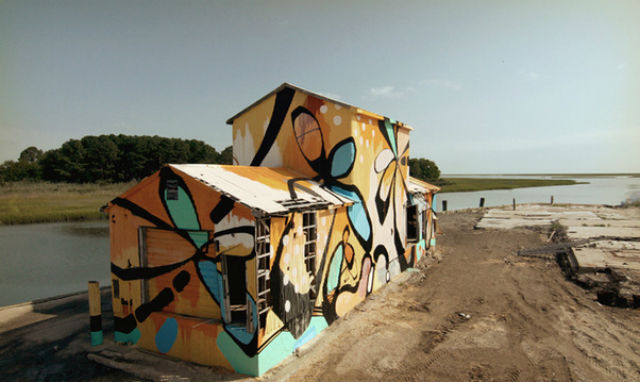
700 Delaware
2012
Washington DC
House paint and aerosol
NG: Toss up between a blank canvas and a blank wall, which would you pick?
Stenciling master Logan Hicks has a solo show this week at Los Angeles Contemporary Exhibitions (LACE). Thin Veils And Heavy Anchors opens on March 8th and only runs through March 10th, so mark it down on your calendars and don’t let this show pass you by. With this show, Hicks has continued to work with a combination of etching and stenciling, but he’s the work is on a massive scale that I don’t think I’ve seen from Hicks in quite a few years, and it looks like the combination of a stenciled layer beneath the etched architectural components (which I believe is new) has really helped to make the etched bits more aesthetically interesting (or perhaps just more apparent in photographs). I wish I could see this show in person, but I’ll settle for everyone I know in LA going there instead. So please go check out Thin Veils and Heavy Anchors at LACE.
The show opens on March 8th from 6:30-10pm.
Also, the LA Weekly is doing a print giveaway with Hicks. Enter here.
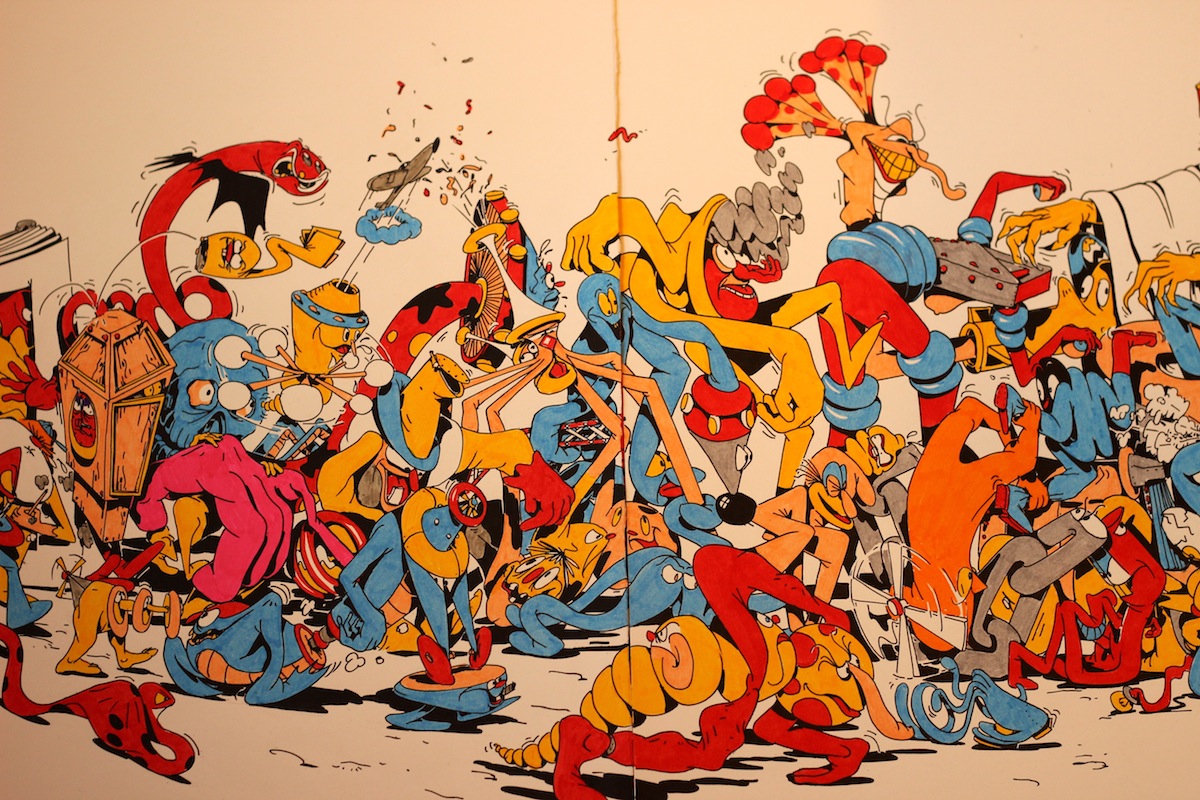
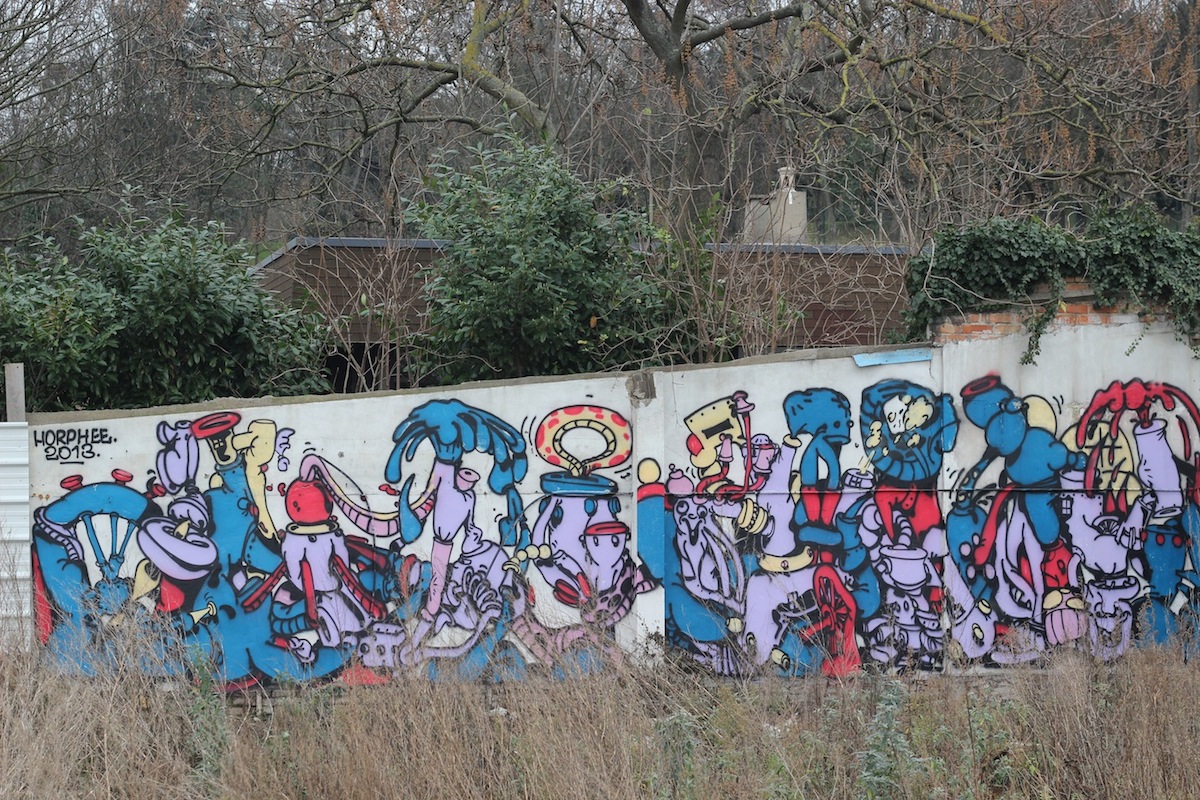
Parisian graffiti king and PAL crew member Horfee‘s first London solo show, Horfee’s Imaginarium, opens later this month with Topsafe London at 4 Wilkes Street E1 6QF in Shoreditch. Horfee is one of the world’s most interesting and celebrated active graffiti writers, and he’s got a very promising gallery career developing. Horfee’s mad cartoons have a rare crossover appeal such that they can be appreciated by those familiar with his graffiti and the fine art world too.
Horfee’s Imaginarium opens March 14th (5-9pm) and runs through March 23rd. Email horfe @ topsafelondon .com to RSVP for the opening.
I can’t wait to see more from this show, but Topsafe London has sent over quite a healthy preview. More after the jump…
Jack Murray aka Panik ATG has written a must-read post about some historic London graffiti on The Foundry being covered by a street-art-emulating ad for Microsoft’s Surface. Hopefully somebody once again uses that surface for something creative very soon.
I’m not quite sure what has happened here. First, an artist who goes by the name Edwin painted this piece in Hackney Wick. Now, it looks like this. It seems to me that Sweet Toof went up and added his teeth to the piece as a subtle diss to Edwin for ripping off LennyTheHighRoller, the character that Sweet Toof and Cyclops used to paint back when their Burning Candy crew really dominated Hackney Wick. Yes, lots of street artists paint skulls and graffiti writers paint skulls, but the similarities here, particularly the eyes and given the location, are too much to ignore as mere coincidence. Also, this might be a stretch, but the hands in Edwin’s piece kinda look like Gold Peg’s hands (who also painted with Burning Candy in Hackney Wick and elsewhere).
This film about M. Chat is screening in Philadelphia next week at the Slought Foundation. Strange thing though. The description of the film actually never gives the name of the artist, but M. Chat has a Wikipedia article and a Twitter account and shows work in galleries. Additionally, the Slought Foundation has posted downloadable templates of M. Chat’s work for people to customize and put up on their own. I called up the Slought Foundation and was told that Thoma Vuille, the man who it seems was behind M. Chat, is not involved in the show, although the man I spoke with suggested that the M. Chat logo may have been painted by a collective rather than just one man (like The Toasters collective with one logo and multiple members). So, is this appropriation of an unexplained urban mystery or theft an artist’s creation? I’m not one for strict copyright laws, but it does seem to me like the moral thing to do here would be to at least give some credit to Vuille aka M. Chat rather than pretend that the cat is still a complete mystery.