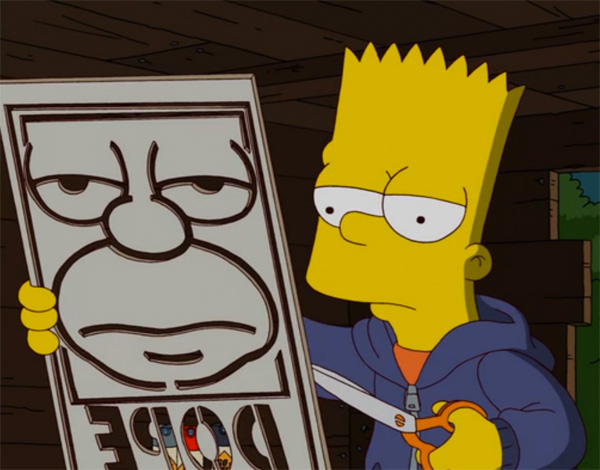
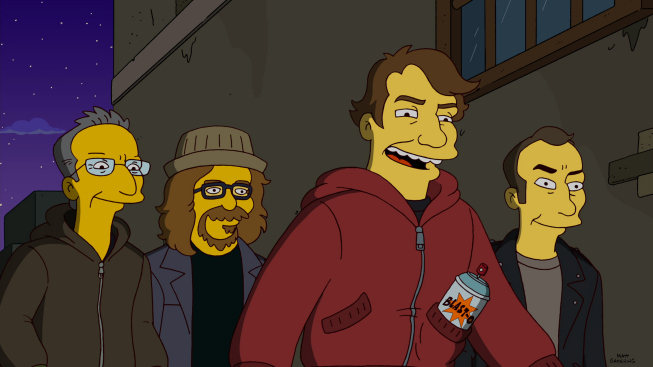
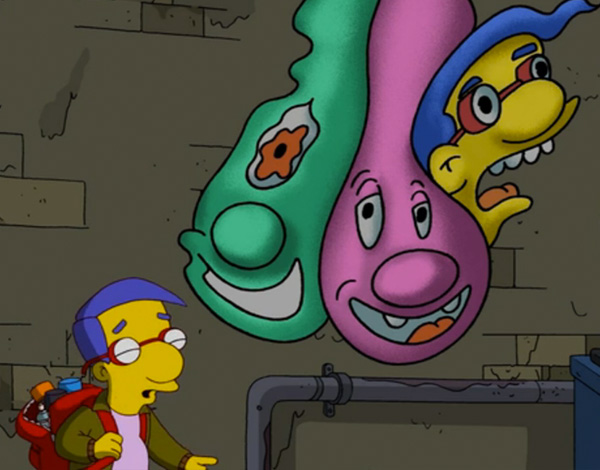
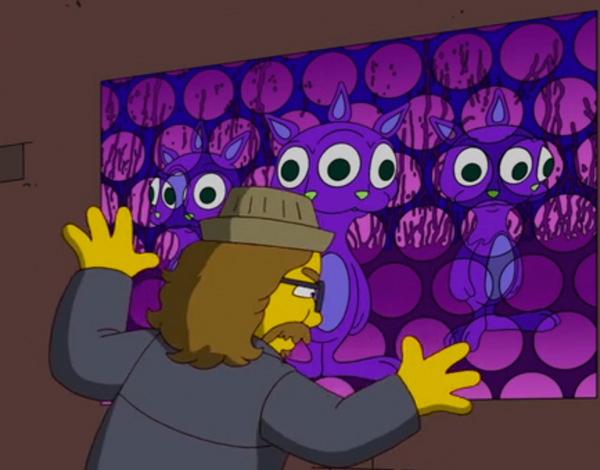
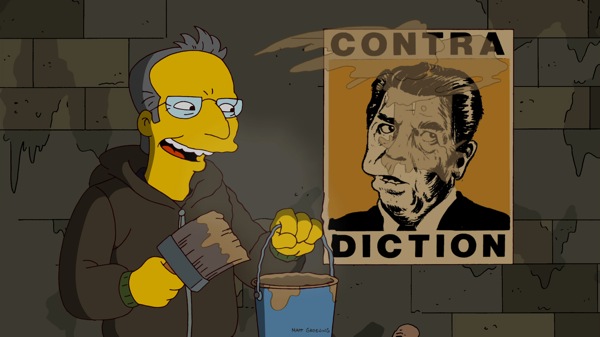
Last night The Simpsons aired the highly anticipated episode “Exit Through The Kwik-E Mart”, which guest starred a few of street art’s all-stars: Shepard Fairey, Ron English, Kenny Scharf, and Robbie Conal. The episode has Bart covering Springfield in wheat-pastes of Obey-esque posters of Homer, which eventually leads him to the likes of the street artist guest stars. If you want a full recap of the episode go here.
What struck me was actually something we all already knew- street art is on the market and has seen some fast and steep increases in its value. It’s just weird to see it satirized on The Simpsons: Bart’s street work leads him to show work in a gallery. Bart jumps on Homer’s car and tags the hood, and as Homer starts to yell at him for doing this, Bart points out that he just increased the car’s value by 50x.
Being on the Simpsons is definitely noteworthy for street art history. But this isn’t the first time art vandals have rocked the cartoon world: Obey Giant was on Family Guy. Invader was referenced on Futurama. Shepard Fairey’s Obama poster was featured on South Park. Banksy directed this cool Simpsons’ intro.
If you’ve seen the episode what did you think? If you haven’t, but still feel the need to insert your opinion, what’s your take on street art getting Simpsonized?
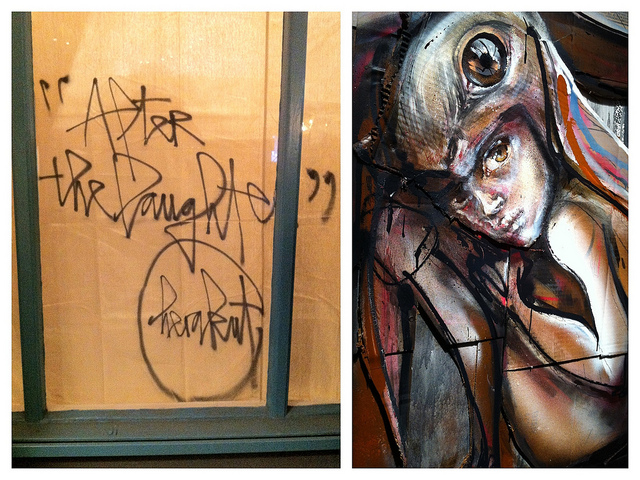
Herakut‘s recent solo installation at LeBasse Projects attracted quite a crowd to their Chinatown location. The exterior featured a carnival atmosphere–one with popcorn and cotton candy machines whirring and popping–but those belied the darker works on view inside.
It’s difficult not to compare Herakut and Os Gemeos after they had dueling openings on February 25th, but it’s worth noting that each was successful for different reasons, and in different ways. Although both featured triumphs of scale, and moved the bar up on what street artists can (and perhaps should) pull off in gallery spaces, Os Gemeos relied on playful lighting, bold color choices, and some instances of technological cleverness while Herakut combined their dark fairy-tale images with a flair for the dramatic.
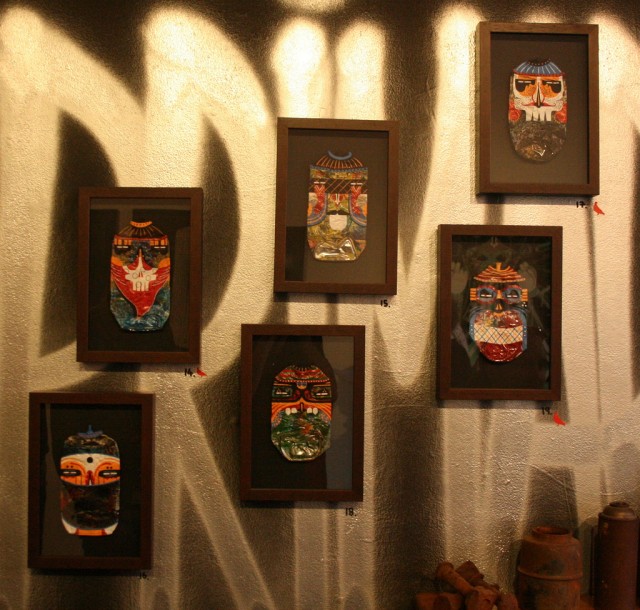
The largest pieces in the show came straight from the stage of Downtown L.A.’s Palace Theatre, where Herakut collaborated with Lucent Dossier on “When Lucent Found Herakut” earlier last month. In fact, members of the troupe worked the crowd over the course of the evening, dressed in masks designed by the German duo. A unicorn was present, a monkey too. I was put off by this at first; I felt it distracted from the art on the walls. It took me time to see that the artistry involved in the mask-making is a large part of what Herakut do, and these simply delivered life-sized recreations of their trademark women and children wearing animal head hats.
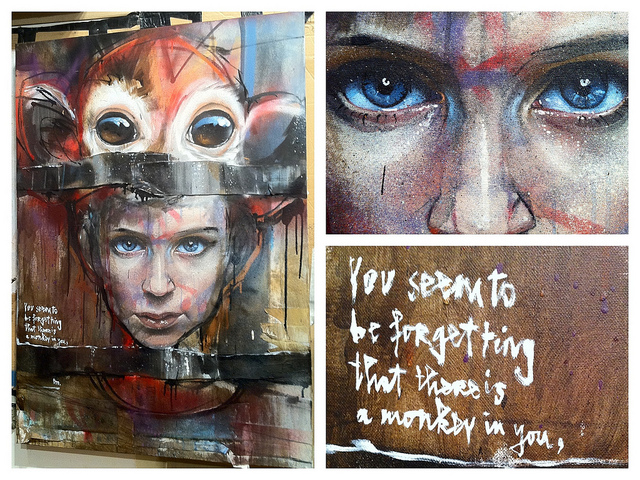
"You Seem To Be Forgetting That There Is A Monkey in You, Too."
One of the most intriguing aspects of the show were the statues (also adorned with hats) that were done either completely in casting stone, or with papier-mâché and tape, as was the case with two different deer pieces. However, the standout work was a canvas: a portrait of a child wearing a monkey’s head atop its own. The point where both merge is taped over–as is the chin–and it’s left to our imaginations how this fusion came about, or perhaps even how violent it was. The text reminds viewers that we “seem to be forgetting that there is a monkey” in us, as well.
It is this awareness of nature–not simply of the natural world, but also of our own human natures–that suffuses this show. It’s in everything from the small prints to the larger pieces. As with some Herakut, the work is not always the most comfortable viewing, but it is clear-eyed: a persistent reminder that part of what makes us human is the presence of the animal within.
“After the Laughter” runs through March 17 at LeBasse Projects Chinatown: 923 Chung King Rd. Los Angeles, CA 90012.
Sickboy has a solo show coming up next week in San Fransisco at White Walls Gallery. It will be Sickboy’s “first major US solo show” (whatever that means). Wonder Club, made up of a new body of work, opens on March 17th and runs through April 7th. While Londoners are probably quite familiar with Sickboy’s work on the street and in the gallery, this show should be something a bit new and very fun for San Franciscans.
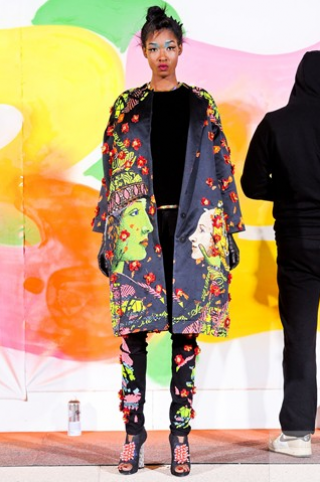
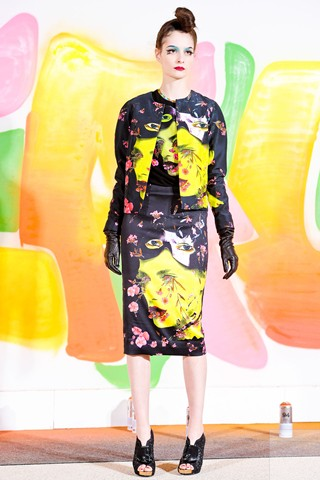
India based designer Manish Arora took to the streets as inspiration for his debut collection of ready to wear at Paris Fashion Week. The clothes featured superimposed images of Judith Supine‘s famed work throughout the collection. Created to look like a high end city street, the catwalk was transformed with the help of several Parisian graffiti artists who spray painted their colourful tags.
While many artists are turning to clothes to sell products to the mainstream (hey we have Labrona creating shirts for us), it is interesting to see the fashion world turning to street artists to sell expensive wares to women. While Judith Supine may not be a name that most fashionable will be familiar, they certainly know that prints are in this season (yes this is my girly side showing). Most importantly however, it is evident that Supine’s work translates well into clothing. We already know that Shepard Fairey, Miss Van and Keith Haring all know how to make street art fashionable, but few artists besides Supine have translated their works into catwalk worthy creations.
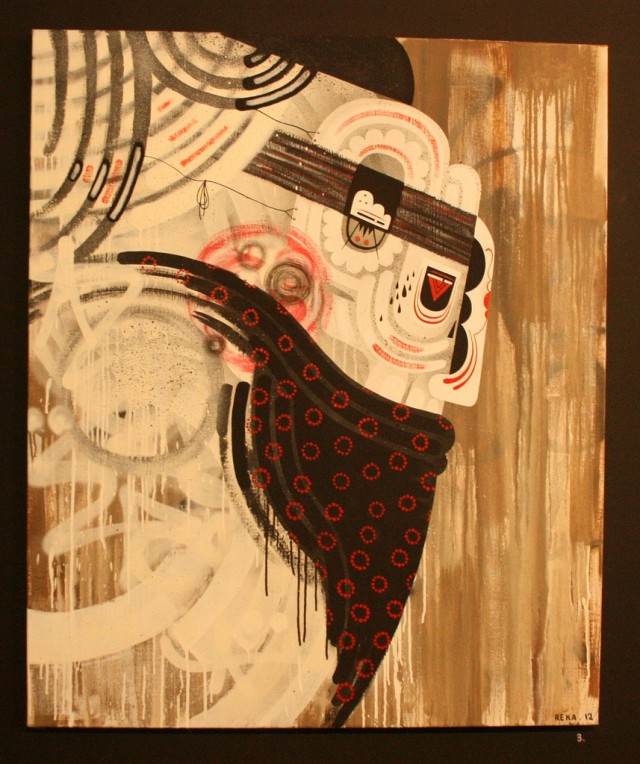
Last night I went to the launch of Reka‘s latest show “Primary Suspects” at Backwoods gallery in Collingwood. As usual Reka did not disappoint.
Reka’s blog gives a good run down of what the show is all about… “When a suit goes to work, they take their briefcase. When I go to work, I take my cans. Primary Suspects is a reflective exploration into the lifestyle of street vandals and the effect that it takes on us, both mentally and physically. From brushes with the law, confrontations with other graffiti writers, climbing onto rooftops and exploring the underground, the streets have become our desks” (Read the rest here).
The show also explores Reka’s fascination with old found spray cans, which he has painted and named after some of Melbourne’s graffiti and street art legends.
Apart from the paintings and old cans, Reka put together a short looping film of himself wearing a suit and getting sprayed by hydrants full of paint in the 4 primary colours. This played on the back wall and got a lot of attention.
It’s officially spring break, which meant the last week for me has primarily consisted of sitting at my desk where I read and type furiously until my eyes are tearing up and my fingers are sore. It also means I could only blog when procrastinating and that the next few days should be a chance to write some longer posts that I’ve been sitting on. In the mean time, here’s what I’ve been finding around the web this week:
The man who came up with the Broken Windows Theory died this week.
The Living Walls Conference has two great announcements this week: 1. They are now a 501(c)(3), aka an official non-profit organization. 2. In addition to the annual conference, there will be 6 “Living Walls Concepts” mini-events throughout the year, starting in March.
Craig Ward wrote a letter critiquing Banksy’s critique of advertisers. Given: Banksy is one of the world’s best marketers himself. Beyond that, the letter is a bit of a mess and Ward points out that he has worked in advertising himself. Clearly, it’s written from the perspective of someone who has lost his perspective and seems to boil down to “There’s worse stuff in the world, so umm, please leave advertisers alone.” No doubt that there are greater evils in the world than the public advertising that seems to be the primary target of Banksy’s critique of advertising, but that sure as hell doesn’t mean it’s a good thing. Additionally, one of Ward’s points as to why traditional advertising isn’t as bad as Banksy’s advertising is that traditional advertisers pays for the locations they use. With that argument, Ward completely disregards both the negative externalities of massive ad campaigns that occur regardless of how much the advertiser pays (compared to the documented positive externalities of Banksy’s street art) and the illegal nature of many advertising campaigns which do not pay the government for the space that they use. By his standard, hiring an assassin to kill someone might be better than doing it yourself, because at least there’s money involved and somebody is getting paid for their time.
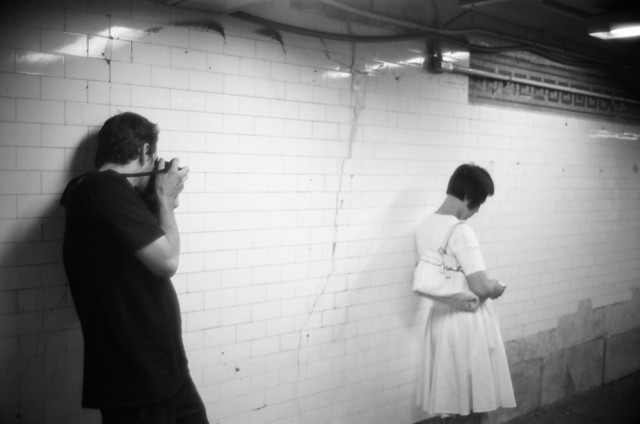
Okay this is a little bit outside of Vandalog’s usual coverage, but the fantastic street photographer and filmmaker Cheryl Dunn has a show opening in London this month at a brand new gallery run by Pedro Matos called Ivory & Black. Dunn’s work was included in the Art in the Streets show at MOCA in LA last year and also in the classic documentary Beautiful Losers. Dunn’s show, Sometimes the Answer, will open on March 23rd from 6-9pm and run through April 21st. Work for the show will span Dunn’s 30-year catalog of images and there will be a book published to accompany the show.
Ivory & Black promises to be an important addition to London’s art scene. They are working with Andrew Schoultz, Cleon Peterson, Cheryl Dunn, Deanna Templeton, Ed Templeton, Geoff McFetridge, James Jean, Pedro Matos, Richard Colman, Ryan Travis Christian, Skullphone and Wes Lang.
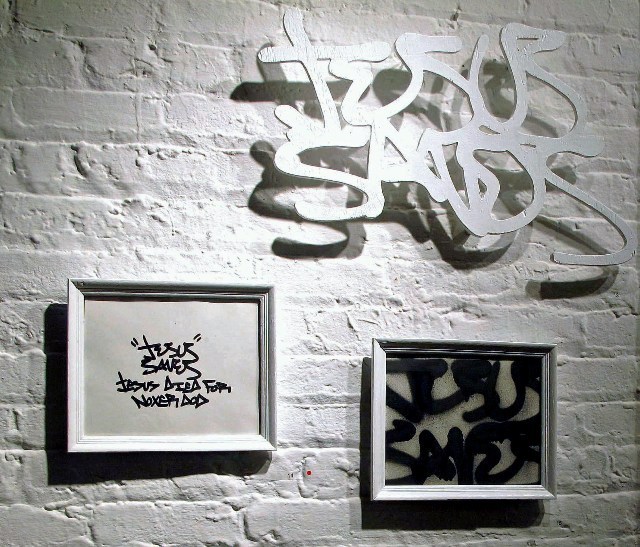
Jesus Saves -- whose tag is just about everywhere in NYC
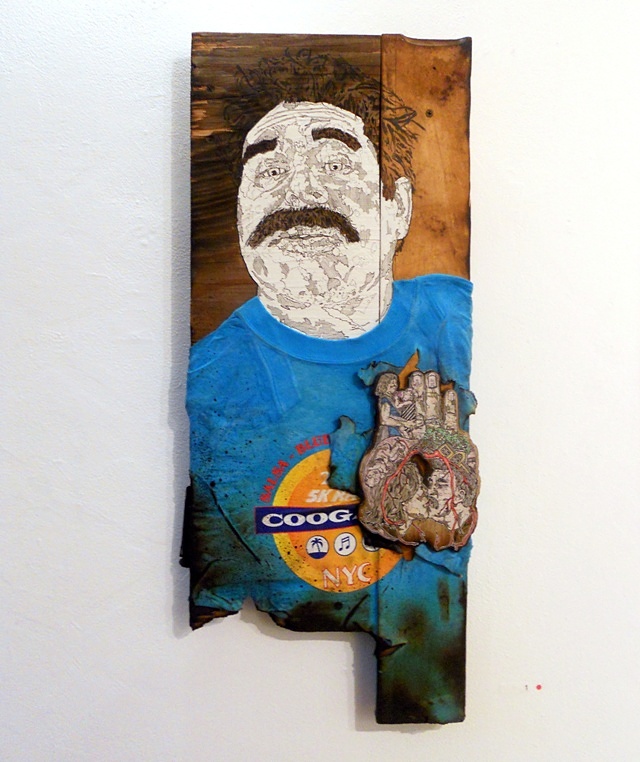
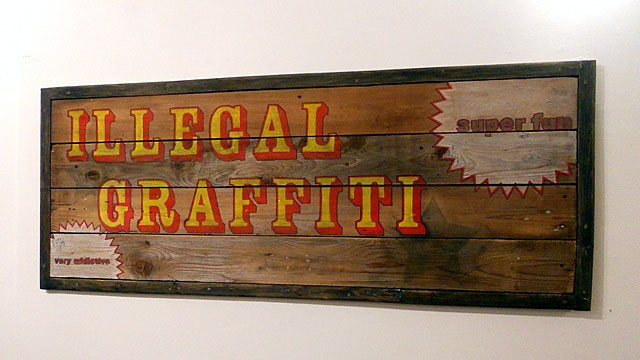
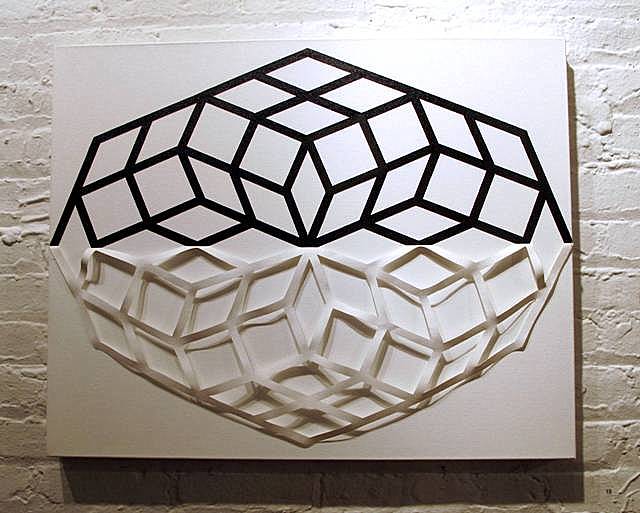
We made it over to Pandemic Gallery’s current exhibit ALL TALK! earlier in the week and loved the way it presented the works of some of our favorite artists whose work surface regularly in the public sphere. We also loved the incredible mix of aesthetic sensibilities. Here’s a sampling:
NohJColeyGabriel SpecterAakash Nihalani
The exhibit continues through March 11th @ 37 Broadway (between Wythe and Kent) in Brooklyn.
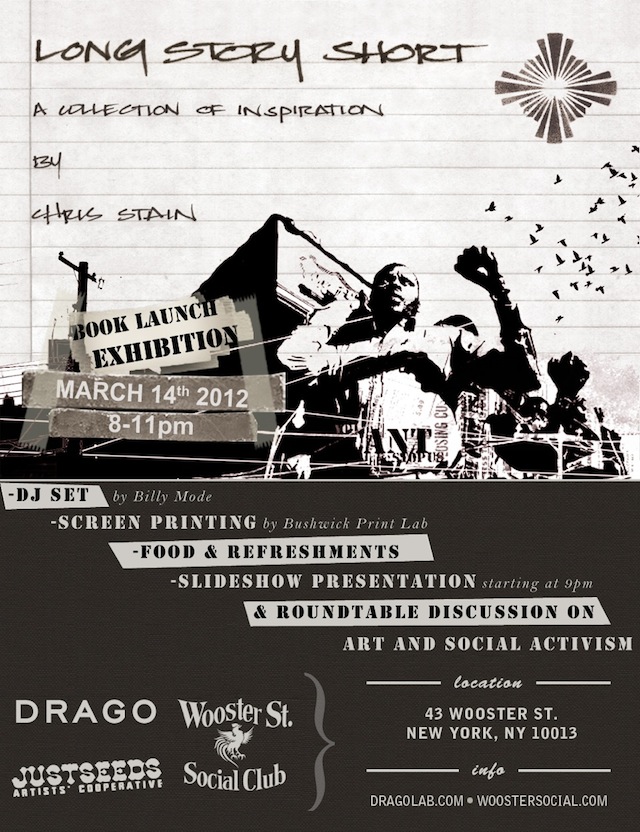
Chris Stain (interviewed) has his new book, Long Short Story, will be launched at the Wooster St. Social Club, site of the television show NY Ink, on March 14th from 8-11pm. Long Short Story is being published by Drago. Drago describes the launch as a “book launch/art show/printmaking/music/food/lecture event extravaganza,” and the art exhibit accompanying the launch will stay up for two weeks.