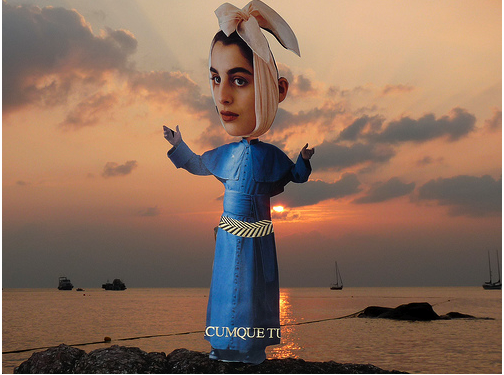
New Judith Supine in Ko Tao, Thailand after the solar eclipse. Photo by Patrice Roldan.
Check out the latest Banksy piece which has recently appeared in Park City, Utah, where the Sundance Film Festival starts on Thursday. Apparently there are a few other pieces by him in Park City as well, but this is the only one with a nice photo online so far. I’d love to see somebody take some pictures of all the documentary filmmakers who will undoubtedly be filming this piece over the next few days.
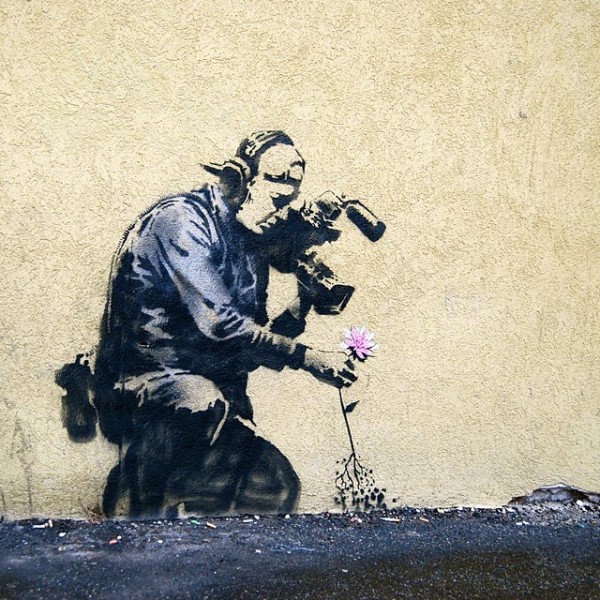
Photo by Brendan Bybee for whitelotuscooks.com
I Love Graffiti has posted two great interviews this week. The first is with graffiti legend Taki183 and the second is with Robbo (of fighting with Banksy fame).
With Taki183:
Taki, where did you grow up?
I grew up in Washington Heights, moved there when I was a little kid. A lot of Greeks at the time stayed with the Greeks, then that changed with the Heights, the183th street, hung out with everybody and it was a pretty nice place to grow up.
Is it safe to say Washington Heights was the birthplace of modern graffiti in New York City?
I would say the east side of Manhattan was the birthplace of graffiti because that’s where the media picked it up. They couldn’t give a crap what happened in Washington Heights or the Bronx. When it happened on the east side, that’s when it was in the paper.
When you started writing graffiti, what were you calling it? Did you call it tagging or writing?
I think we were calling it writing, but if we saw a subway car we would say, “Let’s go hit the car.” If you hit it from end to end, you’d “kill the car”— that was how we talked Part of the reason it became big during the summer of ’70 is because I was going to summer school at George Washington High School and my desk was full of graffiti. I had written my name and all these people would write on my table also. I already had a name and people were meeting me and they would go out and write. That was the big summer I was working as a messenger. I was in a lot of places and I just kept writing; as long as I had a marker I’d keep writing. It was addictive.
You were doing this solely for the purpose of writing your name?
Yeah, just to say I was there, basically.
Read the rest on I Love Graffiti…
And with Robbo (which was actually the English translation of an interview done for a Hungarian blog):
When did you start writing graffiti, and what did inspire you?
Robbo: Back in the late 70″s and early 80′ i was a young skinhead writing on wall’s before i new what graffiti was. About 1983 i had seen graff on tv. films ie; the worriers, at about that time i noticed a tag named KOSH and realized that he was a writer a well and thats where it all began.
How did you tell your parents, that you’d like to do this? What was their reaction?
Robbo: My mum was cool about it as graff was not the social problem that it is today. I never lived with my dad but when i see him he always said he new i was ok coz he See my name everywhere.
How did you feel, and what did you paint on your very first painting?
Robbo: My first piece was of (THE MASTER ROBBO) with a ghostbusters character. I felt very prod and excited.
What names and crews have you painted so far? When and how did your current crew founded, and what does it’s name stand for?
Robbo: ROBBO,ROB484,ROBSTER and ROBER. WRH (we rock hard.1986 till now)
WD (world domination. 1987 till now). PFB (only crew members are allowed to know what it stands for. 1989 till now ). My first crew was THE ART MASTERS (1984‐86).
Read the rest on I Love Graffiti…
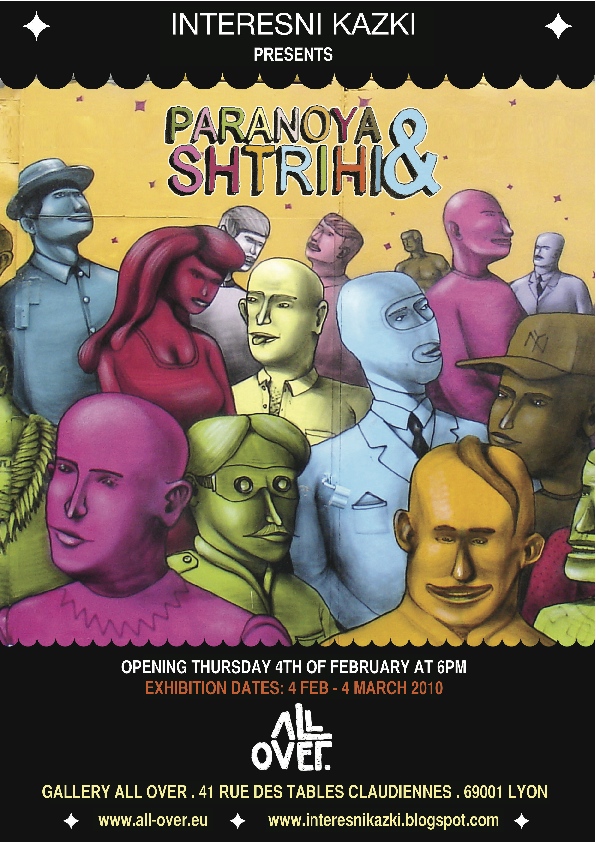
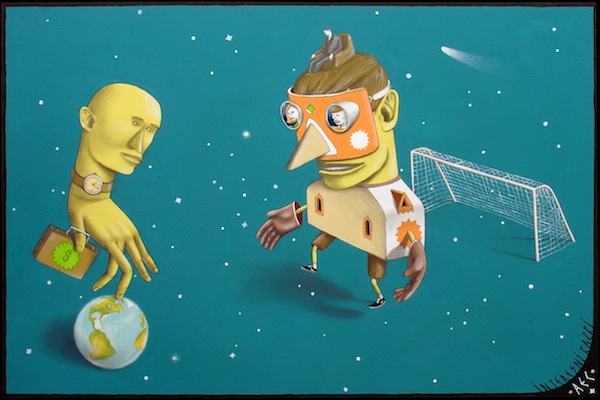
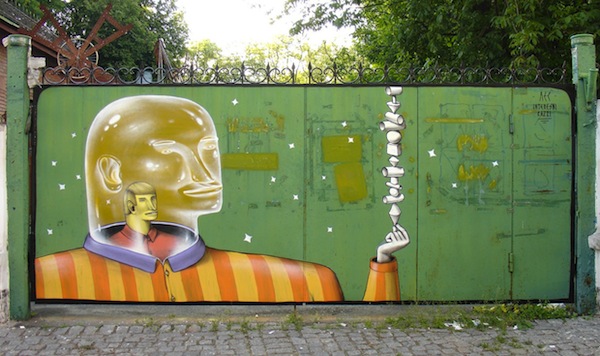
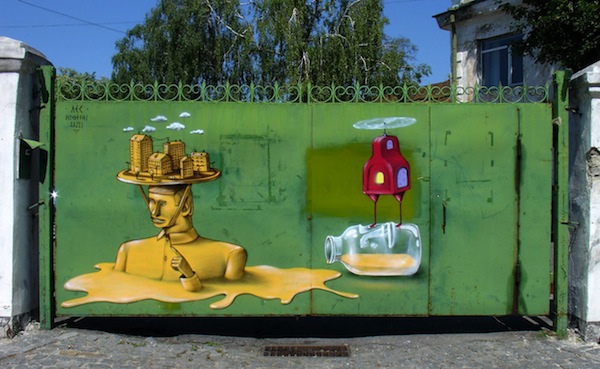
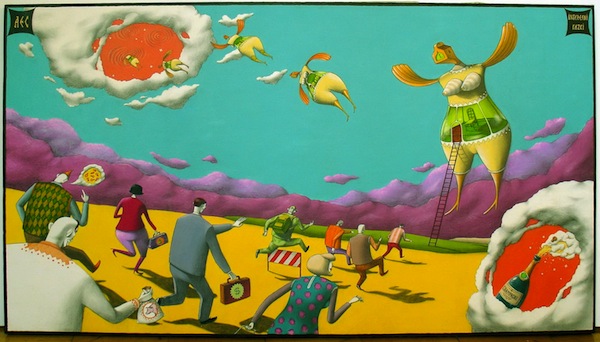
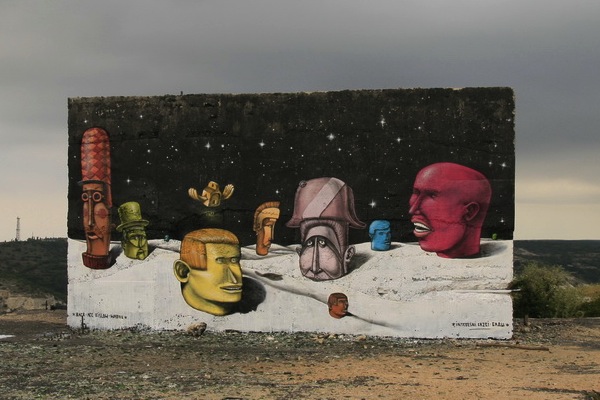
Interesni Kazki are pretty much what people think of when they think of street art in Ukraine, so I’m excited to see that they are bringing some of their work to Gallery All Over in Lyon, France. The duo’s imagery is somewhere between Date Farmers and Os Gêmeos, but still all their own.
For the first time in France, Ukrainian artists AEC and Waone from Interesni Kazki will exhi- bit their last work in the gallery All Over, in Lyon, for a show called “Paranoya & Shtrihi”. Their enchanting world of animated objects, symbols and characters will be displayed with work on canvas, papers, and murals. Opening will be on thursday the 4th of february and the show will runs until the 4th of march 2010.
AEC (Aleksei Bordusov) and Waone (Wladimir Manzhos) are two precursors of graffiti in Eastern Europe. Both grew up in Kiev, Ukraine, where they developped their art among the collective IK they created in 1999. At first, these initials corresponded to Ingenuous Kids, a crew of 11 friends who practiced graffiti. As their art evolved over the years, in 2005 the two friends continued their passion under the name of Interesni Kazki (that we can trans- late as “interesting tale”) in order to slowly break with traditional graffiti codes. They stood out for example, by excluding lettering from their paintings in order to represent fantastic and surrealistic characters. This new art bears a certain relationship to the South American Muralism movement, whose practice consists of painting murals with political content over the walls of cities, especially on public buildings.
They usually work together, which allows them to be better organized, and therefore even more efficient. They also use very large areas such as entire building facades, a dozen of which have already been completed in Kiev, as well as more than 50 other paintings all over Ukraine.
All these paintings share the fantastic sphere proper to Interesni Kazki representing the imagery of fairy tales, magic, space, mysticism, science and religion. This world of living objects, symbols, and magical beings is “an all-embracing image of the universe” which denies the ordinary and senselessness. Through this paradoxical universe the two artists wish to represent reality the way they perceive it and in turn allow the spectator to discover his or her own respective reality.
Here’s some of their artwork:
Check out the latest giant stencil project from Broken Crow:
Broken Crow Stencil Mural – 1 Day Time lapse – Lion Man from The BFC on Vimeo.

Andreas von Chrzanowski / case is not only part of Ma’Claim, one of the world’s greatest crews – his fine art is some of the best being created today. Andreas has a show coming up at Signal Gallery (in conjunction with Campbarbossa) on February 18th called Never odd or eveN. Here’s a quick preview of what has gone on behind-the-scenes to create each immaculately spray painted artwork.
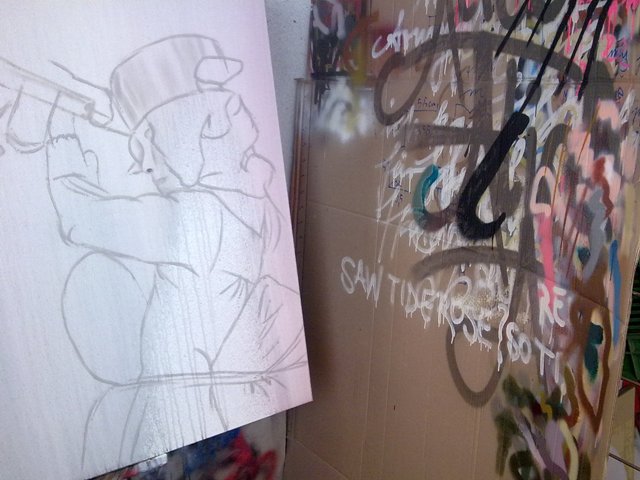
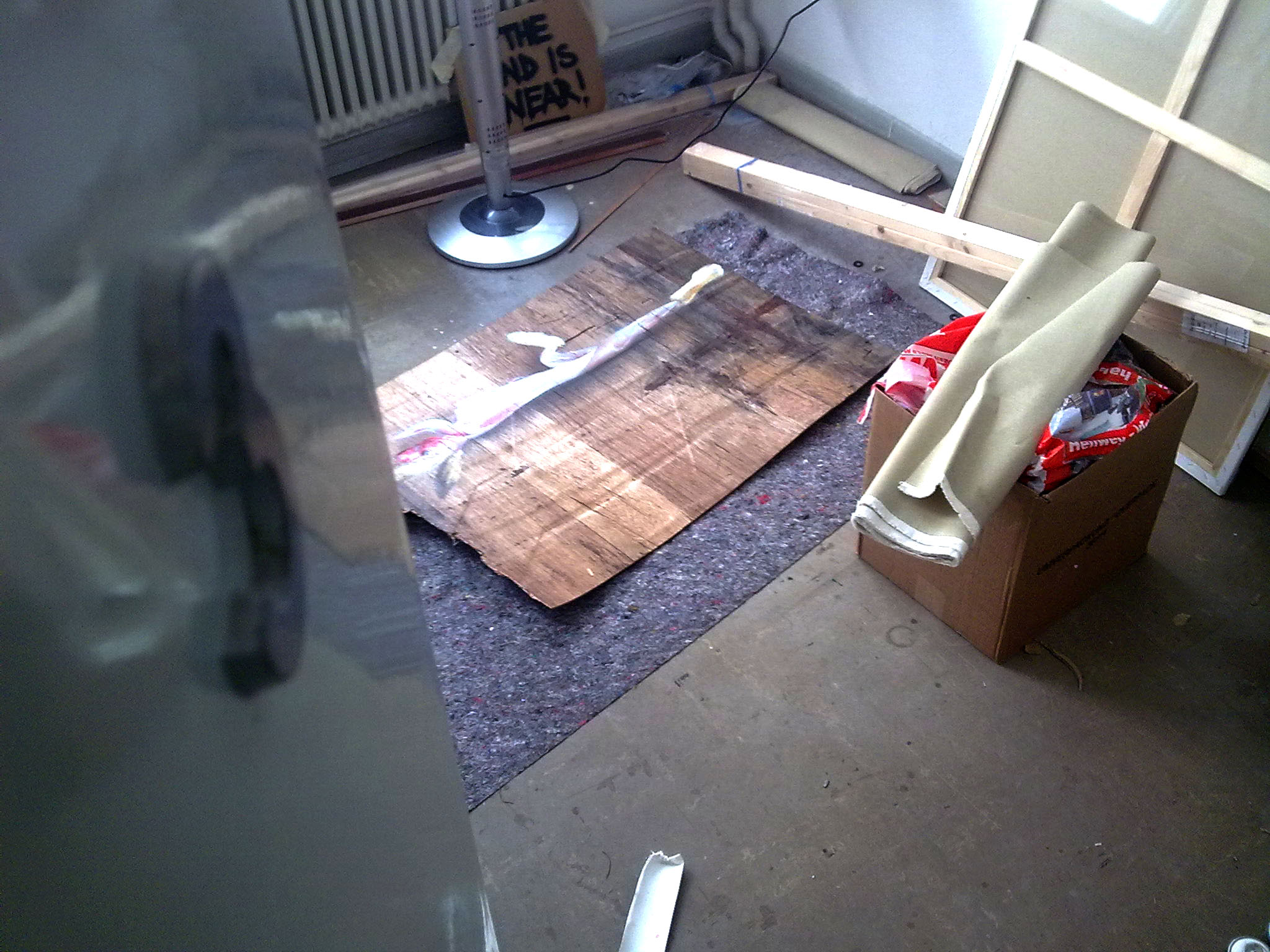
I must have a thousand amazing photos so will post more soon! If you’re in London next month, make sure to head on over to Signal to see it all in person.
– Elisa
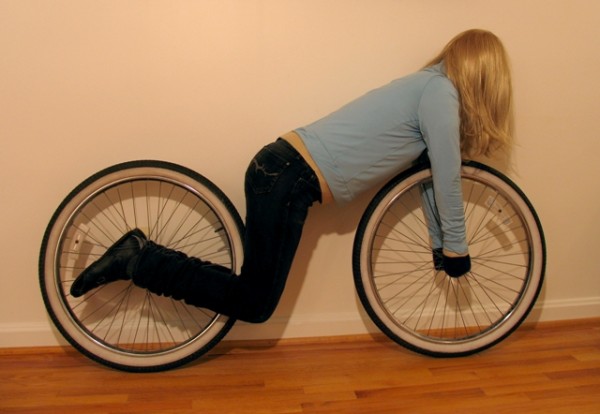
This Thursday, LA is in for a treat: The opening of Mark Jenkins’ solo show Meaning Is Overrated at the Carmichael Gallery.
In January 2010, Carmichael Gallery presents Meaning Is Overrated, a solo exhibition of new hyper realistic conceptual works and site-specific installation pieces by Mark Jenkins that reconsider the aesthetic and practical qualities of the human body. Works range from those in which the human is recast as a specialized object, such as Spokes, which features a tape cast sculpture of a girl fashioned to function as a bike, to those in which human posture is contorted to resemble that of another animal. Each piece is “an exploration of evolution within the realm of the absurd,” says Jenkins.
There will be an opening reception for Meaning Is Overrated on Thursday, January 21 with Jenkins in attendance. The exhibition will run through February 18, 2010.
Mark Jenkins is an internationally acclaimed American artist known for the mixed media sculptures and street installations he places throughout urban and environmental settings, sometimes with, but often without, permission. Playful and enigmatic, his work successfully transforms the ordinary into the unexpected.
Jenkins’ process involves dry-casting everything from fire hydrants and toy ducks to baby dolls and people, often himself or his assistants, with box sealing tape, the latter often dressed to appear scarily life-like. When placed outside or slipped indoors, announced or otherwise, these sculptures have the ability to both camouflage into their surroundings and elicit spectacular amounts of attention from viewers.
Jenkins’ works have been observed lounging atop billboards, slumped over on cafeteria tables,
panhandling in the streets, emanating from street poles, drowning in bodies of water, clinging to statues, overturning street signs and more in locations such as Belgrade, Vienna, Washington D.C., London, Barcelona, New York, Moscow and Seoul. By situating his pieces within such peculiar contexts, the artist brings cities, landscapes and interiors to life in a unique and thought-provoking manner. Whether indoors or out, his work engages its viewers and provokes a complex examination of self and surroundings.
Don’t ask me how it happened, I’m still not entirely sure, but if you happen to pick up a copy of Vogue Italia this month, you’ll find an article about me and street art on page 96. I don’t speak Italian, but based on Google’s very rough translation, the article seems to be about The Thousands and me proselytizing street art as “museum quality.” So that’s pretty cool. And, because a. I’m no fashion icon, and b. it was an article about the virtues of street art, instead of photos of me taken by a famous photographer, the article features some pictures from The Thousands book of work by Burning Candy, Skewville, Elbow-toe and Chris Stain, so be on the look out for next year’s line of Skewville inspired tshirts at H&M.
Kaws recently spoke with talk@playground and made a series of video interviews in conjunction with Pharrell. Here’s one of the videos:
The rest, all with Pharrell, can be seen on talk@playground.
As previously discussed here, Banksy and Robbo have been having a bit of a fight lately. Now, Robbo has gone over a 2nd new Banksy piece and promises to hit even more. Here’s Robbo’s latest dis:
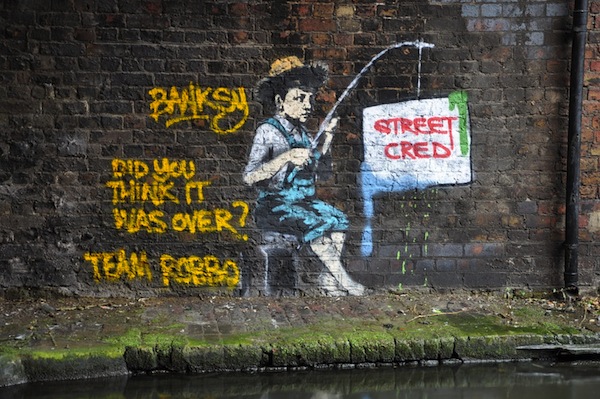
I could get into the details of this whole thing, but whatever I write about this story will be 2nd to what nolionsinengland has already posted over at Graffoto. It’s a must read post for Banksy fans or anyone interested in the the battle between graffiti and street art.