The New York Times is given you a chance to ask graffiti legend and talented fine artist Lee Quinones (aka Lee) a question. I don’t get star-struck often, but he was at the Primary Flight opening in Miami last year, and I just froze up whenever I caught sight of him, this guy is a legend. Just go to their website and post a comment on the article to ask your question. The first set of questions will be answered on Wednesday.
There are a lot of people commenting already. One of my favorites is from Anne. She asks, “Since it appears you have profited as a result of your graffiti art, have you made any effort to pay restitution to the city or other property owners of locations you vandalized?” That’s probably the most inteligent way I’ve ever heard somebody ask a graffiti artist how they feel about coming from an illegal art movement into something legal that profits from those illegal actions. Much better than how Nolane put it.
This could be the best piece of street or public art ever to grace the streets of New York City. I guess we’ll see…
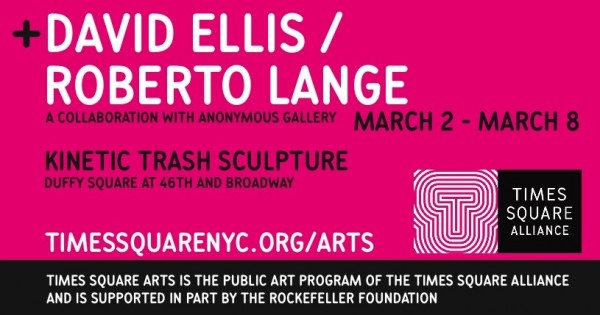
March 2-8 2010, during the Armory Arts Week and in addition to a booth at SCOPE Art Show, Anonymous Gallery collaborates with the Times Square Alliance to present a public installation from artists David Ellis and Roberto Lange. The kinetic sound sculpture, conceptualized by Ellis and composed by Lange, will be carefully positioned in the Duffy Square area of Times Square near 46th and Broadway.
The sculptures are made from scavenged refuse found on the street: buckets, bottles, trash cans, paper shreds, cardboard boxes that are syncopated using programming and player piano actuators to create percussive, rhythmic beats and tones. The installation, as only a collection of debris, plays on the public’s perception of trash. The placement, and more importantly the activation in the public arena, creates dialog with unassuming crowds that amass.
Although the public installation is meant for undiscerning spectators, similar works by David Ellis and Roberto Lange can be found in permanent collections including The Margulies Collection and most recently, through Anonymous Gallery, The Saatchi Collection.
Last year, JR made a version of his Women Are Heroes project in Paris, covering bridges and walls along the Seine. He’s recently posted this video documenting the project:
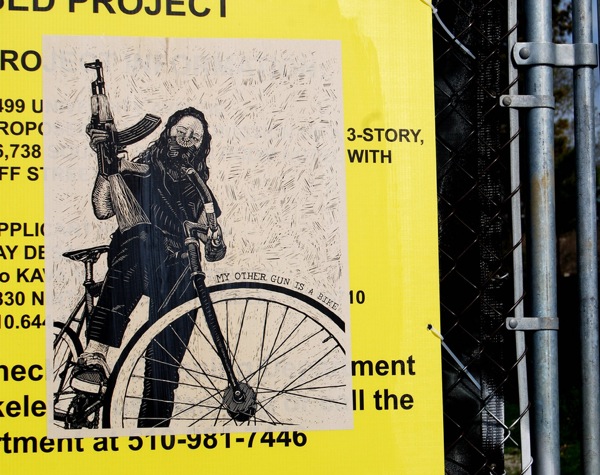
I don’t pretend to totally understand the bike-culture phenomenon (Critical Mass and whatnot), though I assume it has something to do with a combination of environmentalism, health and hipsterism. But I do love a good propaganda poster. This one is by Paul Barron and has appeared in Berkeley, California.
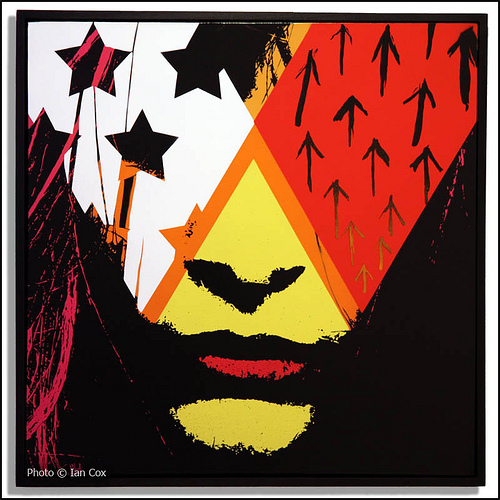
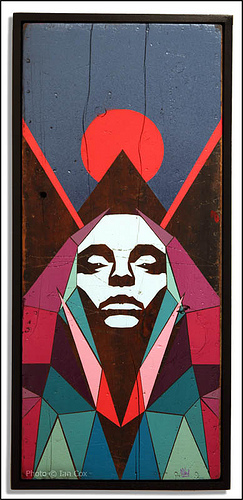
Other has been pretty active on flickr recently, with a number of new outdoor and indoor pieces these last few weeks. Both paintings are for sale, so you can contact troy.lovegates@gmail.com if you’re interested.
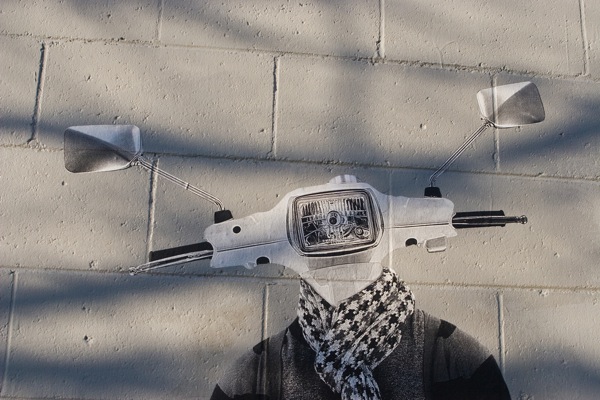
Hrag Vartanian has a fantastic article on Hyperallergic about Fauxreel and what it means when street artists take do corporate jobs outdoors. Fauxreel found himself labeled a sell-out a couple of years ago when he partnered with Vespa for a campaign that involved illegal wheatpastes on the streets of Toronto. The whole debate is very interesting, because really, all street art is advertisement to some degree, so where do we draw the line at what is acceptable? And of course, do artists have a right to partner with companies on advertising campaigns, and if so, how should they go about it? Personally, I’d say it’s generally great when artists collaborate with corporations on projects, but they need to avoid any illegal pieces for that advertising campaign.
I definitely think artists can work commercially and with a conscience, however, I think that if you are going to do this you should be aware of the differing motivations and you should try to make the commercial project provoking to the public in some respect. Because I like blurring the lines and playing with the public’s perceptions in some of the work I create, I immediately realized that the difficulties surrounding an illegal street campaign completed by a commercial interest would be a perfect fit for me. So I approached the Vespa Squarehead project with the goal of raising questions about the role of advertising in public space, examining the grey area between street art, graffiti and advertising and attempting to make connections between products and people’s identities. If I can complete a series of work that will pose and examine these types of questions and it will allow me to make some money at the same time, there’s nothing wrong with that in my opinion.
Will working on a project like that endear you to the public? Probably not, and for me that’s okay. I think the notion a great deal of the public holds, is that street artists should all fall under the same political leftist umbrella and they should all be anti-capitalism. This is certainly untrue (think about Banksy or Shepard Fairey as businessmen and Princess Hijab as a right wing street artist) and it would be boring if it were. Although the simple act of placing up illegal artwork can be said to have political connotations, if the work in question is a stencil of Talib Kweli or a paste up of fried chicken, the work is then purely aesthetically based and not political at all.
In terms of drawing a line between street art and street advertising and deciding what distinguishes the two, I am not the one to be judging that. I am far more interested in the overlapping areas in between and engaging with audiences who appreciate work that challenges the political status quo associated with street art, or art in general, as well as talking to fellow artists who understand these nuances and who utilize them within their work and their approach to developing their practice and essentially their brand.
Hrag’s analysis of the issue is insightful and definitely an interesting read. He’s one of the few bloggers who really writes about street art in a serious academic fashion, in addition to enjoying the art.
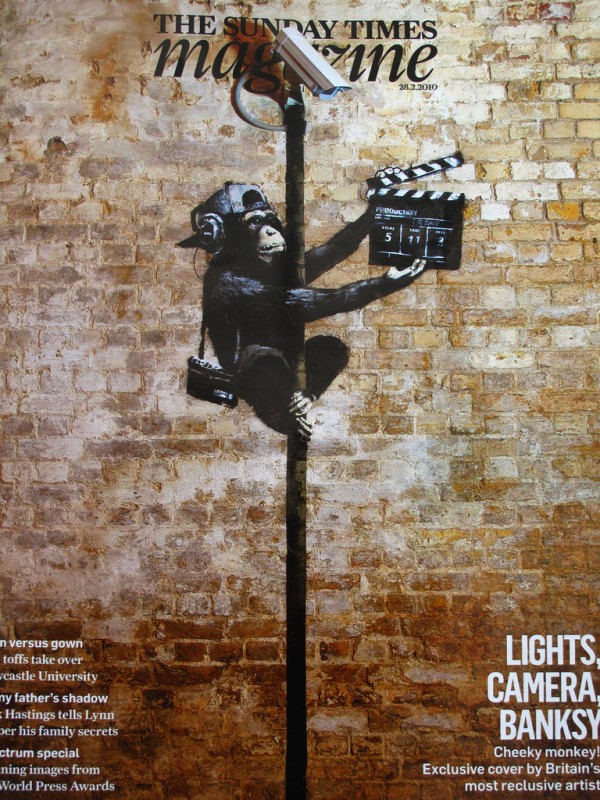
This week’s issue of The Sunday Times Magazine has a really nice cover designed by Banksy. The magazine also includes an article on the artist and an interview.
The article covers such a wide range of topics from his identity and personal life to the art market to why CCTVs are irritating, so I’m not even going to try and pick out my favorite bits. The article is a good read though, and if you’re not completely sick of Banksy-mania, it’s worth reading. You can find it online here.
On a related noted, The Times had an article on Saturday about Mr. Brainwash and Exit Through The Gift Shop. It’s probably the best article I’ve read so far to look at Mr. Brainwash as a person and artist in an unbiased and thought-provoking manner. They even speak to MBW himself and get his take on the film, which definitely strays from the official story. You can read that article here.
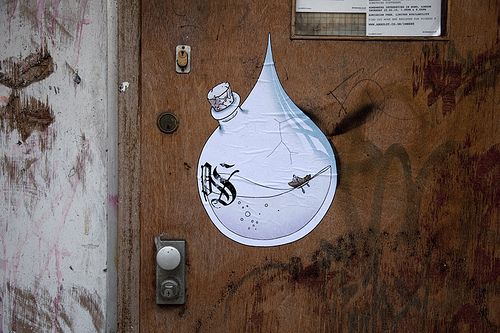
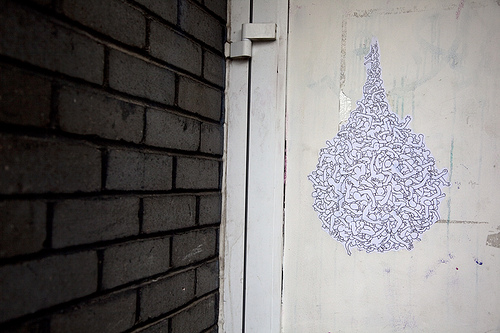
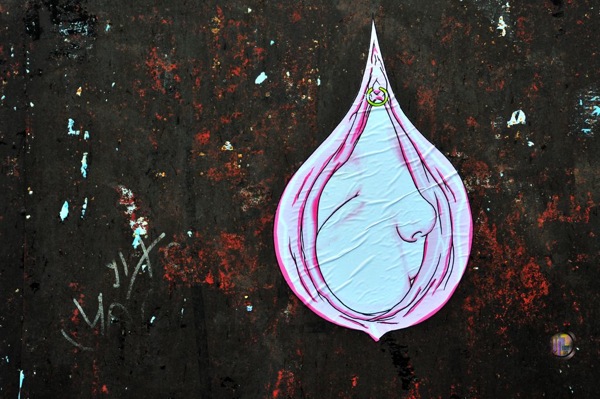
I’ve been seeing some interesting paste-ups around London recently by an artist called PS. All the pieces are the same tear-drop shape, but the content differs greatly. Here are a few photos:
Photo by invisiblemadevisiblePhoto by invisiblemadevisiblePhoto by unusualimage
“In this way, via a constant bombardment of a hegemonic truth, corpo-political regimes control the means by which individuals seek to know, decipher, and act on themselves. Acting as if they were freea in within a liberal, democratic system of rule, the good consumer citizen is calculatedly and spatially constructed.”
BC Biermann, a PhD Assistant Professor of Film/Media Studies California Baptist University – Riverside has recently published a paper on “Spatial Distributions of Power: Illegal Billboards as Graffiti in Los Angeles.”
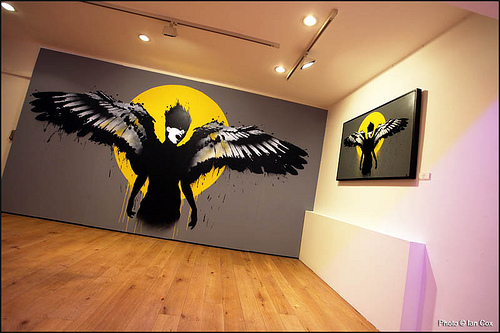
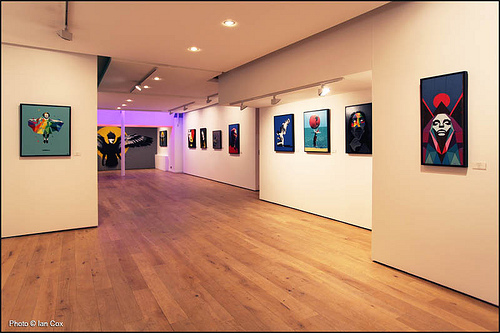
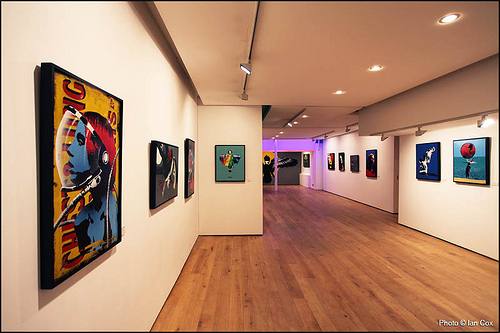
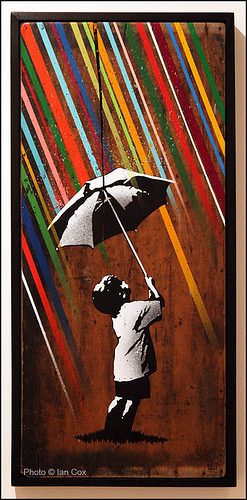
Eelus‘ solo show, The Colour Out of Space, opened on Thursday night at Blackall Studios in London. It’s a really interesting show. While the images could be hit and miss, what you can’t argue with is Eelu’s technical ability. He’s not one of those lazy “artists” who figure that anybody who can afford a can of spray paint and an exacto-knife should try to cut crappy stencils and sell the resulting canvases for £1000. Eelus’ stencils are flawlessly cut and painted.
There were plenty of prints and originals, but Eelus also painted two large walls in the gallery.
While some of the work was classic Eelus, the best pieces showed a new direction for him. He’s using more color and geometric shapes.