***As a sidenote, I just wanted to clear things up about where I am working and such. I finished up my internship with Lazarides about a month ago and am now interning at Purple PR, who does represent Lazarides. But Vandalog has been posting about Morley since before my involvement with the gallery and pr firm, but we wanted put this out there for readers so they are aware.***
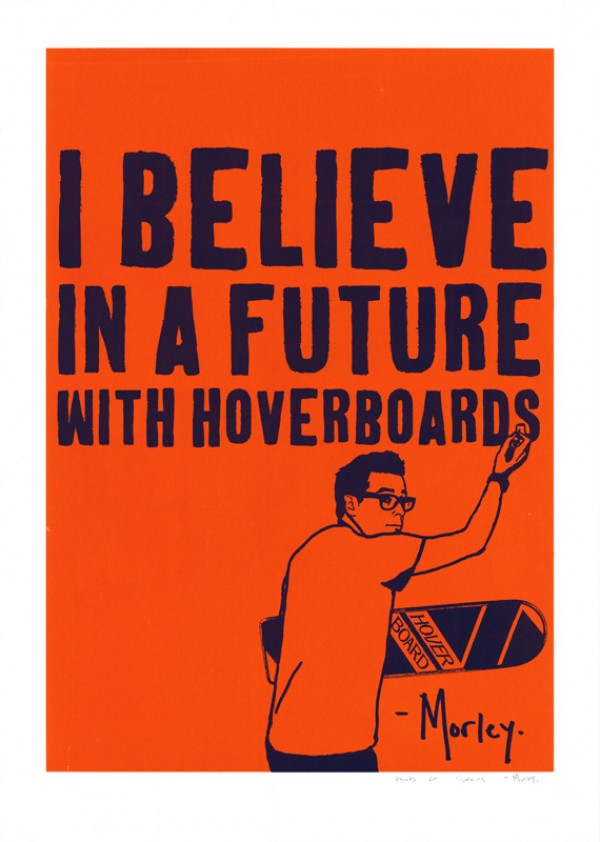
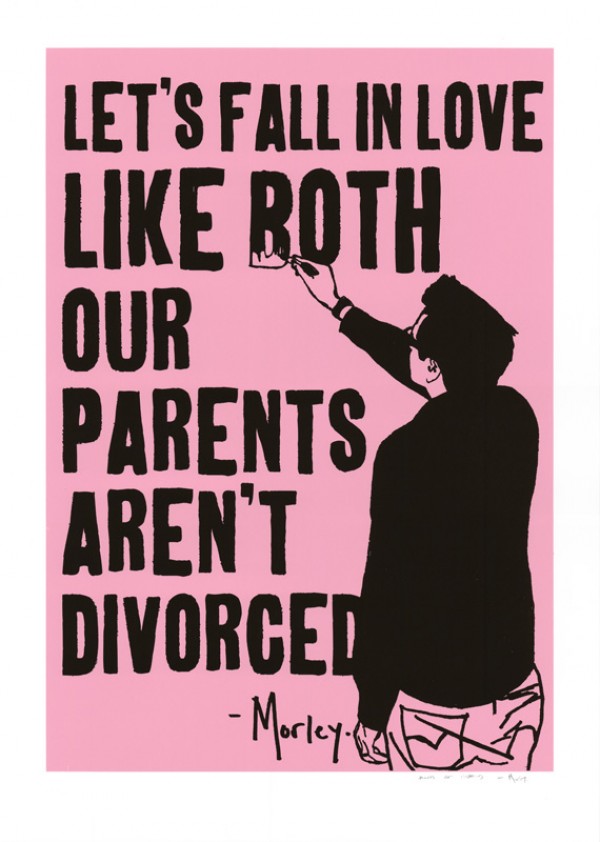
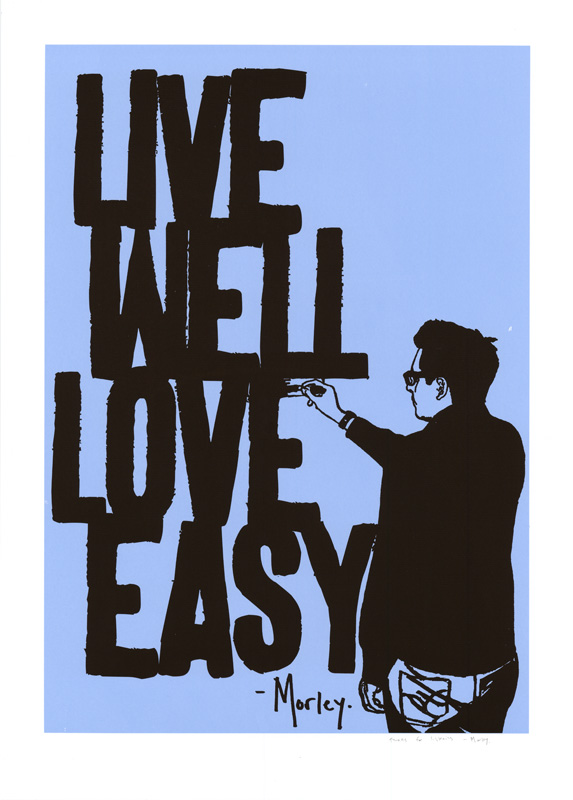
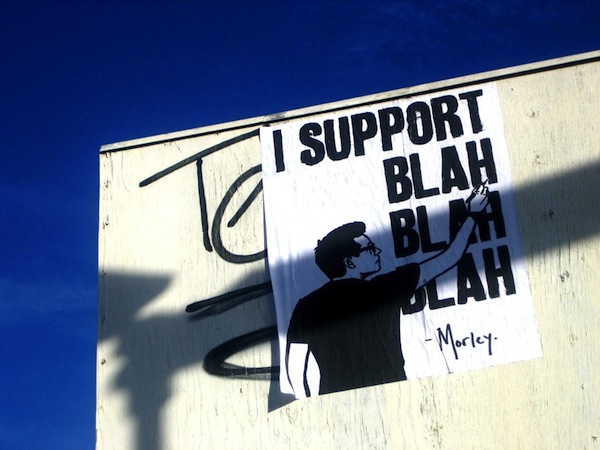
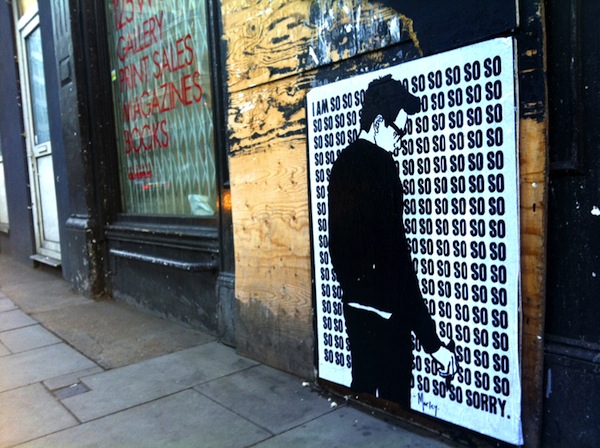
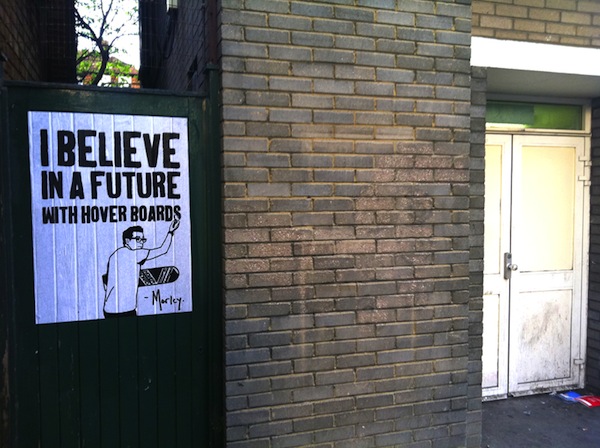
I have always thought that some of the best street art is that which makes the passerby think. An artist doesn’t need to get up on a billboard or paint a five story mural to make an impact. Some of my favorite works right now are by Morley, a humbled artist wheatpasting black and white phrases in Los Angeles and most recently London. An East Coaster turned California transplant, Morley is making waves with his work that is getting considerable exposure on blogs and street art sites alike for his witty societal commentary. A complete oxymoron, Morley is a “masked” artist for all intent and purposes, but uses his middle name as his moniker and the character in his works is a likeness of himself. Unlike most artists, he is very transparent about his work and how he feels about being a part of the street art community on his blog. It just goes to show you that being a little different and breaking the mold is exactly what street art needs today, and Morley seems to be that bit of unpretentious breath of fresh air.
Let’s start from the beginning: your name. Is Morley your actual name or just a moniker?
Morley is my middle name. Growing up I was never a fan of it. I used to go to great lengths to conceal it in school. While all my friends seemed to have really cool sounding middle names, mine just seemed like the name of the boring grandfather that no one wants to talk to at the family reunion. Growing up in Iowa, the list of things I desperately wanted to reinvent about myself was pretty long and it wasn’t until I moved to Manhattan that I started to see the value of all the things that embarrassed me, because it was those things that made me who I am. While I may not be able to trick people into thinking I’m cool, I can communicate on a more honest level artistically. So with that in mind I decided to use the name proudly in my art as a constant reminder to be true to myself, warts and all.
How did you get into street art in the first place?
While I was in college at The School Of Visual Arts I started seeing it around the city. The idea of people putting up stuff on the streets that wasn’t just a flyer for their DIY punk band was totally foreign and exciting to me. The notion of someone giving their art to the world seemed cool but the fact that they didn’t bother asking for permission to do so was what got me hooked. My only hesitation was the fact that as a screenwriting major, I didn’t know if I had anything visual to contribute. Nevertheless, I started to silkscreen slogans onto contact paper and stick them up around the subways. I wanted to leave little messages for anyone who needed some sort of positive encouragement, or even just something to make them laugh. New York, like all major cities, can be a pretty lonely place and if you’re not careful, you can drown in the feeling of anonymity one gets when surrounded by strangers that rarely speak to one another. Once I moved to Los Angeles, I found a very different atmosphere. The entire city seemed to be populated by dreamers, each slowly watching the dream they came here with slowly wither and die- or mutate into a more practical desire to simply survive. As one of those people myself, I wanted to make messages of hope and humor not only for others but for myself as well. I decided that what I needed was a reoccurring visual theme that could convey the idea that someONE was putting these messages out there. A kindred spirit, a friendly face. I decided to start drawing myself into the messages and at the same time decided that I needed to start making these messages bigger and harder to miss for the faint of heart that may need to see them the most. I started blowing them up at Kinkos and wheat pasting them around the city as a
hobby. These days the ‘hobby’ seems to absorb a lot more of my time.
What’s your alter ego a.k.a what’s your day job?
To pay the bills (and keep me in posters and wheat paste) I work as a casting editor for various reality TV shows (some more nauseating than others). Not something I’m particularly proud of, as someone who considers himself a writer. It can sometimes feel like I’m aiding the enemy- but since it funds my work, I like to think that the evil I contribute to evens out.
Your work obviously consists of wheat pasting. Have you experimented with other mediums or do you want to?
I also work with paint markers doing larger pieces and then I wheat paste a life size cut out of myself next to what I’ve written. This allows me to take over an entire temporary wall that can be up to six or seven car lengths long. I also make magnets that I stick to random cars as a sort of gift once noticed and a kind of traveling art piece prior to that. I am also just starting to play with the idea of doing one of a kind pieces that I could put in a gallery. Up to now I’ve been hesitant to pursue galleries for a few reasons, primarily because my stuff was created to be a friendly voice on the streets, not a disinfected gallery. The other reason is that I enjoy the fact that what I do is practically rejection proof and I can’t say I’m looking forward to the possibility of having to be critiqued on that level. On the other hand, the silliness of arbitrarily limiting where my art could go seems daft.
Now I have to ask about the guy in your paste-ups. Is that you or even a general likeness?
The guy in the picture is indeed me- but I decided to leave out my six-pack abs and huge biceps. After all, that would be bragging,
wouldn’t it?
What is your favorite piece you have created thus far?
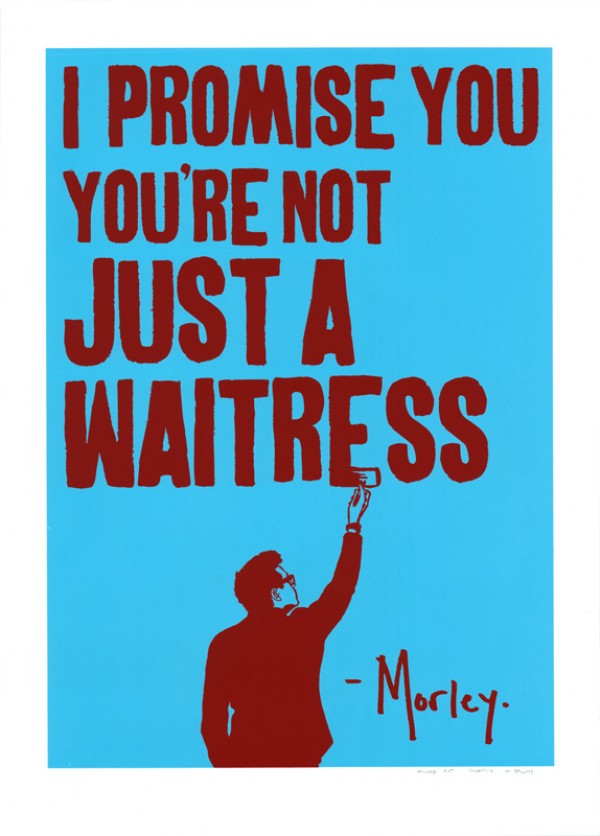
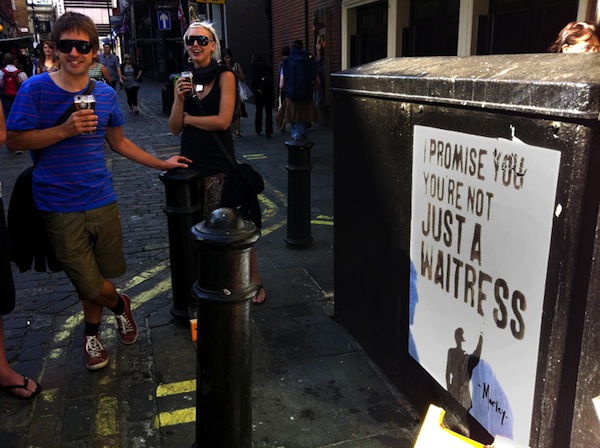
I’m most proud of the work that seems to speak to people. While my favorite piece that I’ve done is probably “Let’s Fall In Love Like “Both Our Parents Aren’t Divorced”, it’s been really touching to hear people’s reaction to “I Promise You You’re Not Just A Waitress.” The other night I was having dinner with my wife and a waitress came up to me and told me how important the message was to her. Knowing that she felt what she did may have been the proudest moment I’ve had so far. People accuse street artists of egomania and trying to cheat their way through paying dues in the more formal art world but since I have never intentionally set my sights on being legitimized as an artist, that kind of reaction is the most validating feeling I could have
hoped for.
Is there any phrase you thought of that you want to do a poster of and then thought better of it?
I made a couple posters that have swear words in them. One says: “Love Is A Battlefield And I Was In The Shit.” (“The Shit” being a euphemism in America for the bloody front lines of war). I made another that says: “If you could have one wish what would it be and you can’t say “to have a million wishes” because that’s bullshit”. Both were meant to be funny and I even have the drawing of me obscuring the offending word but I still haven’t been able to muster the courage to post either of them up. I tend not to curse myself as a general rule and the idea of a child seeing the poster makes me feel a bit guilty.
Working in LA, there is obviously a different art scene burgeoning there. How do find the difference in works or personalities between the LA, NYC and London scenes?
Los Angeles right now seems to be taking on the role of Seattle during the early 90s grunge scene in that it’s become one of focal cities for the movement. I think that Los Angeles has accepted the inability to silence street art, which is a bit of a double-edged sword. While it reduces the fear of getting busted for it, it also means that a lot more people are doing it. I’m never against someone expressing themselves, but one of the great things about street art was that the risk usually weeds out the fair-weather artists and leaves only the people who are compelled to do it by a desperate need to be seen. We’ve probably reached saturation point in terms of how many artists there are trying to get up and how much space there is to do so a while ago. On my recent trip to London, I was very pleasantly surprised at how many open spots there were. While I’m sure that has to do with how clean the authorities keep the city, it was a nice change to have such a broad canvas to play with, even if it meant that the work wouldn’t last very long.
One of the most interesting aspects I find in your work is your blog. You seem to be open about who you are, what you do and how you feel about being a so-called “street artist.” Why do you feel the need to have a blog that isn’t just pictures of your work?
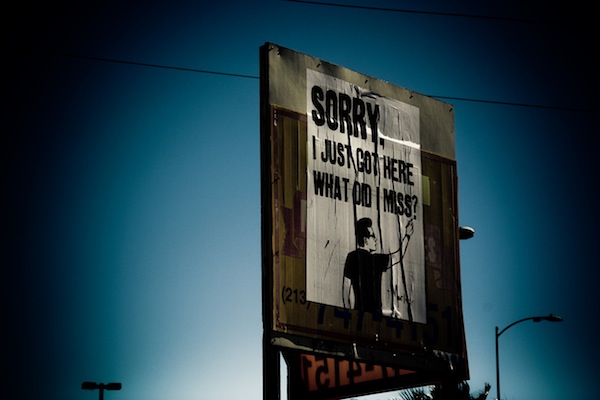
I keep my blog as confessional as possible because it’s an extension of the work itself. One of the goals was always to be an alternative to the other artists out there. I’ve always been a bit insecure about how simple and word based my stuff is. Looking at the artists I admire, I can’t help but feel like I don’t begin to measure up. The only way to get past this was to embrace it. Much like my middle name moniker, I saw this as an opportunity to stand out. While I wish I could pull off the cool anonymity of someone like Banksy, I knew that I was too dorky to pull it off effectively so instead I would be the artist that you formed more of a relationship with. In my fantasies, everyone who sees my stuff is inspired and encouraged to keep pursuing their dreams, not kill themselves and find healing from past emotional wounds- or if nothing else, gets a laugh out of it. That kind of privilege is usually limited to the people that you have a real connection with and that connection is earned with honesty and vulnerability. The blog is my way of offering both.
As people start becoming more familiar with you, has the blog changed at all since you started it?
A little. When I first started the blog I think it focused more on the process of getting up and the adventures that a street artist has. The nuts and bolts of it. This was because it was foremost on my mind as I felt my way through, discovering the dos and don’ts. As I started to get more feedback and notice that people were paying attention to me, I took the responsibility more seriously.
I have to congratulate you on your print release with Lazarides this month. How did the collaboration come about in the first place?
Thanks! They contacted me out of the blue actually. It took me a while to believe that it wasn’t just a big joke perpetrated by the same sort of girls who would ask me if I thought their friend was hot only to laugh and mock me when I blushed. But after they convinced me that it was not a cruel joke, I was very excited. Getting to have my stuff sold with The Outsiders felt like being signed to a major label after being discovered in a karaoke club. I felt like any minute they would discover that I was a fraud because I wasn’t as talented as all the other artists they work with. I’ve since found peace about it with the knowledge that the worst thing that can happen is that no one buys the prints and I just keep putting up posters for myself, and that’s not
so bad.
One aspect that most Laz artists share is their ability to adapt their work for outdoor and indoor environments. How does your work translate (if at all) to an indoor setting?
I think it translates in that it represents a message that someone might continually want or need to hear. The context is very different and that does alter how the messages are perceived, but at their core, the intention is still the same. I suppose the true test of this theory is when the prints go on sale. As I’m new to the idea of someone hanging my work in their living room, the easiest way I can think to relate to it is to imagine that I came in their house and put it up myself and they are just too lazy to take it off their wall. As I develop more of my work, I hope to get more adept at creating things with ownership in mind, but for now I’m just happy that Laz and company think people would want to look at my stuff permanently. I hope they’re right.
On your recent trip to London you put up some really great pieces in some pretty strong spots. How the hell did you manage to post in the Picadilly Tube without being caught?
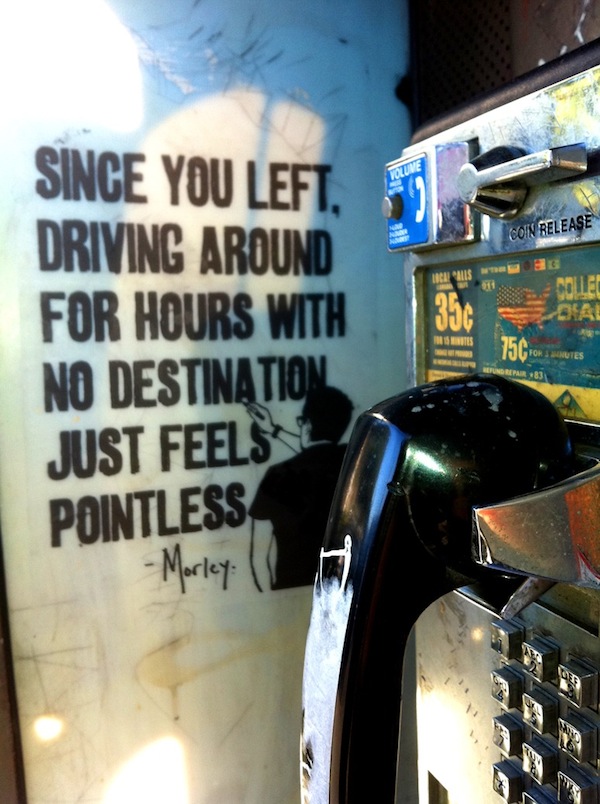
While I would love to claim nerves of steel and cat burglar reflexes, I can only credit naiveté. In Los Angeles no one really seems to care if you’re not vandalizing something of significant value so I do my work in the middle of the day and without much concern for the possibility of someone having a problem with it. I took this approach with me to England. My theory was, those cameras I saw everywhere can’t possibly be monitored every second and in the two minutes it takes me to put up a poster, it wouldn’t be enough time for them to spot me and send in the men with tasers and chloroform. They’d show up and be really bummed that I just casually walked out after putting it up. Of course this is just a theory. I’m sure if I understood the real risk I might be a little more careful. I think the easiest thing to do if one gets caught is to feign ignorance and claim to not know you weren’t allowed to put stuff up, then take it down while it’s still wet. My rule of thumb has always been that it’s better to apologize than to ask permission.
What’s in store for you next? Any shows on the horizon?
I don’t have any shows at the moment but would be interested in participating in something like that if the prospect arose. I’ve only met one or two of the artists whose work I share the streets with and am curious to see what else we might have in common. I’m sure there’s part of me that just wants to feel accepted by my peers and embraced as a contemporary but at the same time, the perspective that gives my art its personality was derived from being the type of guy who’s not voted “most popular,” so I’m okay just appreciating each opportunity as they come.
Photos by Morley