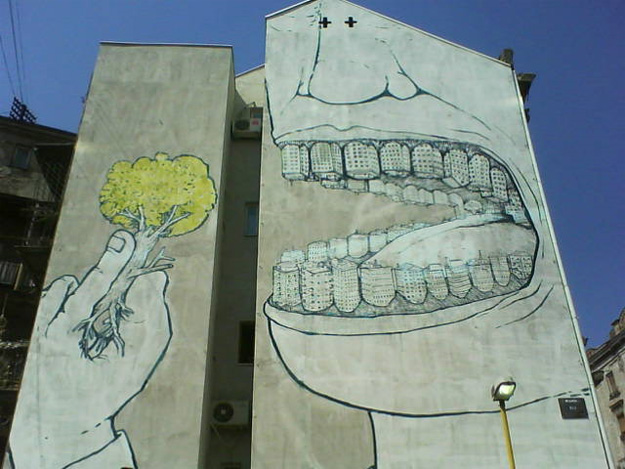
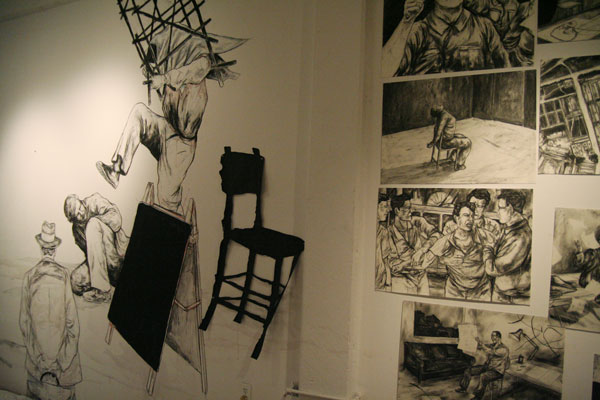
via urbanpainting.info. photo courtesy of 1984-productions.com. progress shots here.
see you at BELEF 2010 everybody!
Elisa x
via urbanpainting.info. photo courtesy of 1984-productions.com. progress shots here.
see you at BELEF 2010 everybody!
Elisa x
Recently, Juxtapoz has had three interviews with some of the more interesting emerging street artists I can think of: Gaia, Imminent Disaster, and Dennis McNett. Gaia and Imminent Disaster are both friends of the blog (and of course, Gaia posts here from time to time) so it’s always exciting to see them getting press from the big guys like Juxtapoz. Here are my favorite parts from each interview:
If you could punch one living contemporary artist, who would it be?
There are better people to hate on the planet than other people that make things.
Street artists often profess this war of conscience around the gallery/street issue, but you don’t seem to share those conflicts.
My perspective is I get up, I do work in the street, and I try to make it good and valuable, so that the experiences augment each other. Institutions provide certain opportunities but you have to go through these filters. There are no filters in street art—except for the obvious one, the law. Beyond that, there’s no curator deciding where you put up work, how you put up work…
Institutions provide other opportunities. If there’s this populous notion of ‘I want to show my work to as many people as possible’—you’re going to get that done a lot better institutionally. You may get a lot of passerby on the street, but think about how many people move through The Met each day.
Imminent Disaster (part one, part two)
Along the notion of “reclaiming public space,” why is street art is concentrated in “hipster” or gentrifying neighborhoods?
It’s a valid observation, and comes up often in the street art scene. It probably has to do with the fact that street art is a scene with a different audience. There are obscure graffiti spots in abandoned buildings or tunnels that are more about the difficulty of getting to the spot and therefore, will likely only be seen by other writers. Whereas street art tends to prefer to be seen by the scene—people who watch, collect, curate but do not necessarily do street art.
The duration of the mediums also might factor in on this. If wheatpaste was a more permanent mark on a wall, street artists might be more exploratory with their placement and find more obscure spots that would get much less traffic but last much longer. A look to stencil artists might prove this theory wrong, however. Even though it would last forever, I’ve never seen a celebrity head stencil in Queens.
I know I’ve personally been very lax on interviews on Vandalog for a long time, but I’ve got 2-3 coming up soon so keep an eye out for that.
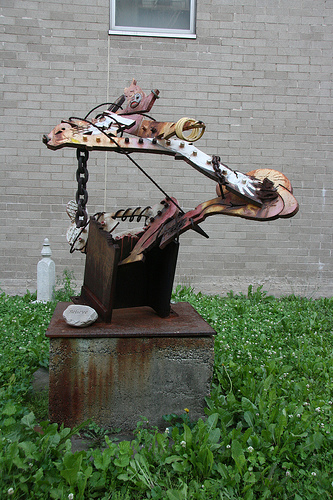
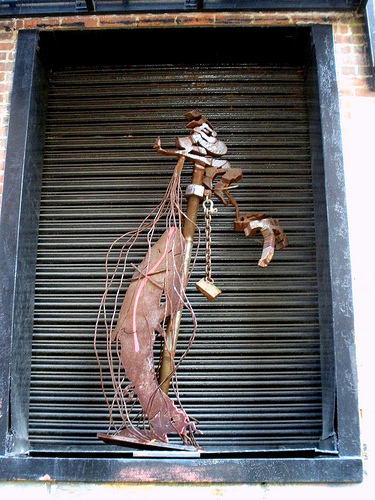
Revs is getting even more complex with his latest sculptures. Love it.
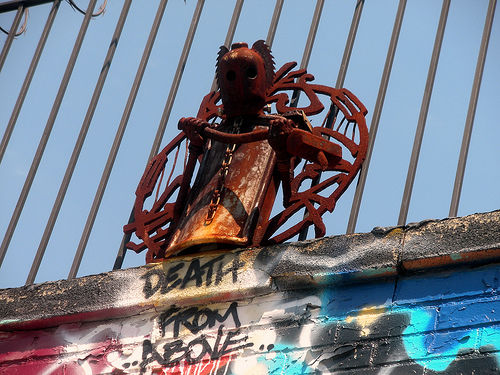
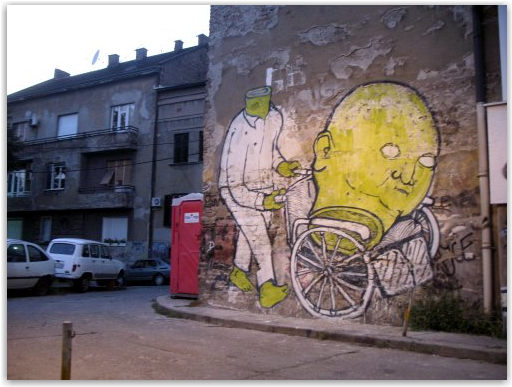
Ever since Blu mysteriously wrote “my building” above an image of a large blank wall on his blog last Sunday, I’ve been constantly checking back for progress shots. I’ve been excited about seeing his new work in Belgrade for weeks now, so it’s nice to finally be able to share some pictures. Here is the progress to date. (That piece above is another street piece he just did.)
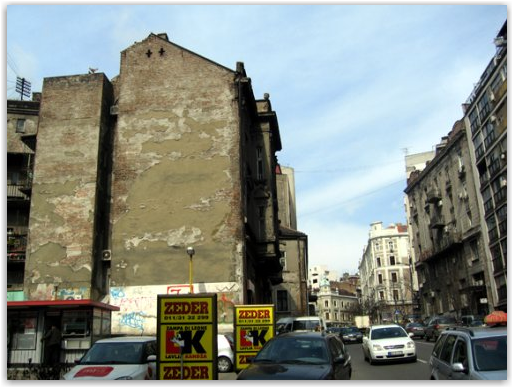
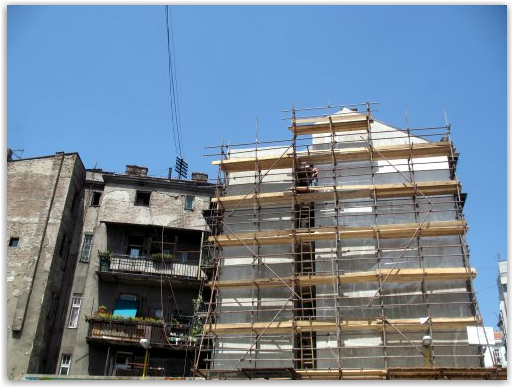

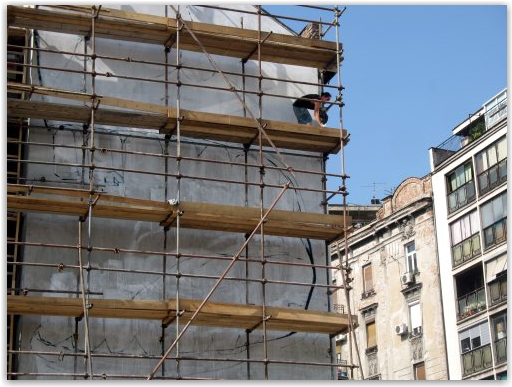
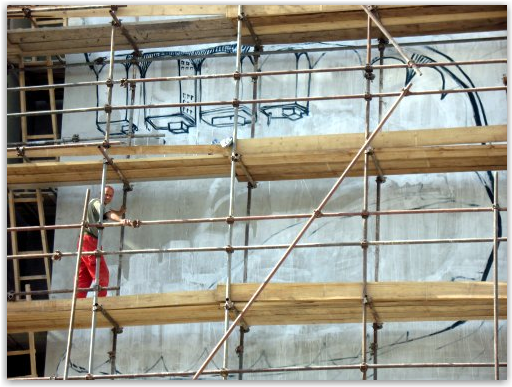
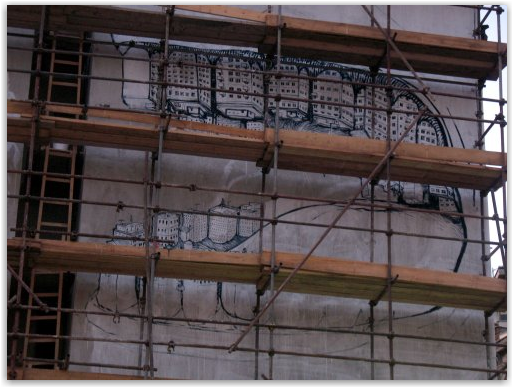
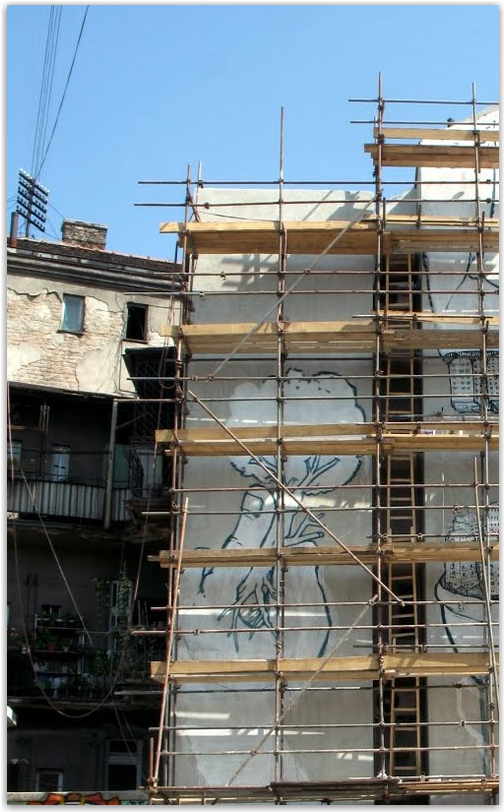
Can’t wait to see the finished piece! Belef 09 definitely seems like a very cool event (see M-City’s work here). I’ll post pics from another of my favorite artists in a bit.
General Howe emailed me recently about his work, and I think it’s something well worth checking out. My friend and I glued some toy soldiers to the street last year, but we just did it for fun. I like the fact that General Howe actually has a point to his work. Here’s what he said:
For just about two years now I have been spreading the streets of Brooklyn with British colonial toy soldiers in locations where Americans and British fought in the Battle of Brooklyn. The Commanding General of the British was General Howe, which I have taken as my street art identity.
The research and experiences of doing this work has led me to my most recent project, Remains of Wallabout Bay. I have been making linoleum cut images of bones and remains of dead American soldiers from the Revolutionary war. The British captured thousands of American soldiers and would keep them on prison ships docked in Wallabout Bay a.k.a. Brooklyn Navy Yard. When these unfortunate soldiers would die, their bodies were discarded over the side of the ship, I imagine in similar fashion to trash and waste that is discarded in this same area today.
This work stemmed from having so many different emotions about the U.S. being in Afghanistan and Iraq. My thoughts kept bringing me back to past wars we’ve been involved in and thinking of the question, what would we do if foreign armies invaded and occupied our own country?
This work has been fun and meaningful and I look foreword to making work on the street for years to come.
And here’s some of his work…
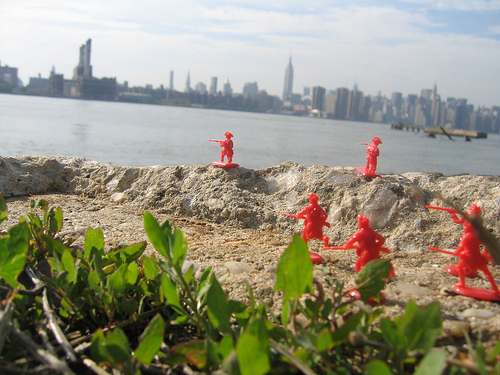
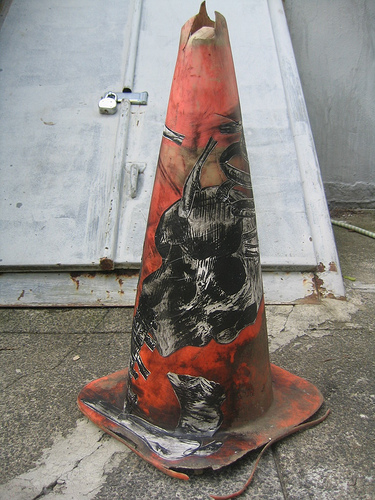
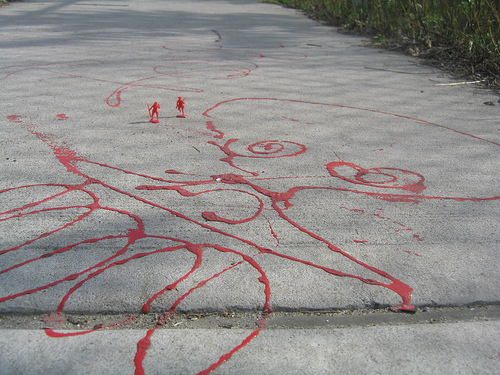
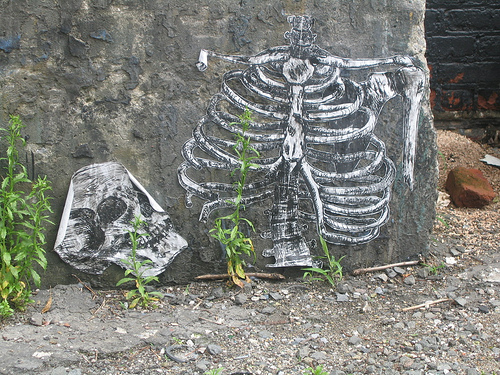
Check out more at General Howe’s flickr
Beautiful Losers film trailer from beautifullosersfilm on Vimeo.
If that trailer looks interesting to you, check out Hooked for more info about the upcoming screenings at The ICA in London. I’ll be there for opening night on Thursday.
Oh and if you’re in Malaga, Spain for some reason this month, check out the Beautiful Losers show there.
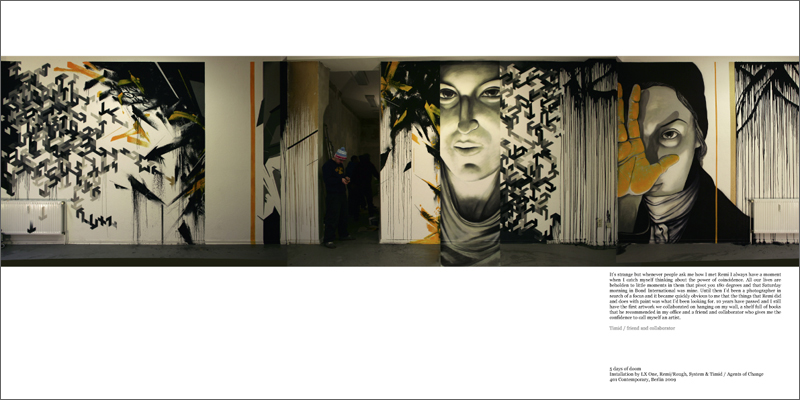
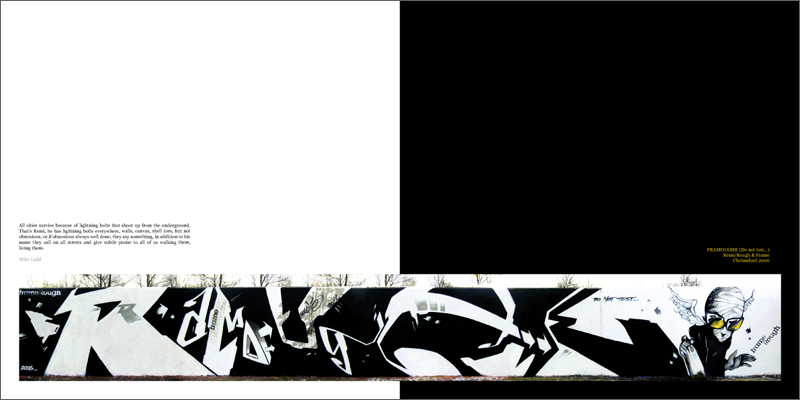
An exciting announcement came to my inbox late last night from Remi/Rough. His book, Lost Colours and Alibis, is being released soon and is now available for preorder. Most Vandalog readers are probably familiar with Remi’s recent work, but I’m most looking forward to seeing his older graffiti.
Remi/RoughLost colours and alibis bookThe new Remi/Rough book is available for pre order from: http://www.agents-of-change.co.uk/hundreds of artworks by myself and other very talented artists, plus a foreword by New York legend; Mare 139.The book also contains a full catalogue of the Lost colours and alibis paintings exhibition
Here’s a few pictures:

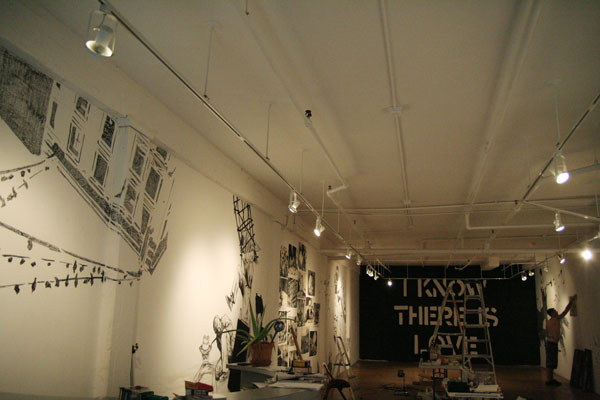
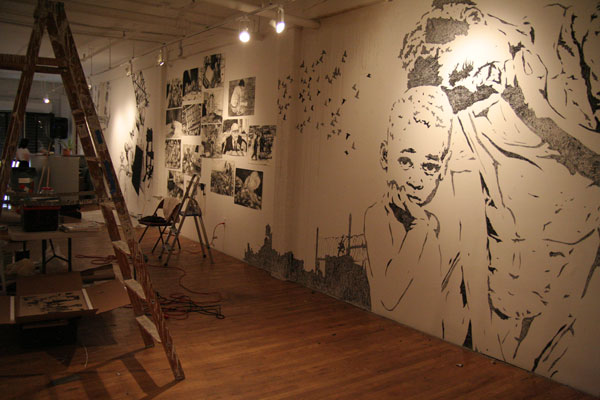
Just got a few preview shots for you of the Chris Stain and Armsrock show that opens this Friday at Ad Hoc Art. I’ve got a few friends who are currently on holiday in New York, and I’ve been urging them to all go to the opening of “I Know There is Love.” Last year’s show here in London with Chris Stain, Armsrock and Poncho was absolutely fantastic (got myself a Chris Stain from that show hanging right next to me as I type), and so I expect their work at Ad Hoc to be just as good. And look out for another post here on Vandalog after the show opens.
Photos via Ad Hoc Art
More photos at Arrested Motion
The whole process from the beginning to the end.
– Gaia
I’ve got a book about Dalek sitting on my desk and just a few weeks ago saw some very cool work from Delta in Paris, so I’m glad to finally announce that these two artists will be doing 2 person show at Elms Lesters later this month. Dalek’s progression from graffiti to Murakami like precession and his ability to create new worlds is rivalled in street art only by perhaps KAWS, and Delta’s work just needs to be seen in person to be appreciated. The detail is too great for any jpeg to ever explain. This show should be a real treat.
Here are all the details from Elms Lesters:
28 August – 26 September 2009
Tuesday – Saturday 12 – 6pm, Thursdays ’til 8pmThis exhibition brings together two International painters of magnitude.
James Marshall, aka DALEK, who currently lives in Carolina, and Amsterdam based Boris Tellegen, aka DELTA, are both masters of their handling of colour and texture.
Marshall, who spent a year as an assistant to Takashi Murakami, has developed and honed a technique of meticulously applying flat blocks of colour, whilst playing with shapes and exaggerated optical perspectives.
“Two changes in technique have recently allowed DALEK to ratchet the spatial complexity up a notch. In linear terms, there’s an increased overlapping between forms whilst, in colour terms, subverting the light-to-dark or conversely dark-to-light build-up of tonal depth by interjecting chop-change colour values at will across the picture plane to break up conventional recession “ Ben Jones – art historian
Conversely, Tellegen is constantly experimenting with his his complex ‘architectural’ paintings, collages and 3D sculptural wall pieces, discovering, through his use of colour and references to urban decay, how to play with perspectives through the build up of textures and shadows.
“There’s an openness in DELTA’s practice to organic breakdown which might at first seem antithetical to the precision of his work’s apparently precise graphic underpinning. Thinking back to one of his street pieces, with the moss proliferating and gradually covering the relief, helps point up in a rare natural example a key conceptual theme for DELTA throughout: the organic system and its threat to subsume the man-made.” Ben Jones – art historian
Private View: Thursday 27th August between 6 – 9pm
More at Elms Lesters