Art – Substance = ?

February 13th, 2013 | By | 8 Comments »
5422575202_3bcd4b1ebe_z

Alec Monopoly. Photo by savagecats.

Note from the editor: This is a guest post by Nico Glaude, who will hopefully be contributing more to Vandalog in the future. – RJ Rushmore

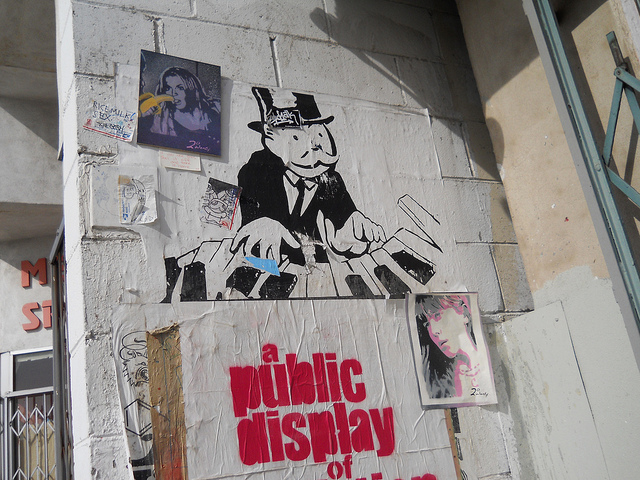
RJ tweeted this a few days ago “Alec Monopoly is in the latest issue of @JuxtapozMag. Seriously? Come on Evan. I know you’re better than that!” Which got me thinking; what exactly is going on to the state of street art culture? For those that don’t know, Alec Monopoly is a street artist who “lightly” appropriates the Mr. Monopoly character in the streets, sometimes he’s playing a keyboard or even playing the turntables. His interior work follows the same guidelines of appropriation; Mr. Monopoly on canvas either pasted with monopoly money or news paper articles related to the economic state of the U.S. The point of it all? Maybe there is none.
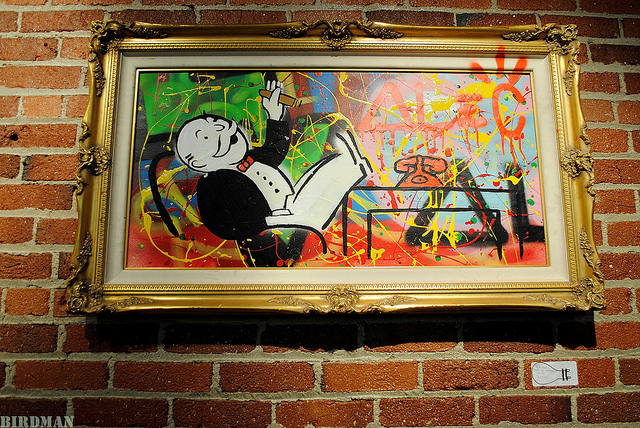
Alec Monopoly

Alec Monopoly. Photo by Birdman.

Meaningless art is something that will always plagued the art world, and most definitely plays it’s part in the streets. Yes there will forever be the debate of subjectivity, but let’s just be closed minded for a minute and examine things. What’s make Alec’s art pointless? The lack of effort in it all, the irony of taking on the economic state as a message, yet selling his art for thousands upon thousands of dollars. There’s no sense of real purpose or substance in his work, no evolution. If you take a minute to think about it, the same can be said about countless other “artists” who are getting rewarded even though they’re in a constant state of mediocrity.

QG37LID1X

Love Me x Vans Sk8-Hi Slim. Photo courtesy of Vans.

Another case of substance abuse can be latched on to Curtis Kulig’s overly redundant “Love Me” campaign. It’s grown from a simple tag to becoming nothing more than a brand. In terms of marketing, it’s pretty genius, but at what point does it not become art anymore? Like with Alec’s work, Kulig’s work doesn’t evolve, what once had some substance, is now replaced with something that is lost in the world of pure redundancy. “Love Me” is now found on tee-shirts, skateboards, and sneakers. The slogan has become meaningless because the message is gone. It’s now become simply a marketing tool. Maybe, that’s all it ever was.

Love Me collection from Smashbox. Photo courtesy of Smashbox.

Love Me collection from Smashbox. Photo courtesy of Smashbox.

The point to all of this? Well just like Alec’s and Kulig’s art, maybe there is none. Yes meaningless art will forever be inescapable, this article won’t change that, and as I mentioned Alec and Kulig are only two cases of many. But we, as a culture, need stop validating such pointless attempts at attention, and realize that it is simply that, artists trying to get noticed by pawning off pretentious, uninspiring and empty art.  This fact will be true until the end of time, but we need to stop letting artists off so easy, stop granting them a “Get out of jail free” card, and make them realize that in order to gain our attention,they need to start making art that isn’t so meaningless.

Photos by savagecats and Birdman and courtesy of Vans and Smashbox

Category: Guest Posts, Random | Tags: ,
  • Peter Drew

    You’re right, the urban art community does need to turn a critical eye on itself but why not go after the big boys instead of wasting words of these nobodies. If the leaders aren’t held to account then who can blame others for following suit?

  • http://blog.vandalog.com/ RJ Rushmore

    These two may not be THE ABSOLUTE BIGGEST names in the game, but they aren’t nobodies.

    Alec Monopoly has been in Juxtapoz, The Huffington Post, and of course he is a favorite at Melrose&Fairfax. His work is listed by galleries for 5-figure sums. He’s worked with Paramount Pictures and Kiehl’s, I think he’s the official artist of the W Hotels (or something along those lines).

    Curtis Kulig work collaborating with Vans. He’s got his own clothing line in Urban Outfitters. I think he’s worked with OBEY Clothing. He’s interviewed in the latest issue of Juxtapoz and was in the NYTimes magazine in 20011. I actually don’t have much of a problem with Kulig. I think his work is great as graffiti because in that context the name is interesting. But beyond that, I think he’s very overrated.

    Who would you name as of the the leaders who are doing similar work? Shepard? On the whole, I like Shepard’s work, but I’ve called out Shepard here before when he does a print release or something that I think is particularly bad.

  • http://www.facebook.com/scott.goldberg.399 Scott Goldberg

    yea because shep is a real winner? Come on dude, people who dont know read this and believe it. Shep is a lying, thieving, hypocrite. http://andrenaphoto.com/blog/index.php/2012/02/shepard-fairey-dina-douglass/

  • CDH

    I basically agree with Peter, which is why I think places of critical review like this become so important to the street art system. I think bigger people are guilty of greater offences.
    I generally like Shepard too, but I always struggle with the context. He started out as an anti-brand advertising some fictitious product and just progressively became a brand. Along the way there’s been these issues of plagiarism and faked evidence and I feel swindled; it’s clear now that it never represented what it was presented as. It’s been entirely recuperated and repackaged as little packets of cool, sold back to a socially anxious generation.

  • http://blog.vandalog.com/ RJ Rushmore

    I don’t think Shepard is perfect. He’s done some shady things for sure. I was one of Shepard’s harshest and loudest critics in the street art community when he lied in his AP case, and one of the last to move on from that issue.

  • Peter Drew

    Do the achievements you’ve listed to endorse their status actually impress you? I’m not being flippant, I’m actually curious because it doesn’t impress me. They’re ‘nobodies’ based on the emptiness of their work. End of story. Just because someone’s had a bit of press and an excursion in the fashion industry doesn’t mean we have to take them seriously. That’s what I like about this community.

    Sure, you could start with Shepard. I actually admire what he’s achieved but, let’s be honest, it’s been going nowhere for a while. When he calls it all an ‘uncompromised experiment’ he almost seems delusional. Just because his marketing campaign uses an ironic comment of consumerism doesn’t make him a social scientist.

    All the big players could do with taste of reality from the people that care the most. The whole scene would be better off because of it.

  • http://www.facebook.com/benjamingeorge Ben George

    I’ll chime in. This article was a good read, I’ve had similar thoughts myself. @rj_rushmore:disqus I like the way you think. It’s refreshing to hear someone with great arguments and information who is unwilling to judge people or write them off for past mistakes. Thanks for speaking up, your perspective is liberating!

  • http://blog.vandalog.com/ RJ Rushmore

    I wouldn’t say that it impresses me, but it means that they have been put on people’s radar and pages have been printed about them at the expense of others. So impress doesn’t seem like the right word, but I acknowledge their popularity and that their legitimacy in others’ eyes.

    It’s naive to say “these artists don’t matter because I don’t like them.” That’s like saying “The Tea Party doesn’t matter because their members are crazy.” Well, suddenly the Tea Party won a lot of elections and Republicans who might otherwise have been a bit more reasonable or a bit more open to compromise had to shift right.