Graffiti vs. Street Art: A debate I don’t understand

August 15th, 2012 | By | 12 Comments »

Sometimes when I’m making these Wild Style Wednesday posts, I have a difficult time deciding whether I can include a piece because I can’t distinguish if it is “graffiti” or really just “street art”. For some reason, that matters. I ask myself questions like “Does the work have arrows?” “Is there reference to a 3-letter-name graffiti crew?” “Was this done with a legitimate risk of arrest?”

Instead of WSW this week, I’ve decided to compile some photos that didn’t make it into a previous WSW post, and assign them to more fitting ‘subcategories’ of graffiti/street art.
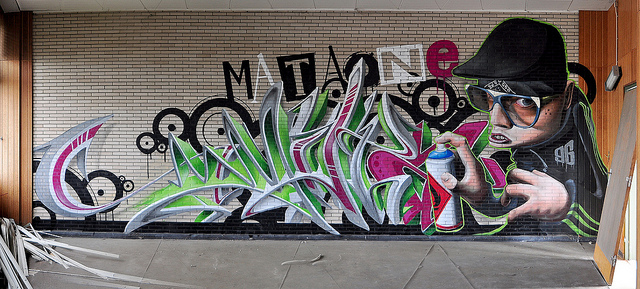
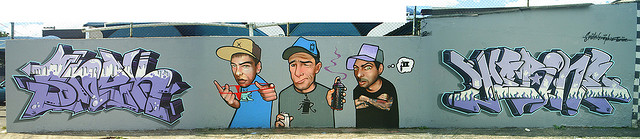
A mural of graffiti.
By MataOne in Renaix. Photo by Startape Photographe.

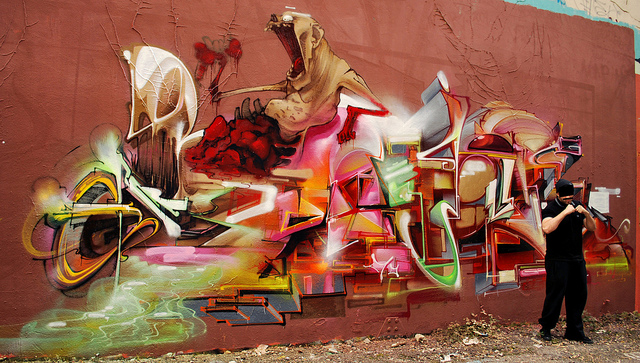
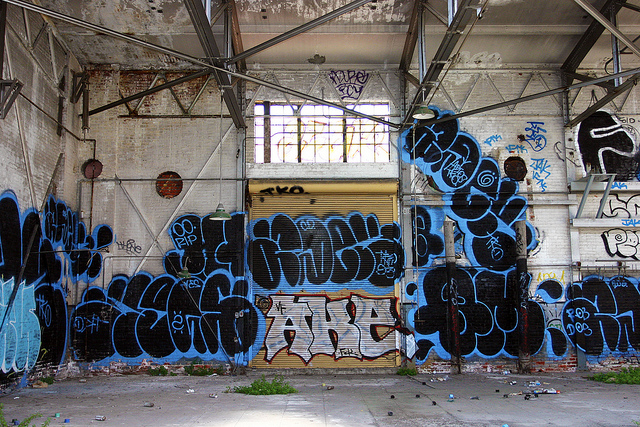
Ghetto product placement
Satyr, Goser, 4Gets and Mr. Ef in East Bay. Photo by FunkandJazz.
Pop-contemporary egoism
Adek and MQ in San Francisco. Photo by FunkandJazz
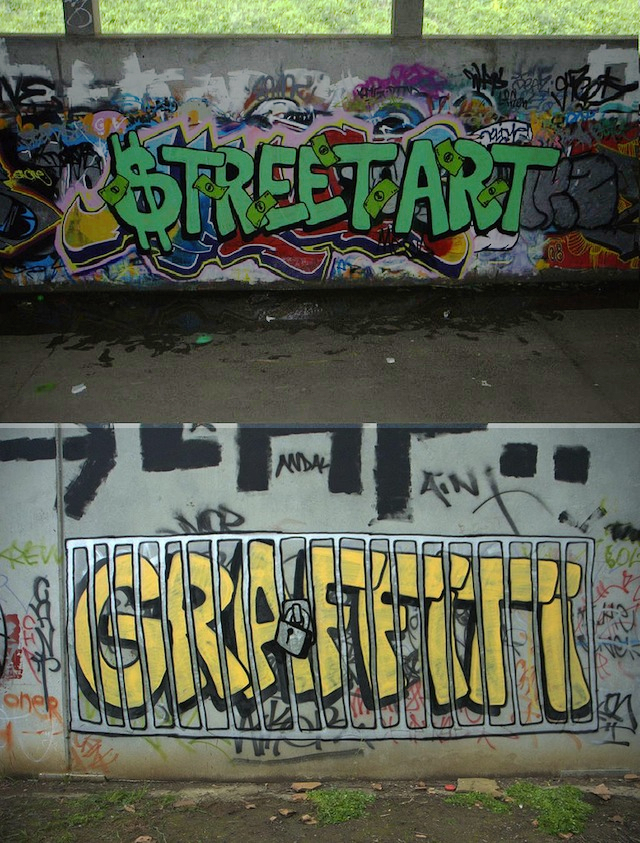
Slap-stick vandalism 
By Lush in Australia. Photo by Merciful Fate.
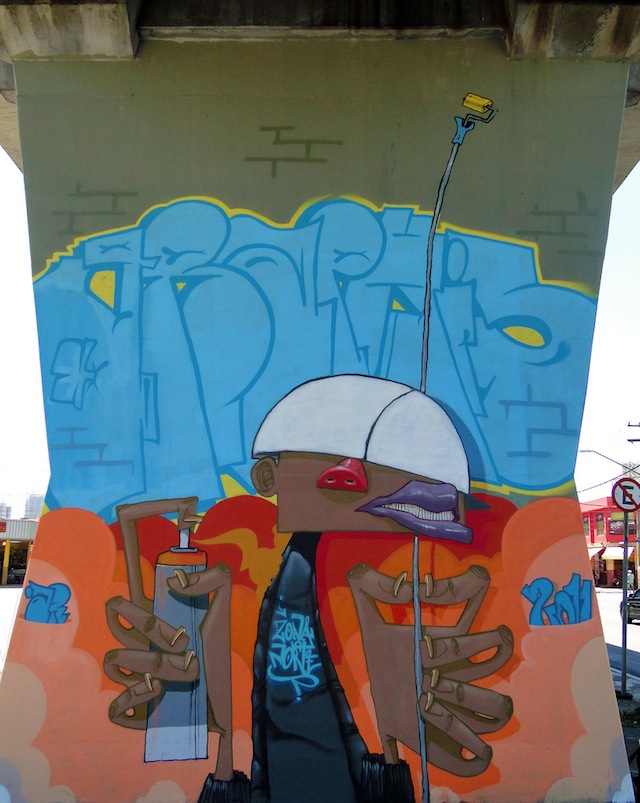
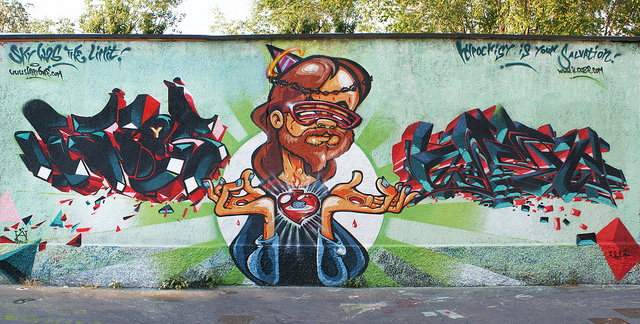
Caricature of a “graffiti artist” painted illegally.
By Graphis in Brazil.

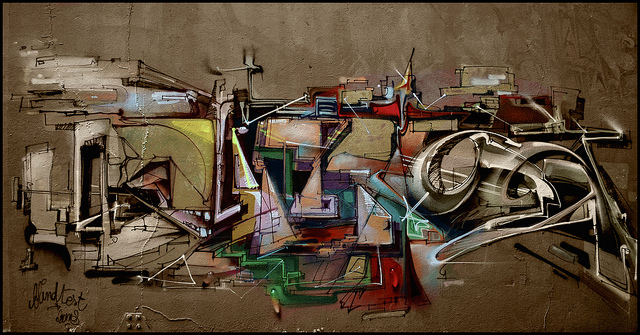
Noncommissioned neo-cubist mural
BemsGF in France. Photo by GhettoFarceur.

Graffiti disguised as street art.
Ed Mun in Brazil.

Art school vandalism
Snek, Graphis and Terone. Photo by Graphis.
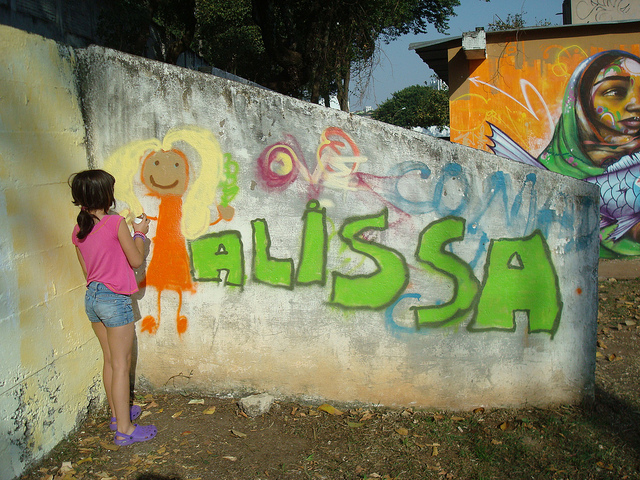
Childstyle graffiti.
Alissa in Brazil. Photo by Graphis.

Unwarranted expressionism
Bims and Rems. Photo by GhettoFarceur.

Let’s play a game.

VIEWERS DECIDE FIVE: Street art? Graffiti? Subcategory?

1.

Cranio in Brazil.

2.

L’Arabe-Stré in France. Photo by GhettoFarceur.

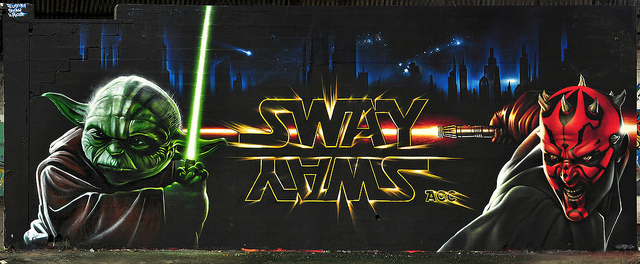
3.

Feustay, Sway and Kalouf in Niort. Photo by Startape Photographe.

4.

Mr. Wany and Coze. Photo by Heavy Artillery.

5.

A tag by Amour in Paris. Photo by Morac19.

 Photos by CranioEd MunFunkandJazzGhettoFarceurGraphis1Heavy Artillery, Merciful FateNardstar and Startape Photographe


Category: Featured Posts, Photos | Tags: ,
  • Poesia Transcend

    Every picture here is graffiti. I think your over analyzing the concept of graffiti. Maybe its a good thing to ask this question but these aren’t the examples to ask the question properly. These are all clear examples of traditional graffiti. Graffiti has a history that is easily recognizable. Most writers take years to even be proficient to paint a wall for the first time. This is something you can see automatically when looking at these pieces. Street Art on the other hand might not have this history as far as graffiti artists. Street artists are just mostly different their skills and history have evolved differently for different reasons, a brush or a computer might be there skilled trait. For graffiti its almost always spray paint. 90% of what you posted was letter based the details and how the artist painted it doesnt define it. Some artists dont use arrows or 3d’s but they paint the most progressive graffiti, although traditional elements they are not required. Illegal vs legal is also not a factor when determining whether its graffiti or not in my opinion. Because an artist might no longer be able to paint illegally doesnt mean he can no longer call a piece he does on the street legally, graffiti. So in summary skill level is a recognizable trait if you are looking for one, when someone has ability to use the spray can it is because they more than likely have been painting graffiti for awhile. Street artists might not have picked up a can as much or have approached the use of spray paint in the same manner. I think they might approach it more as another medium, instead of something to be mastered.

  • http://www.facebook.com/loisinwonderland Lois Stavsky

    I’ve been thinking about this lots, especially as the lines continue to blur. But — here in NYC — most graff writers strive for style, with the focus on letters and characters,. There is little attention to concept, that is so important to “street art.” The lines between the two seem to blur more outside of the U.S. The piece by Mr. Wany and Coze has the feel of graffiti. The other four less so. But I’m not sure it matters!

  • Billy Martin

    Ugh. So clearly you’re an authority on the subject right? Glad you can post on here and perpetuate your ignorance!

  • Caroline Caldwell

    I am very clearly not an authority.

  • Rhiannon Platt

    1) I would like to say that using “ghetto product placement” is an extremely classist phrase.
    2) I think a lot of (but not all) lines between graffiti and street art can be drawn as those who are self-taught and those who have others teach them (ie formal training).

  • http://blog.vandalog.com/ RJ Rushmore

    Of course it’s a classist phrase, but I read that as Caroline using a phrase that an advertiser might use to critique the use of graffiti in advertising. For example, I’m in Atlanta right now, and Coca Cola has been filming ads (which include painting “graffiti”) in lesser developed parts of the city. Sometimes you have to use the messed up language of the people you are critiquing in order to critique them.

  • rsh

    Its very simple. Graffiti = illegal/no permission. Street art = commission/permission

  • DVD

    I think trying to separate the two is like trying to separate aspergers from autism. its a spectrum of public art that (when done well) adds to the the visual landscape of urban environments.

  • http://blog.vandalog.com/ RJ Rushmore

    Really? That’s definitely oversimplified.

  • Steve in Ontario

    As I try to understand graffiti and its relation to vandalism and art I tend towards the simpler conclusion that if the painter is granted permission to use the canvas then it is art; if not, then it is vandalism. If an artist was given permission to paint a wall and the following day someone sprayed over it the artist would most likely be hurt. If the same thing happened to someone who had vandalised the painter would most likely be pissed.

    Some walls scream to be painted on because of poor design and unfriendly street scape, but I do not enjoy seeing interesting public architecture being defaced.

  • Emily H.

    It’s not often that you’re so defensive of a writer.

  • nelson rivas

    I think the differences between graffiti writing and street art, are the intention behind it and the formal elements of each one . Graffiti writing in it’s purest form has no intention to send a message or to have a concept, it’s just about a name and how notorious you can get this name. It could be through countless repetition or quantity, style and technique, location and size. For this reason graffiti is more honest than street art, because it’s nothing but letting people know your name and how flawless your style is or how many locations you are up. While street art, public art or just art, is mostly about the idea or concept, and how the piece interacts within it’s environment (people, architecture, history). This makes it very subjective as any other art form and sometimes confusing because you don’t know what are the real intentions of the artist. Also, from my point of view a street piece can be considered both, as graffiti and street art at the same time, but not always.